WASSCE Government · Systems of Government
Presidential and parliamentary systems
By the WASSCE Tutor team
Updated 12 November 2026 · 7 min read · Prepared against the WASSCE syllabus.
In Sierra Leone, voters choose the President directly on one ballot and their Members of Parliament on another. In Britain, voters choose only Members of Parliament, and whoever leads the largest party in Parliament becomes Prime Minister. These are the two main systems of democratic government: presidential and parliamentary. This lesson compares how they work, their strengths and their weaknesses.
Learning objectives
By the end of this lesson you should be able to:
- describe the features of the presidential system of government
- describe the features of the parliamentary (cabinet) system
- state the merits and demerits of each system
- compare the two systems and give examples of each
Who elects whom?
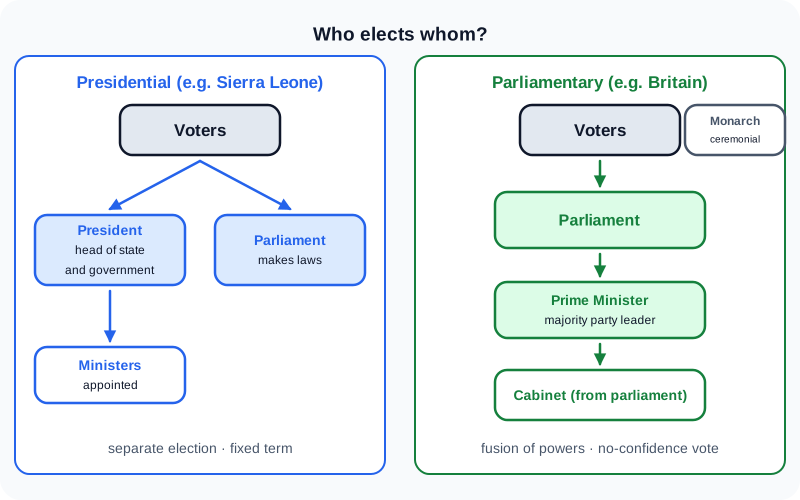
Figure 1. The presidential and parliamentary systems. WASSCE Tutor diagram.
The presidential system
In a presidential system, the president is directly or indirectly elected by the people for a fixed term, is both head of state and head of government, and is separate from the legislature.
Features:
- Single executive: the president is head of state, head of government and commander-in-chief.
- Separate election of the president and the legislature.
- Fixed term of office (in Sierra Leone, five years, renewable once).
- Separation of powers: ministers are not members of the legislature.
- Checks and balances: the legislature approves appointments and budgets; the president may refuse assent to bills; the legislature may remove the president by impeachment for gross misconduct.
- The president is not removed by a vote of no confidence.
Merits: stable, fixed-term government; quick decisions by a strong executive; separation of powers protects liberty; the people choose their leader directly; ministers can be chosen for expertise from outside the legislature.
Demerits: danger of dictatorship from a powerful president; deadlock if the president and the legislature are controlled by different parties; impeachment is slow and difficult; expensive elections; a bad president cannot easily be removed before the term ends.
Examples: Sierra Leone, Nigeria, Ghana, Liberia, the USA.
The parliamentary (cabinet) system
In a parliamentary system, the government (prime minister and cabinet) comes from and is responsible to the legislature, and a separate head of state performs mainly ceremonial duties.
Features:
- Dual executive: a ceremonial head of state (monarch or president) and a head of government (prime minister) who holds real power.
- Fusion of powers: the prime minister and ministers are members of parliament.
- The leader of the majority party in parliament becomes prime minister.
- Collective responsibility: the cabinet stands or falls together and must defend decisions in public.
- Ministerial responsibility: each minister answers to parliament for their ministry.
- Vote of no confidence: parliament can remove the government.
- No fixed term: the prime minister may call an early election (dissolution).
- Official opposition with a shadow cabinet.
Merits: close cooperation between executive and legislature; the government can be removed quickly if it fails; responsible government through daily questioning in parliament; less risk of dictatorship by one person.
Demerits: instability where no party has a majority (frequent coalitions and collapses); weak separation of powers; the majority party can dominate parliament; ministers chosen for loyalty rather than skill.
Examples: Britain, Canada, India, and Sierra Leone from independence in 1961 until it became a republic in 1971.
Comparison
| Feature | Presidential | Parliamentary |
|---|---|---|
| Executive | Single (president) | Dual (head of state and prime minister) |
| How the head of government is chosen | Elected by the people | Leader of the majority party in parliament |
| Term | Fixed | Not fixed; early elections possible |
| Relation to legislature | Separation of powers | Fusion of powers |
| Ministers | Usually not members of the legislature | Members of parliament |
| Removal | Impeachment for misconduct | Vote of no confidence |
| Examples | Sierra Leone, USA, Nigeria | Britain, India, Canada |
Sierra Leone has had both systems. At independence in 1961 it was parliamentary: the Queen was head of state, represented by a Governor-General, and Sir Milton Margai was Prime Minister. The 1971 Republican Constitution made Siaka Stevens an executive President, and the 1991 Constitution keeps a presidential system: the President is elected nationwide, needs at least 55% of valid votes to win in the first round, and may serve two five-year terms.
"Impeachment" and "vote of no confidence" are different. Impeachment removes a president for misconduct after a legal process; a vote of no confidence removes a prime minister and cabinet because they have lost the support of parliament.
Key points
- Presidential: single executive, separate election, fixed term, separation of powers, removal only by impeachment.
- Parliamentary: dual executive, PM from the majority party, fusion of powers, collective responsibility, removal by a vote of no confidence.
- Sierra Leone moved from parliamentary (1961) to presidential (1971 onward); today the President needs 55% for a first-round win and is limited to two terms.
WASSCE examination focus
Expect to state features of the presidential and parliamentary systems, to compare them, and to give merits and demerits. Questions often ask about collective responsibility, the dual executive and why Sierra Leone changed systems in 1971.
Quick check
- Who is the head of government in a parliamentary system?
- What is collective responsibility?
- How can a president be removed from office before the end of the term?
- What percentage of valid votes must a presidential candidate in Sierra Leone obtain to win in the first round?
Answers:
- The prime minister.
- The principle that the cabinet acts as one body: all ministers share responsibility for its decisions and must support them in public, or resign.
- By impeachment (removal by the legislature for gross misconduct), or on grounds of incapacity under the constitution.
- At least 55%.
Keep going with systems of government
This is one of 2 lessons in Systems of Government. Start free with the first lesson of every topic, then unlock them all, plus exam-style practice marked instantly and guided learning tools, from 25 NLe.
- Free account, no card needed
- Everything from 25 NLe
- No automatic renewal
More lessons in Systems of Government
- Monarchy, republic and other forms of rule🔒