WASSCE Government · State and Sovereignty
The state: meaning, features and how it differs from a nation
By the WASSCE Tutor team
Updated 12 November 2026 · 8 min read · Prepared against the WASSCE syllabus.
On 27 April 1961 the Union Jack came down in Freetown and the flag of Sierra Leone went up. The land, the people and many of the officials were the same as the day before, yet something fundamental had changed: Sierra Leone had become a sovereign state. This lesson explains what a state is, how political thinkers explain its origin, and how the state differs from a nation, a government and a society.
Learning objectives
By the end of this lesson you should be able to:
- define the state and describe its four essential elements
- explain the main theories of the origin of the state
- distinguish the state from the nation, the government and society
- explain the terms nation-state and multinational state
What is a state?
A state is a body of people living in a defined territory, organised under a government, and free from external control (sovereign).
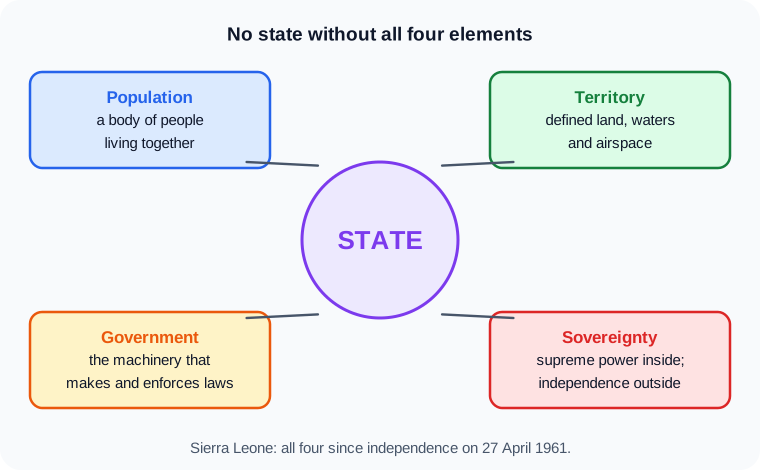
Figure 1. A state must have all four elements. WASSCE Tutor diagram.
| Element | Meaning | In Sierra Leone |
|---|---|---|
| Population | A body of people living together; there is no fixed minimum size | Sierra Leoneans of many ethnic groups: Temne, Mende, Limba, Kono, Krio, Fula and others |
| Territory | A defined area of land, territorial waters and airspace with recognised boundaries | The land bordered by Guinea and Liberia, and the Atlantic coast |
| Government | The machinery through which the state's will is expressed and enforced | The President, Parliament and the courts |
| Sovereignty | Supreme power within the territory and independence from outside control | Gained at independence on 27 April 1961 |
Before 1961, Sierra Leone had people, territory and a (colonial) government, but it lacked sovereignty: the final say lay in London. It was therefore a colony, not a state.
Other features of the modern state: permanence (it continues when governments change), compulsory membership for citizens, recognition by other states, and a monopoly of the lawful use of force.
Theories of the origin of the state
| Theory | Main idea | Key thinkers | Main criticism |
|---|---|---|---|
| Divine origin | God created the state and appointed rulers, who answer only to God (divine right of kings) | Supporters of absolute monarchs, such as King James I | Cannot be proved; was used to justify tyranny |
| Force theory | The state arose when the strong conquered the weak and imposed their rule | Ancient historians; some modern writers | Explains how some states began, but force alone cannot keep a state together |
| Social contract | People living in a "state of nature" agreed to give up some freedom to a ruler in exchange for protection | Thomas Hobbes, John Locke, Jean-Jacques Rousseau | There is no historical record of such an agreement |
| Evolutionary (historical) | The state grew slowly from the family, to the clan, to the tribe, to the kingdom and finally the state, shaped by kinship, religion, war and economic needs | Many modern historians | Widely accepted as the most realistic explanation |
| Marxist theory | The state arose with private property and social classes; it is a tool the ruling class uses to oppress others, and will "wither away" under communism | Karl Marx, Friedrich Engels | The communist states that followed did not wither away |
The social contract thinkers compared:
- Thomas Hobbes (1651): life in the state of nature was "nasty, brutish and short"; people surrendered all their rights to an absolute ruler.
- John Locke (1690): people kept their natural rights to life, liberty and property; government that breaks the contract may be removed. This idea influenced modern democracy.
- Jean-Jacques Rousseau (1762): sovereignty lies with the people as a whole, expressed through the general will.
The state compared with other groups
| Term | Meaning | How it differs from the state |
|---|---|---|
| Nation | A group of people bound by a common history, language, culture or descent, who feel they belong together | A nation need not have its own territory or sovereignty (for example, the Kurds); a state may contain several nations |
| Government | The machinery of the state | Temporary and concrete, while the state is permanent and abstract |
| Society | All the people living together and their relationships, including families, clubs, churches and markets | Society is wider and older; the state is the political organisation of society |
A nation-state is a state whose people mostly share one national identity, such as Japan. A multinational state contains several nations or ethnic groups under one government. Sierra Leone, with many ethnic groups, is a multinational state that seeks unity through shared national institutions and symbols.
Applying the elements. Is a province of a country a state? No. A province has people, territory and a (local) government, but it is not sovereign: it is under the central government. All four elements must be present.
Sierra Leone's national motto, "Unity, Freedom, Justice", and symbols such as the flag, anthem and coat of arms help to build one national identity among its many ethnic groups. This is the task of turning a multinational state into a nation.
"State" in Government does not mean a part of a federation (like a state in Nigeria or the USA). Those are component states without full sovereignty; the sovereign state is the whole federation.
Key points
- A state has population, territory, government and sovereignty; all four are essential.
- Theories of origin: divine, force, social contract (Hobbes, Locke, Rousseau), evolutionary and Marxist; the evolutionary theory is the most widely accepted.
- A nation is a people with a shared identity; a government is the state's machinery; society is the wider community.
- Sierra Leone became a sovereign state on 27 April 1961 and is a multinational state.
WASSCE examination focus
Expect to define the state and explain its features, to explain one or more theories of the origin of the state (especially the social contract), and to distinguish the state from the nation, government and society. Questions often ask why a colony is not a state.
Quick check
- Name the four elements of a state.
- Which element did Sierra Leone lack before 27 April 1961?
- Which social contract thinker argued that people keep their natural rights to life, liberty and property?
- State one difference between a nation and a state.
Answers:
- Population, territory, government and sovereignty.
- Sovereignty.
- John Locke.
- A nation is a people with a shared identity and need not have its own territory or sovereignty; a state must have a defined territory, a government and sovereignty (and may contain several nations).
Keep going with state and sovereignty
This is one of 2 lessons in State and Sovereignty. Start free with the first lesson of every topic, then unlock them all, plus exam-style practice marked instantly and guided learning tools, from 25 NLe.
- Free account, no card needed
- Everything from 25 NLe
- No automatic renewal
More lessons in State and Sovereignty
- Sovereignty: types, location and limitations🔒