WASSCE Government · Rule of Law and Separation of Powers
The rule of law: principles and limitations
By the WASSCE Tutor team
Updated 12 November 2026 · 8 min read · Prepared against the WASSCE syllabus.
"No one is above the law" is one of the most quoted phrases in politics. It means that a minister who steals public funds should face the same courts as a market trader who steals a bag of rice, and that the police cannot lock someone up simply because a powerful person wants them to. This idea is called the rule of law. This lesson explains its meaning and principles, how it is applied, and why it is never perfect in practice.
Learning objectives
By the end of this lesson you should be able to:
- define the rule of law
- explain A. V. Dicey's three principles of the rule of law
- state the conditions that promote the rule of law
- explain the limitations on the rule of law
- identify factors that undermine the rule of law in West Africa
What is the rule of law?
The rule of law is the principle that the law is supreme: everyone, including the government and its officials, is subject to the same laws, enforced by independent courts, and no one can be punished except for a breach of law proved in court.
The opposite of the rule of law is arbitrary rule: government by the whims of rulers rather than by fixed, known laws.
Dicey's three principles
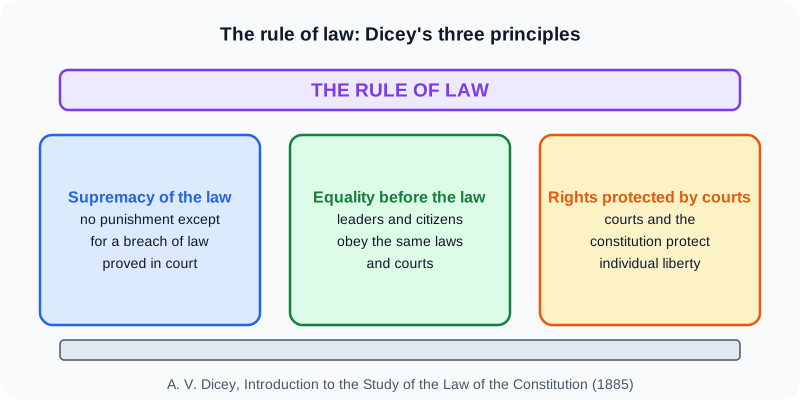
Figure 1. A. V. Dicey's principles of the rule of law. WASSCE Tutor diagram.
The British constitutional lawyer Albert Venn Dicey explained the rule of law in his book Introduction to the Study of the Law of the Constitution (1885):
- Supremacy of the law: no one can be punished or made to suffer in body or goods except for a distinct breach of law established in the ordinary courts. Government must act according to law, not arbitrary power.
- Equality before the law: every person, whatever their rank or position, is subject to the same law and the same courts. Officials who break the law are liable like anyone else.
- Rights protected by the courts (the constitution as the result of ordinary law): individual rights, such as personal liberty and free speech, are secured by the decisions of the ordinary courts. In countries with written constitutions, rights are also guaranteed in the constitution itself.
How the rule of law shows itself in practice
- Fair hearing: an accused person is presumed innocent until proved guilty, is told the charge, has time to prepare a defence and may have a lawyer.
- No retroactive punishment: a person cannot be punished for an act that was not a crime when it was done.
- Habeas corpus: a court can order a detained person to be brought before it, so that unlawful detention is ended.
- Independent judiciary that can rule against the government.
- Laws that are known, clear and published.
Conditions that promote the rule of law
- An independent and impartial judiciary.
- A written constitution that is supreme and protects rights.
- Separation of powers with checks and balances.
- A free press that exposes abuses.
- Political education so citizens know their rights.
- Legal aid for those who cannot afford lawyers.
- Professional, non-partisan police and prosecutors.
- Democracy, with periodic free elections.
Limitations on the rule of law
Even in democracies, the rule of law is limited:
| Limitation | Explanation |
|---|---|
| Immunity of the head of state | In Sierra Leone the President cannot be sued or prosecuted while in office |
| Diplomatic immunity | Foreign diplomats are not tried in local courts |
| Parliamentary privilege | MPs cannot be sued for what they say in Parliament |
| State of emergency | Some rights may be suspended to protect public safety |
| Delegated legislation | Rules made by officials receive less scrutiny |
| Judicial immunity | Judges cannot be sued for their decisions |
| Poverty and ignorance | The poor cannot afford lawyers; many citizens do not know their rights |
| Cost and delay of court cases | "Justice delayed is justice denied" |
| Special tribunals and military rule | Bypass the ordinary courts and suspend the constitution |
| Ouster clauses | Laws that prevent courts from reviewing certain decisions |
In March 2020, President Bio declared a 12-month state of public emergency to fight COVID-19, and Parliament approved it. Emergency regulations allowed lockdowns and curfews that limited freedom of movement. The episode shows that the Constitution itself permits some rights to be restricted in an emergency, provided the proper procedure is followed and the restrictions are reasonable.
Applying the principles. A police officer arrests a journalist on a minister's orders and keeps him in a cell for two weeks without charge.
- Supremacy of the law is broken: he is punished without any breach of law proved in court.
- Equality before the law is broken if the minister is shielded from prosecution for ordering it.
- The remedy: his lawyer applies to the High Court for habeas corpus and enforcement of his rights; the court can order his release and award compensation.
"Rule of law" does not mean "rule by law". A dictator can pass harsh laws and enforce them strictly; that is rule by law. The rule of law requires that laws apply equally to rulers and the ruled, protect rights and are applied by independent courts.
Key points
- The rule of law means the law is supreme and applies equally to all, enforced by independent courts.
- A. V. Dicey (1885): supremacy of the law, equality before the law, rights protected by the courts.
- Shown by fair hearing, presumption of innocence, habeas corpus and no retroactive punishment.
- Limited by immunities, emergencies, delegated legislation, poverty, delay and military rule.
WASSCE examination focus
Expect to define the rule of law, to explain Dicey's three principles, and to state its limitations. Essay questions often ask for "factors that hinder the application of the rule of law in your country": use limitations such as immunity, emergencies, poverty, delay and executive interference.
Quick check
- Who wrote Introduction to the Study of the Law of the Constitution (1885)?
- State Dicey's three principles of the rule of law.
- What is habeas corpus?
- Give two limitations on the rule of law.
Answers:
- A. V. Dicey.
- Supremacy of the law; equality before the law; rights protected by the ordinary courts (the constitution as the result of ordinary law).
- A court order requiring a detained person to be brought before the court so that it can decide whether the detention is lawful.
- Any two: immunity of the head of state; diplomatic immunity; parliamentary privilege; state of emergency; delegated legislation; judicial immunity; poverty and ignorance; cost and delay of court cases; special tribunals and military rule; ouster clauses.
Keep going with rule of law and separation of powers
This is one of 2 lessons in Rule of Law and Separation of Powers. Start free with the first lesson of every topic, then unlock them all, plus exam-style practice marked instantly and guided learning tools, from 25 NLe.
- Free account, no card needed
- Everything from 25 NLe
- No automatic renewal
More lessons in Rule of Law and Separation of Powers
- Separation of powers and checks and balances🔒