WASSCE Government · Republican Constitution of 1971
Why Sierra Leone became a republic in 1971
By the WASSCE Tutor team
Updated 12 November 2026 · 6 min read · Prepared against the WASSCE syllabus.
On 19 April 1971, Sierra Leone stopped being a constitutional monarchy under the British Crown and became a republic. Two days later, Prime Minister Siaka Stevens was sworn in as the country's first executive President. The change came only weeks after soldiers had tried to overthrow him. This lesson explains why Sierra Leone became a republic and how the change was carried out.
Learning objectives
By the end of this lesson you should be able to:
- define a republic
- explain the reasons why Sierra Leone became a republic in 1971
- describe the events surrounding the change
- explain the role of Siaka Stevens and the APC
What is a republic?
A republic is a state whose head of state is a citizen chosen for a fixed term, rather than a hereditary monarch. In an executive republic, the president is both head of state and head of government.
Reasons for the change
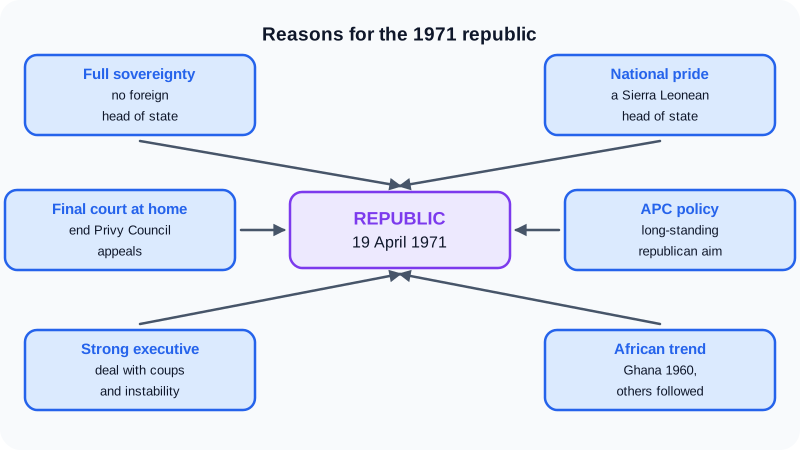
Figure 1. Reasons for the 1971 republic. WASSCE Tutor diagram.
- Full sovereignty: a foreign monarch as head of state was seen as a sign of incomplete independence.
- National pride and identity: Sierra Leoneans wanted one of their own as head of state.
- Ending appeals to the Privy Council: final justice should be decided at home.
- APC policy: the APC had long promised a republic; it now had the majority to deliver it.
- A strong executive: after the coups of 1967 and 1968 and the attempted coup of March 1971, Stevens argued that the country needed a powerful president with clear authority over the armed forces.
- The African trend: Ghana (1960), Tanzania (1962), Nigeria (1963) and others had already become republics.
- Removing the Governor-General's role, which had been at the centre of the 1967 crisis.
How the change happened
| Date | Event |
|---|---|
| 1967–1968 | An earlier republican proposal by Albert Margai's SLPP government fails amid the 1967 election crisis |
| March 1971 | An attempted military coup against Prime Minister Stevens fails; troops from Guinea are invited to help protect the government under a defence agreement |
| April 1971 | Parliament, dominated by the APC, passes the Republican Constitution |
| 19 April 1971 | Sierra Leone becomes a republic; the acting Governor-General, Christopher Okoro Cole, becomes interim President |
| 21 April 1971 | Siaka Stevens is sworn in as executive President |
19 April is still remembered as Republic Day.
Siaka Stevens and the APC
- Siaka Stevens (1905–1988) founded the APC in 1960, became Prime Minister in 1968 and President in 1971.
- He presented the republic as the completion of independence and a way to stabilise the country.
- Critics argued that the change concentrated power in his hands and weakened the checks of the parliamentary system.
The attempted coup of March 1971, led by army commander Brigadier John Bangura, failed. Stevens turned to neighbouring Guinea, whose President, Ahmed Sékou Touré, sent troops to help protect him. Bangura was tried and executed. Weeks later, the republic was declared, giving Stevens the powers of an executive President. Supporters saw a stronger, more secure government; opponents saw the start of a slide towards one-party rule.
Siaka Stevens was not the very first President of the Republic. Christopher Okoro Cole, who had been acting Governor-General, served as interim President for two days (19 to 21 April 1971) before Stevens was sworn in as executive President.
Key points
- A republic has an elected or chosen citizen as head of state, not a hereditary monarch.
- Reasons: full sovereignty, national pride, ending Privy Council appeals, APC policy, a strong executive after coups, the African trend.
- March 1971: failed coup; Guinean troops invited.
- 19 April 1971: republic declared (C. O. Cole interim President); 21 April 1971: Siaka Stevens executive President.
WASSCE examination focus
Expect to explain why Sierra Leone became a republic in 1971 and to describe the events surrounding the change. Objective questions often test the date (19 April 1971) and who became the first executive President.
Quick check
- On what date did Sierra Leone become a republic?
- Who became Sierra Leone's first executive President?
- State three reasons why Sierra Leone became a republic.
- Which country sent troops to support Stevens after the attempted coup of 1971?
Answers:
- 19 April 1971.
- Siaka Stevens (sworn in on 21 April 1971).
- Any three: full sovereignty; national pride; ending Privy Council appeals; APC policy; need for a strong executive after coups; the trend among African states; removing the Governor-General's role.
- Guinea.
Keep going with republican constitution of 1971
This is one of 2 lessons in Republican Constitution of 1971. Start free with the first lesson of every topic, then unlock them all, plus exam-style practice marked instantly and guided learning tools, from 25 NLe.
- Free account, no card needed
- Everything from 25 NLe
- No automatic renewal
More lessons in Republican Constitution of 1971
- The 1971 Republican Constitution: features and effects🔒