WASSCE Government · Public Opinion and Mass Media
Public opinion: meaning, formation and measurement
By the WASSCE Tutor team
Updated 12 November 2026 · 7 min read · Prepared against the WASSCE syllabus.
When fuel prices rise, the anger is heard everywhere: in poda-podas, at market stalls, on radio phone-in programmes and on WhatsApp. If enough people share the same view, government feels the pressure. This shared view is public opinion. In a democracy, leaders who ignore it risk losing the next election. This lesson explains what public opinion is, how it is formed and measured, and why it matters.
Learning objectives
By the end of this lesson you should be able to:
- define public opinion and state its features
- explain the agents that form public opinion
- describe the methods of measuring public opinion
- explain the importance of public opinion in a democracy
- state the factors that limit its influence
What is public opinion?
Public opinion is the collective view or attitude of a large section of the public on an issue of public concern, such as a government policy, a law or the performance of leaders.
Features:
- It concerns public issues, not private matters.
- It is held by a significant number of people, not one individual.
- It is not always unanimous: there may be majority and minority opinions.
- It changes over time as events and information change.
- It can be informed or uninformed, and can be shaped or manipulated.
How public opinion is formed and measured
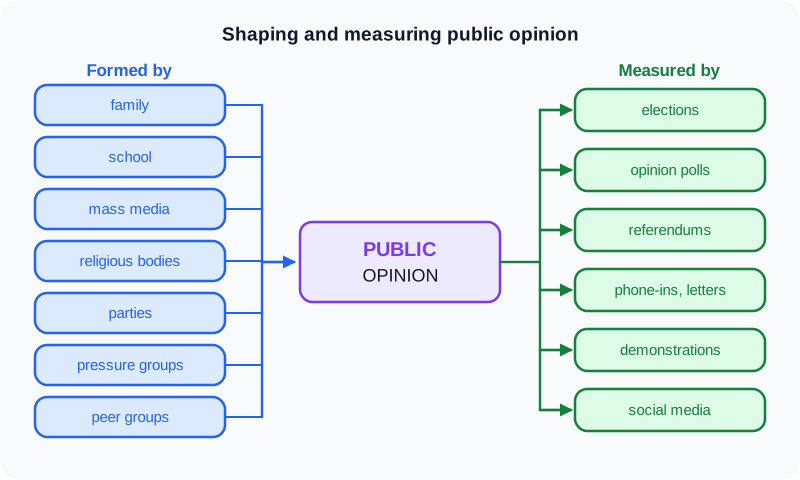
Figure 1. Shaping and measuring public opinion. WASSCE Tutor diagram.
Agents of opinion formation
| Agent | How it shapes opinion |
|---|---|
| Family | Children often adopt their parents' political views and loyalties |
| School | Civic education, teachers and debates shape attitudes to government |
| Mass media | Radio, newspapers, television and social media supply information and interpretation |
| Religious bodies | Sermons and statements by religious leaders influence followers |
| Political parties | Campaigns, rallies and manifestos win people to their views |
| Pressure groups | Campaigns draw attention to particular issues |
| Peer groups | Friends, colleagues and age-mates influence one another |
| Government | Press releases, propaganda and policy announcements |
| Opinion leaders | Chiefs, elders, celebrities and influential individuals |
Methods of measuring public opinion
- Elections: the clearest test of what voters think of the government.
- Opinion polls (surveys): questioning a sample of people to estimate the views of all.
- Referendums: a direct vote on a single issue.
- Radio phone-in programmes, letters to editors and social media.
- Demonstrations, strikes and protests.
- Reports of chiefs, councillors, MPs and security agencies.
- Petitions and memoranda.
How does an opinion poll work? A polling organisation wants to know what voters think of a new policy. It cannot ask every adult, so it questions a sample, say 1,200 adults chosen so that men and women, regions, ages and urban and rural areas are fairly represented. If 60% of the sample approve, the pollster estimates that roughly 60% of all adults approve, within a margin of error of a few percentage points. A badly chosen sample (for example, only people in Freetown) gives a misleading result.
Importance of public opinion
- Guides government policy: governments adjust policies that are unpopular.
- Checks abuse of power and holds leaders accountable.
- Gives legitimacy: a government with public support is more stable.
- Shapes election outcomes.
- Helps law enforcement: laws backed by public opinion are easier to enforce.
- Promotes participation and debate.
Factors that limit the influence of public opinion
- Illiteracy and ignorance of public issues
- Poverty, which makes people easier to manipulate or bribe
- Government control or censorship of the media
- Ethnic and religious divisions, which split opinion
- Fear of victimisation under authoritarian rule
- Poor communication, especially in remote rural areas
- Propaganda and fake news
In Sierra Leone, independent researchers and international survey networks carry out regular opinion surveys on topics such as the economy, trust in institutions and the performance of government. Before elections, polls attempt to predict results. Radio phone-in programmes on local stations are also a lively everyday measure of what people think, especially in areas where few people read newspapers.
Public opinion is not always the majority opinion, and it is not always right. A loud minority, a well-funded campaign or false information can create an impression of public opinion that does not match what most people really think. That is why reliable measurement matters.
Key points
- Public opinion is the collective view of a large section of the public on a public issue.
- Formed by family, school, mass media, religious bodies, parties, pressure groups, peers, government and opinion leaders.
- Measured by elections, opinion polls, referendums, phone-ins, demonstrations and petitions.
- Important because it guides policy, checks power and gives legitimacy; limited by illiteracy, poverty, censorship and division.
WASSCE examination focus
Expect to define public opinion, to explain the agents that form it, to describe how it is measured, and to explain its importance in a democracy. Questions also ask for factors that hinder the expression of public opinion in developing countries.
Quick check
- Define public opinion.
- Name three agents that shape public opinion.
- What is an opinion poll?
- Give two factors that limit the influence of public opinion.
Answers:
- The collective view or attitude of a large section of the public on an issue of public concern.
- Any three: family; school; mass media; religious bodies; political parties; pressure groups; peer groups; government; opinion leaders.
- A survey in which a sample of people is questioned to estimate the views of the whole population.
- Any two: illiteracy; poverty; government control of the media; ethnic and religious divisions; fear of victimisation; poor communication; propaganda and fake news.
Keep going with public opinion and mass media
This is one of 2 lessons in Public Opinion and Mass Media. Start free with the first lesson of every topic, then unlock them all, plus exam-style practice marked instantly and guided learning tools, from 25 NLe.
- Free account, no card needed
- Everything from 25 NLe
- No automatic renewal
More lessons in Public Opinion and Mass Media
- The mass media: roles, influence and press freedom🔒