WASSCE Government · Public Corporations
Public corporations: meaning, features and reasons
By the WASSCE Tutor team
Updated 12 November 2026 · 7 min read · Prepared against the WASSCE syllabus.
The water from the tap in Freetown comes from the Guma Valley Water Company. The electricity in many homes is supplied by EDSA. National radio and television come from the SLBC. None of these is an ordinary government ministry, and none is a private business seeking profit for shareholders. They are public corporations: businesses owned by the state but run with their own management. This lesson explains what public corporations are, their features, why governments set them up and how they differ from ministries and private companies.
Learning objectives
By the end of this lesson you should be able to:
- define a public corporation and state its features
- distinguish a public corporation from a government department and a private company
- explain the reasons for establishing public corporations
- give examples of public corporations in Sierra Leone
What is a public corporation?
A public corporation (statutory corporation, parastatal or state-owned enterprise) is a body created by an Act of Parliament (or decree), owned by the state, and run by a board of directors to provide essential goods or services to the public, usually on a commercial basis but not mainly for profit.
Features of a public corporation
- Created by statute: an Act of Parliament sets out its powers and duties.
- Owned by the state on behalf of the public.
- Managed by a board of directors appointed by the minister or President.
- Separate legal personality: it can sue and be sued, own property and make contracts in its own name.
- Day-to-day independence from the ministry, but subject to the minister's general direction.
- Finances: earns revenue from its services, and may receive government grants and loans.
- Aim: to provide a public service at a reasonable cost, not mainly to make profit.
- Accountable to the minister and Parliament; accounts are audited.
- Staff are employees of the corporation, not civil servants.
Comparing types of enterprise
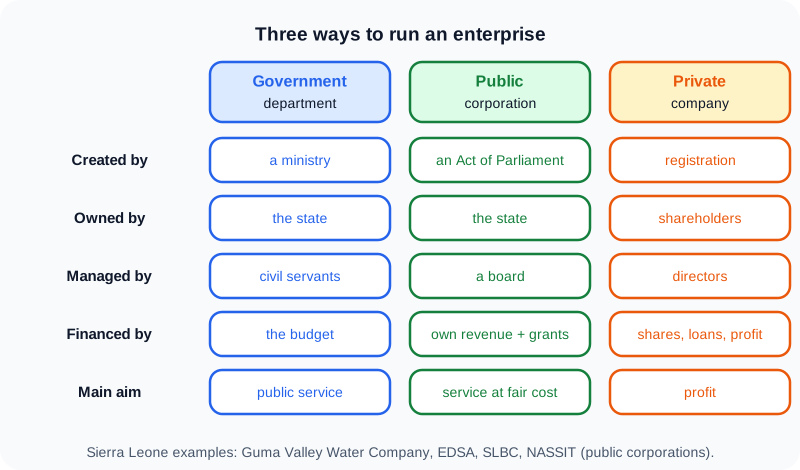
Figure 1. Three ways to run an enterprise. WASSCE Tutor diagram.
| Government department | Public corporation | Private company | |
|---|---|---|---|
| Created by | Administrative decision within a ministry | An Act of Parliament | Registration under company law |
| Owned by | The state | The state | Shareholders |
| Managed by | Civil servants under a minister | A board of directors | Directors elected by shareholders |
| Finance | The national budget | Own revenue, grants and loans | Shares, loans and profits |
| Legal status | No separate legal personality | Can sue and be sued | Can sue and be sued |
| Aim | Public administration and service | Service at a reasonable cost | Profit |
Reasons for establishing public corporations
- To provide essential services (water, electricity, ports) that private firms might not provide, or would provide only to profitable areas.
- Huge capital is needed that private investors cannot or will not raise.
- To prevent private monopolies from exploiting consumers in natural monopolies such as water and power.
- National security and strategic importance, for example ports, airports and broadcasting.
- To promote economic development and industrialisation.
- To create employment.
- To control the economy and keep key sectors in national hands after independence.
- To provide services at affordable prices, sometimes with subsidies.
- To generate revenue for the government.
Public corporations in Sierra Leone
| Corporation | Service |
|---|---|
| Guma Valley Water Company | Water supply to Freetown |
| Sierra Leone Water Company (SALWACO) | Water supply to provincial towns |
| Electricity Distribution and Supply Authority (EDSA) | Distribution and sale of electricity |
| Electricity Generation and Transmission Company (EGTC) | Generation and transmission of electricity |
| Sierra Leone Broadcasting Corporation (SLBC) | Public radio and television |
| Sierra Leone Ports Authority | Management of the Queen Elizabeth II Quay and other ports |
| Sierra Leone Airports Authority | Lungi International Airport |
| National Social Security and Insurance Trust (NASSIT) | Pensions and social security |
| Sierra Leone Road Transport Corporation | Public bus services |
| Sierra Leone Commercial Bank, Rokel Commercial Bank | Banking (state-owned or majority state-owned) |
Electricity in Sierra Leone was once supplied by a single body, the National Power Authority. Under reforms in the 2010s it was split into two public corporations: EGTC, which generates and transmits power, and EDSA, which distributes and sells it to customers. The aim was to make each part more efficient and easier to hold to account, and to open generation to private investors.
A public corporation is not a government ministry. Its staff are not civil servants, it has a board, it earns its own revenue, and it can sue and be sued in its own name. Its link to government is through the minister, who appoints the board and gives general policy directions.
Key points
- A public corporation is created by statute, owned by the state and run by a board to provide a service, not mainly for profit.
- Features: statutory creation, state ownership, board management, legal personality, day-to-day independence, accountability.
- Reasons: essential services, huge capital, preventing private monopoly, strategic importance, development, employment, revenue.
- Sierra Leone examples: Guma Valley, SALWACO, EDSA, EGTC, SLBC, Ports Authority, NASSIT.
WASSCE examination focus
Expect to define public corporations, to state their features, to explain reasons for establishing them, and to distinguish them from government departments and private companies. Give Sierra Leonean examples in your answers.
Quick check
- How is a public corporation created?
- State two differences between a public corporation and a government department.
- Give three reasons for establishing public corporations.
- Name two public corporations in Sierra Leone and the services they provide.
Answers:
- By an Act of Parliament (or a decree under a military government).
- Any two: a public corporation is run by a board, a department by civil servants under a minister; a corporation has separate legal personality, a department does not; a corporation earns its own revenue, a department is financed from the budget; corporation staff are not civil servants.
- Any three: to provide essential services; huge capital needed; to prevent private monopolies; strategic importance; to promote development; to create employment; to control key sectors; to provide affordable services; to generate revenue.
- Any two, for example: Guma Valley Water Company (water for Freetown); EDSA (electricity distribution); SLBC (public broadcasting); Sierra Leone Ports Authority (ports); NASSIT (social security).
Keep going with public corporations
This is one of 2 lessons in Public Corporations. Start free with the first lesson of every topic, then unlock them all, plus exam-style practice marked instantly and guided learning tools, from 25 NLe.
- Free account, no card needed
- Everything from 25 NLe
- No automatic renewal
More lessons in Public Corporations
- Control, problems and reform of public corporations🔒