WASSCE Government · Public Administration and Civil Service
The civil service: features, structure and functions
By the WASSCE Tutor team
Updated 12 November 2026 · 7 min read · Prepared against the WASSCE syllabus.
Ministers come and go with elections and reshuffles, but the officials who keep the schools paid, the hospitals supplied and the records kept stay at their desks. They are the civil service, the permanent machinery of government. This lesson explains what the civil service is, its main features, how it is organised and what it does, with examples from Sierra Leone.
Learning objectives
By the end of this lesson you should be able to:
- define public administration and the civil service
- explain the features (principles) of the civil service
- describe the structure of a ministry and the grades of the civil service
- explain the functions of the civil service
- describe the role of the Public Service Commission
Public administration and the civil service
Public administration is the organisation and management of government business: carrying out public policy through ministries, departments and agencies. The civil service is the body of permanent, paid, professional officials who work in government ministries and departments to advise ministers and implement government policy.
The public service is wider than the civil service. It includes the civil service plus the police, the armed forces, teachers in government schools, staff of public corporations and local councils.
Features of the civil service
- Permanence: civil servants stay in office when governments change, giving continuity.
- Political neutrality: they serve any government loyally and do not take part in partisan politics.
- Anonymity: they work behind the scenes; the minister takes public responsibility for the ministry's actions.
- Impartiality: they treat all citizens equally, without favour.
- Hierarchy: a clear chain of command from the top to the bottom.
- Expertise and professionalism: officials are trained specialists.
- Recruitment and promotion on merit, through the Public Service Commission.
- Security of tenure: they cannot be dismissed at will.
- Rules and procedures (sometimes called "red tape") that ensure consistency.
Structure of a ministry
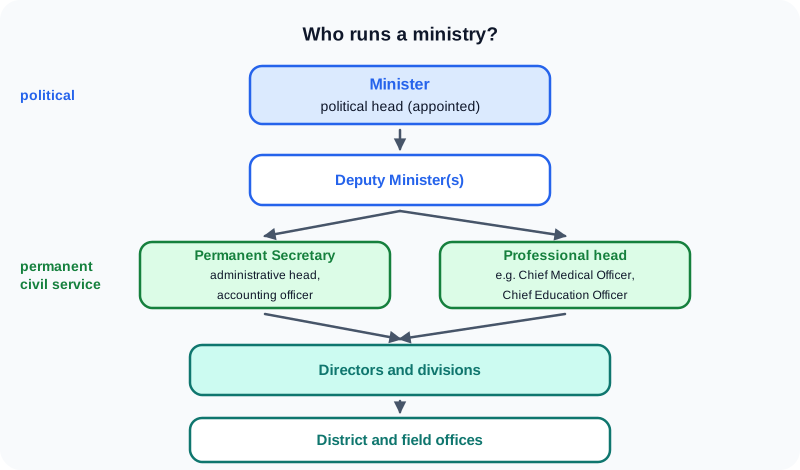
Figure 1. Who runs a ministry. WASSCE Tutor diagram.
| Officer | Role |
|---|---|
| Minister | Political head: sets policy and answers to the President and Parliament |
| Deputy Minister | Assists the minister |
| Permanent Secretary | Administrative head and accounting officer of the ministry; chief adviser to the minister |
| Professional head | Leads technical staff, for example the Chief Medical Officer in the Ministry of Health |
| Directors | Head divisions or departments within the ministry |
| District officers | Deliver services in the districts |
At the top of the whole service in Sierra Leone is the Secretary to the Cabinet and Head of the Civil Service.
Grades (classes) of the civil service
| Class | Work |
|---|---|
| Administrative | Senior officials who advise on and coordinate policy (permanent secretaries, directors) |
| Professional | Specialists such as doctors, engineers, lawyers and economists |
| Executive | Middle-level officers who carry out policy and supervise |
| Technical | Technicians, surveyors, laboratory staff |
| Clerical | Clerks, typists and records staff |
| Subordinate (support) | Drivers, messengers, cleaners and security staff |
Functions of the civil service
- Implementing government policies and laws.
- Advising ministers on policy, based on expertise and records.
- Drafting policy papers, bills and regulations.
- Preparing the budget estimates of ministries.
- Collecting revenue (taxes, fees and duties).
- Providing continuity when governments change.
- Keeping records and statistics.
- Making delegated legislation under powers given by Acts.
- Representing the government at meetings and in negotiations.
- Delivering public services such as education and health.
The Public Service Commission
The Public Service Commission (PSC), established by the 1991 Constitution, is responsible for appointing, promoting, transferring and disciplining public officers, so that these decisions are made on merit and not by politicians. The Human Resource Management Office (HRMO) manages the civil service workforce and payroll records.
When the SLPP took over from the APC in 2018, ministers changed but most permanent secretaries, directors and other civil servants remained in post. This continuity meant that salaries were still paid, schools still opened and records were not lost during the change of government: the civil service at work as the permanent executive.
The minister, not the civil servant, answers publicly for a ministry's decisions. That is the principle of anonymity and ministerial responsibility. Civil servants advise privately, then carry out the minister's decision even if they disagreed.
Key points
- The civil service is the permanent, professional body of officials who advise ministers and implement policy.
- Features: permanence, neutrality, anonymity, impartiality, hierarchy, expertise, merit, security of tenure.
- A ministry is led politically by the Minister and administratively by the Permanent Secretary (accounting officer).
- Functions: implementing policy, advising ministers, drafting laws, budgeting, revenue collection, continuity, records, delegated legislation.
- The Public Service Commission appoints, promotes and disciplines public officers on merit.
WASSCE examination focus
Expect to define the civil service, to explain its features (especially neutrality, anonymity and permanence), to state its functions, and to describe the role of the Public Service Commission. Questions may ask you to distinguish the civil service from the public service.
Quick check
- Who is the administrative head of a ministry?
- Explain the principle of anonymity in the civil service.
- State three functions of the civil service.
- What is the main function of the Public Service Commission?
Answers:
- The Permanent Secretary.
- Civil servants work behind the scenes and are not publicly named or blamed for policies; the minister takes public responsibility for the ministry.
- Any three: implementing policy; advising ministers; drafting bills and regulations; preparing budget estimates; collecting revenue; providing continuity; keeping records; delegated legislation; representing government; delivering services.
- To appoint, promote, transfer and discipline public officers on merit, free from political interference.
Keep going with public administration and civil service
This is one of 2 lessons in Public Administration and Civil Service. Start free with the first lesson of every topic, then unlock them all, plus exam-style practice marked instantly and guided learning tools, from 25 NLe.
- Free account, no card needed
- Everything from 25 NLe
- No automatic renewal
More lessons in Public Administration and Civil Service
- Problems of the civil service, control and reform🔒