WASSCE Government · Pre-Colonial Political Systems of the Mende and Temne
The Mende political system before colonial rule
By the WASSCE Tutor team
Updated 12 November 2026 · 7 min read · Prepared against the WASSCE syllabus.
Long before the British arrived, the peoples of what is now Sierra Leone governed themselves. They had rulers, councils, courts, laws, taxes and armies. The Mende of the south and east built many independent chiefdoms, held together by powerful secret societies and by warrior leaders. This lesson explains how the Mende were governed before colonial rule, and why their system is still important for understanding chieftaincy today.
Learning objectives
By the end of this lesson you should be able to:
- describe the political organisation of the Mende before colonial rule
- explain the roles of the chief, the council of elders, the speaker and sub-chiefs
- explain the political, judicial and social functions of the Poro and Sande societies
- describe how chiefs were chosen and how their power was limited
- name notable Mende rulers of the nineteenth century
The Mende and their land
The Mende are the largest ethnic group in the south and east of Sierra Leone. Before colonial rule, Mende country was not one kingdom. It was divided into many independent chiefdoms, some small and some built into large confederacies by successful war leaders. Wars between chiefdoms were common in the nineteenth century, and many towns were protected by stockades (wooden war fences).
Political organisation
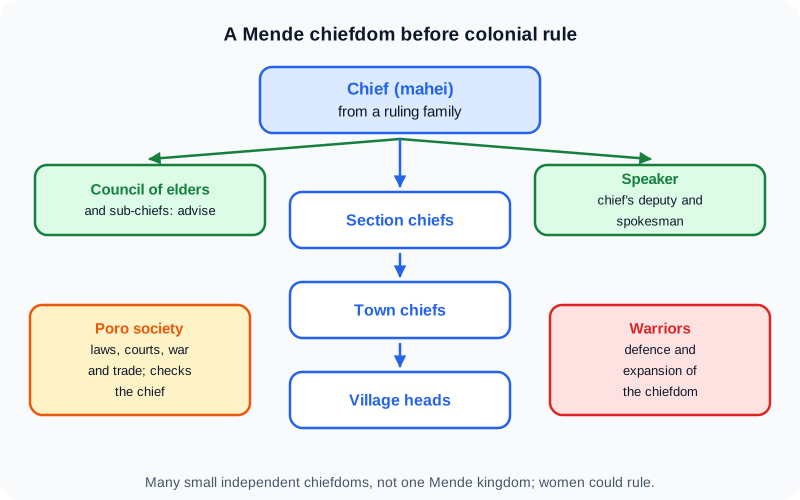
Figure 1. A Mende chiefdom before colonial rule. WASSCE Tutor diagram.
| Office or body | Role |
|---|---|
| The chief (mahei) | Head of the chiefdom: kept law and order, led in war, judged disputes, allocated land, received tribute and represented the chiefdom |
| Council of elders and sub-chiefs | Advised the chief; their views were needed on important matters; helped choose a new chief |
| The speaker | The chief's deputy and spokesman; received visitors and passed on the chief's decisions; acted for the chief when absent |
| Section chiefs | Ruled sections (groups of towns) on behalf of the chief |
| Town chiefs and village heads | Ruled towns and villages; settled minor disputes; collected tribute |
| Warriors | Defended the chiefdom and expanded it through war; successful warriors could become chiefs |
Choosing a chief
- Chiefs came from ruling families whose ancestors founded or conquered the chiefdom.
- There was no automatic succession from father to son. The elders, sub-chiefs and Poro leaders chose the most suitable candidate from the ruling families.
- Women could become chiefs. The best-known example is Madam Yoko of the Kpaa Mende, who ruled from Senehun in the late nineteenth century.
The Poro and Sande societies
The Poro is a men's secret society found among the Mende and several other peoples of Sierra Leone and Liberia. The Sande (also called Bondo) is the women's society. Both initiate young people into adulthood and play important roles in community life.
Political and social functions of the Poro:
- Law-making: issuing laws ("Poro law") that everyone had to obey, for example closing farms, banning certain activities or regulating trade.
- Judicial work: settling serious disputes, especially between chiefs or chiefdoms.
- Checking the chief: a chief who abused power could be warned or disciplined through the Poro.
- War and peace: helping to decide war, and to make peace between chiefdoms.
- Choosing and installing chiefs, together with the elders.
- Education: training boys in the bush school in skills, customs and loyalty.
- Uniting different chiefdoms, because membership crossed chiefdom boundaries.
The Sande trained girls in domestic skills, moral conduct and community values, and gave women a recognised voice in society.
Limits on the chief's power
- The council of elders had to be consulted.
- The Poro society could discipline or restrain a chief.
- Custom and religion set rules the chief had to follow.
- Unpopular chiefs could lose support, and powerful sub-chiefs or warriors could break away.
Several Mende rulers became famous in the nineteenth century. Kai Londo built a powerful state in Luawa (Kailahun area). Nyagua ruled from Panguma and was later arrested by the British after the 1898 rising. Madam Yoko expanded the Kpaa Mende confederacy and worked closely with the British. Their careers show how war, alliances and diplomacy shaped Mende politics.
Do not describe the pre-colonial Mende as a single centralised kingdom ruled by one king. Mende country had many independent chiefdoms, though some were grouped into larger confederacies under strong warrior leaders.
Key points
- Mende country (south and east) had many independent chiefdoms, not one kingdom.
- The chief (mahei) ruled with a council of elders, a speaker and sub-chiefs; warriors were important.
- Chiefs were chosen from ruling families by elders and the Poro; women could rule (Madam Yoko).
- The Poro made laws, settled disputes, checked chiefs and trained boys; the Sande trained girls.
- Notable rulers: Kai Londo (Luawa), Nyagua (Panguma), Madam Yoko (Kpaa Mende).
WASSCE examination focus
Expect to describe the political organisation of the Mende, to explain the roles of the Poro society, and to explain how the chief's powers were limited. Questions often ask you to compare the Mende and Temne systems.
Quick check
- Was pre-colonial Mende country one kingdom? Explain.
- State three political functions of the Poro society.
- Name a famous Mende woman ruler.
- Who chose a new Mende chief?
Answers:
- No. It was divided into many independent chiefdoms, some grouped into confederacies by warrior leaders.
- Any three: making laws; settling disputes; checking the chief; deciding war and peace; choosing and installing chiefs; uniting chiefdoms.
- Madam Yoko of the Kpaa Mende.
- The elders, sub-chiefs and Poro leaders, from among the members of the ruling families.
Keep going with pre-colonial political systems of the mende and temne
This is one of 2 lessons in Pre-Colonial Political Systems of the Mende and Temne. Start free with the first lesson of every topic, then unlock them all, plus exam-style practice marked instantly and guided learning tools, from 25 NLe.
- Free account, no card needed
- Everything from 25 NLe
- No automatic renewal
More lessons in Pre-Colonial Political Systems of the Mende and Temne
- The Temne political system and a comparison with the Mende🔒
All of Pre-Colonial Political Systems of the Mende and Temne →