WASSCE Government · Political Parties and Pressure Groups
Political parties: types, functions and party systems
By the WASSCE Tutor team
Updated 12 November 2026 · 7 min read · Prepared against the WASSCE syllabus.
At election time in Sierra Leone the streets turn green for the SLPP and red for the APC, and smaller parties campaign in their own colours. Each party hopes to win power and put its programme into action. Political parties are the main vehicles through which citizens compete for power in a democracy. This lesson explains what parties are, the types of party, what parties do and the different party systems.
Learning objectives
By the end of this lesson you should be able to:
- define a political party and state its features
- classify political parties into types
- explain the functions of political parties
- distinguish one-party, two-party and multi-party systems, with merits and demerits
- identify the problems facing political parties in West Africa
What is a political party?
A political party is an organised group of people who share broadly similar political ideas and aims, and who seek to win control of government through elections in order to carry out their programme.
Features of a political party:
- An organised structure: national executive, regional and constituency branches.
- Leadership: a party leader, chairman and other officers.
- A manifesto or programme: the policies it promises to carry out.
- Membership, with members' cards and dues.
- The aim of winning power through elections.
- A name, symbol and colours that identify it.
- A constitution that governs its internal affairs.
- Registration with the state: in Sierra Leone, with the Political Parties Regulation Commission (PPRC).
Types of political party
| Type | Meaning | Example |
|---|---|---|
| Mass party | Seeks the widest possible membership among ordinary people | Many nationalist parties before independence |
| Elite (cadre) party | Led and controlled by a small group of notable or educated people | Early colonial-era parties of the educated elite |
| Ideological party | Built around a clear ideology | Communist and socialist parties |
| Broker (catch-all) party | Tries to attract voters from all groups by balancing interests | Most modern major parties |
| Charismatic party | Built around a popular leader | Parties formed around one founder |
| Ethnic or regional party | Draws support mainly from one ethnic group or region | Parties with strong regional strongholds |
Functions of political parties
- Contesting elections and forming the government when they win.
- Recruiting and training leaders for public office.
- Formulating policies and presenting them in manifestos.
- Political education: informing voters about issues.
- Interest aggregation: combining the demands of many groups into one programme.
- Providing an opposition that criticises and checks the government.
- Linking the government and the people.
- Promoting national unity when parties draw support from all regions.
- Political socialisation: shaping citizens' political attitudes.
- Giving voters a choice between alternative programmes and leaders.
Party systems
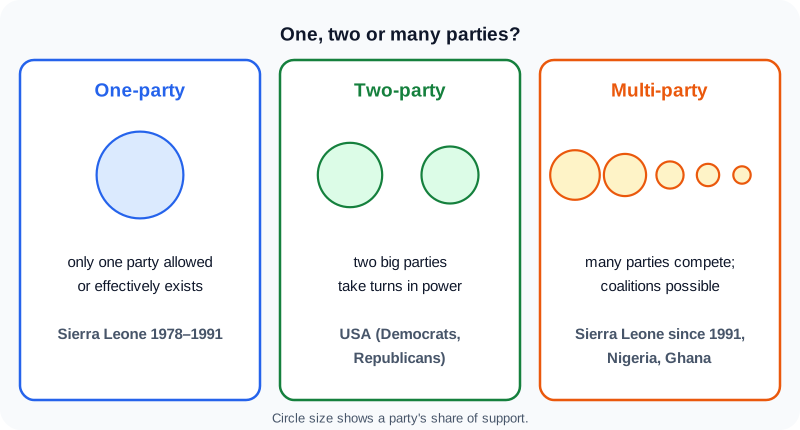
Figure 1. One, two or many parties. WASSCE Tutor diagram.
| System | Merits | Demerits |
|---|---|---|
| One-party (only one party allowed, de jure, or effectively, de facto) | Can promote unity; avoids divisive party conflict; quick decisions | No real choice; no opposition; leads to dictatorship and abuse of rights; elections become a formality |
| Two-party (two major parties alternate in power) | Stable government; clear choice; strong opposition ready to take over | Limited choice; minorities and small parties are ignored |
| Multi-party (several parties compete) | Wide choice; minorities represented; encourages debate | Can produce weak coalition governments; instability; parties may form along ethnic lines |
Sierra Leone has experienced every type of system. The 1978 Constitution made the All People's Congress (APC) the only legal party, a de jure one-party state. The 1991 Constitution restored multi-party politics. Today about 17 parties are registered with the PPRC, but national politics is dominated by two: the Sierra Leone People's Party (SLPP), founded in 1951, and the APC, founded in 1960. Power has alternated between them since 2007, so some describe the system as multi-party with two dominant parties.
Problems of political parties in West Africa
- Ethnic and regional voting, which makes parties look like ethnic associations
- Poor internal democracy: leaders imposed rather than elected
- Lack of funds, and dependence on rich sponsors
- Weak ideology: parties differ little in policy
- Violence by party supporters during campaigns
- Defections ("carpet-crossing") and splits
- Personality cults around leaders
A party with the most members is not necessarily a mass party, and a two-party system does not mean only two parties exist. In the USA many small parties exist, but only the Democrats and Republicans have a real chance of winning power. What matters is how many parties compete effectively for power.
Key points
- A political party is an organised group that seeks to win power through elections to carry out its programme.
- Types: mass, elite, ideological, broker, charismatic, ethnic or regional.
- Functions: contesting elections, recruiting leaders, policy-making, political education, interest aggregation, opposition.
- Systems: one-party (Sierra Leone 1978–1991), two-party (USA), multi-party (Sierra Leone since 1991).
- Sierra Leone: SLPP (1951) and APC (1960) dominate; parties register with the PPRC.
WASSCE examination focus
Expect to define a political party, to state its functions, and to compare party systems with merits and demerits. Questions on Sierra Leone often ask about the one-party state under the 1978 Constitution and the problems facing parties today.
Quick check
- What is a political party?
- State three functions of political parties.
- What is a de jure one-party state? Give an example.
- Which body registers and regulates political parties in Sierra Leone?
Answers:
- An organised group of people with similar political ideas who seek to win control of government through elections to carry out their programme.
- Any three: contesting elections; recruiting and training leaders; formulating policies; political education; interest aggregation; providing an opposition; linking government and people; promoting unity; giving voters a choice.
- A state in which the law or constitution allows only one party, for example Sierra Leone under the 1978 Constitution, when the APC was the only legal party.
- The Political Parties Regulation Commission (PPRC).
Keep going with political parties and pressure groups
This is one of 2 lessons in Political Parties and Pressure Groups. Start free with the first lesson of every topic, then unlock them all, plus exam-style practice marked instantly and guided learning tools, from 25 NLe.
- Free account, no card needed
- Everything from 25 NLe
- No automatic renewal
More lessons in Political Parties and Pressure Groups
- Pressure groups: types, methods and functions🔒