WASSCE Government · Meaning and Nature of Government
What government is: meanings, purposes and functions
By the WASSCE Tutor team
Updated 12 November 2026 · 8 min read · Prepared against the WASSCE syllabus.
Every day in Sierra Leone, decisions made by people you may never meet shape your life: whether your school is free, what the police may do, how much tax a trader pays, and which roads are repaired before the rains. The body that makes and enforces those decisions is the government. Government as a subject asks who holds that power, how they got it, how they use it and how they can be checked.
Learning objectives
By the end of this lesson you should be able to:
- explain the three meanings of the word "government"
- state the characteristics of government
- explain why government is necessary in every society
- describe the legislative, executive and judicial functions of government
- distinguish between the government and the state
Three meanings of government
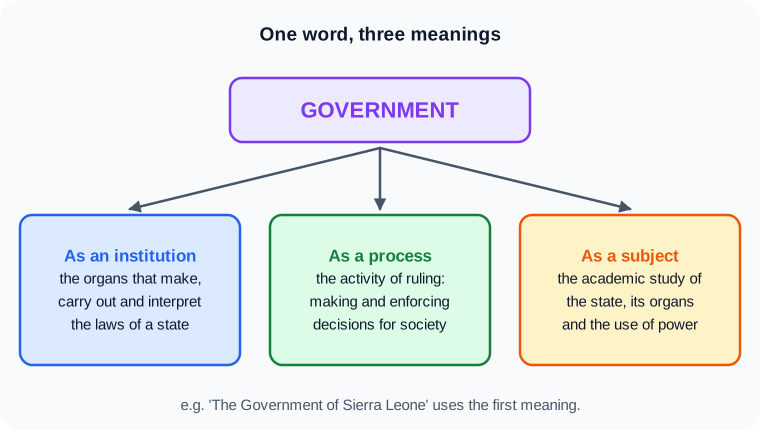
Figure 1. The word "government" has three meanings. WASSCE Tutor diagram.
| Meaning | What it refers to | Example |
|---|---|---|
| Government as an institution | The machinery or organs of the state that make, carry out and interpret laws: the legislature, executive and judiciary | "The Government of Sierra Leone has built new classrooms." |
| Government as a process (activity) | The act of governing: making rules, taking decisions, keeping order and providing services | Parliament debating a budget; a minister issuing regulations |
| Government as an academic subject | The systematic study of the state, its institutions and the use of power | The WASSCE subject you are now studying |
Government is the machinery through which the will of the state is formulated, expressed and carried out. It is the body of people and institutions with the authority to make and enforce laws for a society.
Characteristics of government
- It exercises authority and power: its decisions are binding on everyone in the state.
- It has a monopoly of legitimate force: only the government may lawfully use force, through the police and the armed forces.
- It is continuous: governments (the people in office) change, but the institution of government continues.
- It acts through people: officials, ministers, judges and civil servants carry out its work.
- It operates within a territory: its laws apply within the boundaries of the state.
- It is organised into organs: usually the legislature, the executive and the judiciary.
Why government is necessary
Without government, society would face what the philosopher Thomas Hobbes called a life that is "solitary, poor, nasty, brutish and short". Government is needed to:
- maintain law and order, so that people and property are safe
- defend the state against external attack, through the armed forces
- protect fundamental human rights and settle disputes through the courts
- provide social services: schools, hospitals, water, electricity and roads
- manage the economy: collect taxes, control money and banking, regulate trade, create jobs
- conduct foreign relations: represent the state abroad and join international bodies such as the UN and ECOWAS
- promote national unity among people of different ethnic groups, religions and regions
The functions of government
All the work of government can be grouped into three functions, each done mainly by one organ:
| Function | Organ | What it involves | In Sierra Leone |
|---|---|---|---|
| Legislative (rule-making) | The legislature | Making, amending and repealing laws; approving the budget | Parliament |
| Executive (rule-application) | The executive | Carrying out laws and policies; running ministries; defence and foreign policy | The President, Vice-President, ministers and civil service |
| Judicial (rule-adjudication) | The judiciary | Interpreting laws, settling disputes, punishing offenders | Supreme Court, Court of Appeal, High Court and lower courts |
Government and the state
The two words are often used as if they meant the same thing, but they do not.
| The state | The government |
|---|---|
| Permanent: it continues as long as the country exists | Temporary: the people in office change after elections or coups |
| Made up of all the people, the territory, the government and sovereignty | Only one element of the state: its machinery |
| Abstract: it cannot be seen | Concrete: its officials and buildings can be seen |
| Possesses sovereignty | Exercises sovereignty on behalf of the state |
| Membership is compulsory for citizens | Not every citizen is part of the government |
Planning a WASSCE essay answer. Question: "Highlight five reasons why government is necessary in a modern state."
- Write one sentence defining government.
- Give five separate points, each as a short heading followed by one or two sentences of explanation, for example: "Maintenance of law and order. Government makes laws and uses the police and courts to stop crime, so people can live and work in safety."
- Use a Sierra Leonean example in at least one point, such as Free Quality School Education under the provision of social services.
- Do not repeat the same idea in different words: "keeping peace" and "maintaining order" count as one point.
In 2018 the Government of Sierra Leone introduced Free Quality School Education, paying school fees in government and government-assisted schools. It shows all three meanings at once: an institution (the Ministry of Basic and Senior Secondary Education) carrying out a process (making and implementing a policy) that students of Government can analyse.
Do not confuse "the government" with "the ruling party". A party wins an election and forms the government of the day; the government itself is the permanent machinery of the state that continues when another party takes over.
Key points
- Government means an institution, a process and an academic subject.
- It has a monopoly of legitimate force, makes binding decisions and is continuous.
- Government is needed for law and order, defence, rights, services, the economy, foreign relations and unity.
- Its three functions are legislative (making laws), executive (carrying them out) and judicial (interpreting them).
- The state is permanent and abstract; the government is temporary and concrete, and is only one element of the state.
WASSCE examination focus
Expect to define government in its three senses, to state the functions or the importance of government, and to distinguish government from the state. Essay questions reward separate, well-explained points with examples; objective questions often test which organ performs which function.
Quick check
- State the three meanings of government.
- Which organ of government interprets the law?
- Give two differences between the state and the government.
- Name the three functions of government.
Answers:
- An institution, a process (activity) and an academic subject.
- The judiciary.
- Any two: the state is permanent while the government is temporary; the state is abstract while the government is concrete; the state possesses sovereignty while the government exercises it; the state includes all citizens while the government is only one element of it.
- Legislative (rule-making), executive (rule-application) and judicial (rule-adjudication).
Keep going with meaning and nature of government
This is one of 2 lessons in Meaning and Nature of Government. Start free with the first lesson of every topic, then unlock them all, plus exam-style practice marked instantly and guided learning tools, from 25 NLe.
- Free account, no card needed
- Everything from 25 NLe
- No automatic renewal
More lessons in Meaning and Nature of Government
- Key political concepts: power, authority, legitimacy and more🔒