WASSCE Government · Major Political Parties in Sierra Leone
The SLPP and the APC: formation, aims and record
By the WASSCE Tutor team
Updated 12 November 2026 · 6 min read · Prepared against the WASSCE syllabus.
Since independence, almost every elected government in Sierra Leone has been formed by one of two parties: the Sierra Leone People's Party (SLPP) or the All People's Congress (APC). Their rivalry has shaped elections, the constitution and even the country's experience of military rule. This lesson explains how the two parties were formed, what they stood for, where their support came from, and their records in government.
Learning objectives
By the end of this lesson you should be able to:
- describe the formation and early leadership of the SLPP and the APC
- state the aims and symbols of each party
- explain the bases of support of the two parties
- outline each party's periods in government and their main achievements and failures
Who has governed Sierra Leone?
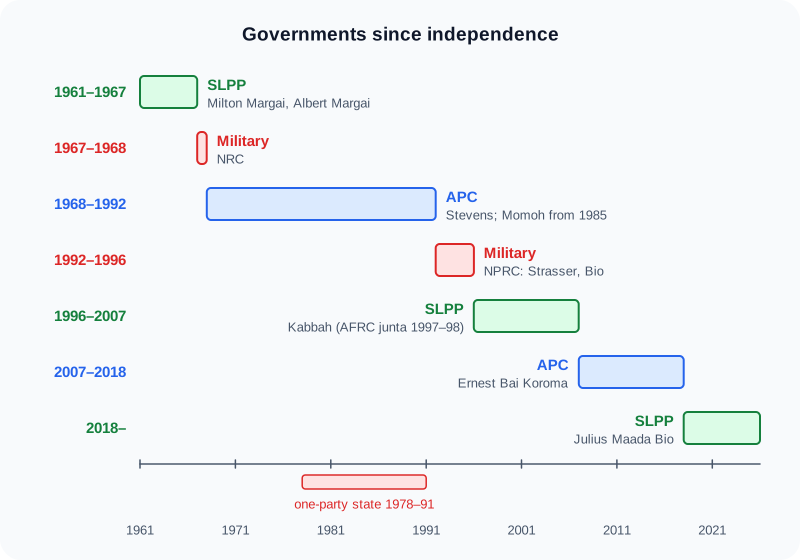
Figure 1. Governments since independence. WASSCE Tutor diagram.
The Sierra Leone People's Party (SLPP)
- Formed: 1951, by the merger of the Sierra Leone Organisation Society, the People's Party and members of the Protectorate Educational Progressive Union.
- Founding leader: Dr (later Sir) Milton Margai.
- Symbol and colour: the palm tree; green.
- Early aims: to unite the Colony and the Protectorate, to win self-government and independence by peaceful means, and to develop the Protectorate.
- Traditional base: strongest in the south and east, among Mende-speaking areas, with early support from Paramount Chiefs and the Protectorate educated elite.
SLPP in government:
| Period | Leader | Highlights |
|---|---|---|
| 1951–1964 | Sir Milton Margai | Led the country to independence (1961); moderate, consensus-building style |
| 1964–1967 | Sir Albert Margai | Expanded development projects; proposed a one-party state and republic; lost the 1967 election |
| 1996–2007 | Ahmad Tejan Kabbah | Elected during the war; overthrown by the AFRC in 1997 and restored in 1998; ended the civil war (2002); post-war reconstruction |
| 2018 onward | Julius Maada Bio | Free Quality School Education; abolition of the death penalty (2021); repeal of criminal libel (2020); move to PR elections (2023) |
The All People's Congress (APC)
- Formed: 1960, from the Elections Before Independence Movement, after Siaka Stevens refused to sign the Lancaster House agreement.
- Founding leader: Siaka Stevens.
- Symbol and colour: the rising sun; red.
- Early aims: to represent ordinary people, workers and youth; to oppose the SLPP's close links with chiefs and the elite; to make Sierra Leone a republic.
- Traditional base: strongest in the north and among urban workers in the Western Area.
APC in government:
| Period | Leader | Highlights |
|---|---|---|
| 1968–1985 | Siaka Stevens | Made Sierra Leone a republic (1971); introduced the one-party state (1978); hosted the OAU summit (1980); economic decline and corruption |
| 1985–1992 | Joseph Saidu Momoh | Severe economic crisis; restored multi-party politics in the 1991 Constitution; overthrown by the NPRC in 1992 |
| 2007–2018 | Ernest Bai Koroma | Won the 2007 election, a peaceful change of party; road building and energy projects; the Ebola epidemic (2014–2016) |
Comparing the two parties
| SLPP | APC | |
|---|---|---|
| Founded | 1951 | 1960 |
| Founder | Milton Margai | Siaka Stevens |
| Symbol / colour | Palm tree / green | Rising sun / red |
| Traditional strongholds | South and east | North and Western Area |
| Early image | Party of chiefs and the Protectorate elite | Party of workers, youth and "the common man" |
| Notable record | Independence; ending the civil war | Republic; one-party state; post-war infrastructure |
Sierra Leone has had two peaceful changes of ruling party through elections since the civil war: 2007, when the APC's Ernest Bai Koroma defeated the SLPP's Solomon Berewa in a run-off, and 2018, when the SLPP's Julius Maada Bio defeated the APC's Samura Kamara in a run-off. Both times the losing party accepted the result, strengthening democracy.
Do not describe either party as purely ethnic. Both have national support, and both have won votes and seats outside their traditional strongholds. However, voting patterns have often followed regional lines, which is a major challenge for national unity.
Key points
- SLPP: founded 1951, Milton Margai, palm tree, green; strongest in the south and east; led the country to independence and ended the war.
- APC: founded 1960, Siaka Stevens, rising sun, red; strongest in the north and Western Area; created the republic and the one-party state.
- Power has alternated: SLPP 1961–67, APC 1968–92, SLPP 1996–2007, APC 2007–18, SLPP from 2018.
WASSCE examination focus
Expect to describe the formation, aims and leaders of the SLPP and APC, to compare the two parties, and to assess their records in government. Questions also ask about the role of parties in Sierra Leone's democracy and the problem of regional voting.
Quick check
- When was the SLPP formed, and by whom?
- What is the symbol of the APC?
- Which party was in power when the civil war ended?
- In which years did power pass peacefully between the parties through elections after the war?
Answers:
- In 1951, under the leadership of Dr Milton Margai.
- The rising sun.
- The SLPP, under President Ahmad Tejan Kabbah.
- 2007 (SLPP to APC) and 2018 (APC to SLPP).
Keep going with major political parties in sierra leone
This is one of 2 lessons in Major Political Parties in Sierra Leone. Start free with the first lesson of every topic, then unlock them all, plus exam-style practice marked instantly and guided learning tools, from 25 NLe.
- Free account, no card needed
- Everything from 25 NLe
- No automatic renewal
More lessons in Major Political Parties in Sierra Leone
- Other parties and the party system in Sierra Leone🔒