WASSCE Government · Independence and the 1961 Constitution
The Independence Constitution of 1961: features
By the WASSCE Tutor team
Updated 12 November 2026 · 6 min read · Prepared against the WASSCE syllabus.
At independence in 1961, Sierra Leone did not write a new constitution from scratch. Its Independence Constitution, agreed at Lancaster House, was modelled closely on the British Westminster system: a monarch as head of state, a Prime Minister and Cabinet answerable to Parliament, and judges whose final court of appeal sat in London. This lesson explains the main features of the 1961 Constitution.
Learning objectives
By the end of this lesson you should be able to:
- explain how the 1961 Constitution came into being
- describe the structure of government under the 1961 Constitution
- state its main features
- explain the role of the Governor-General and the Prime Minister
Background
The 1961 Constitution was agreed at the Lancaster House conference in 1960 and brought into force by a British Order in Council. It came into effect on 27 April 1961, when Sierra Leone became an independent state and a member of the Commonwealth.
Structure of government
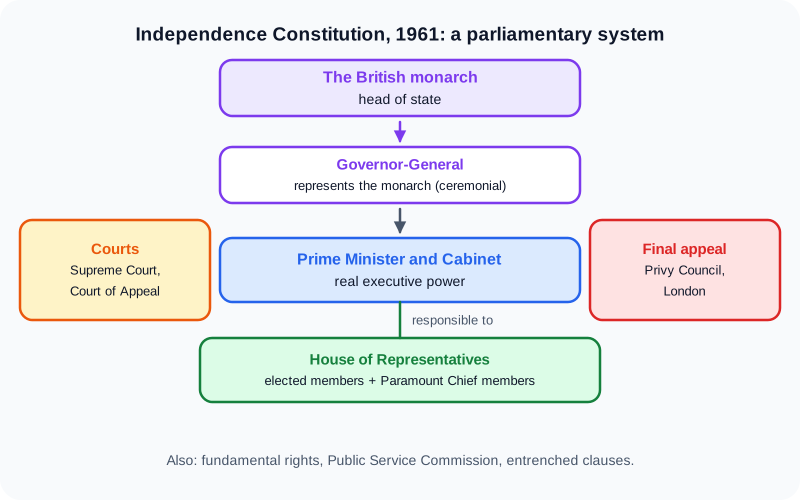
Figure 1. Independence Constitution, 1961. WASSCE Tutor diagram.
Features of the 1961 Constitution
- Parliamentary (Westminster) system of government.
- Head of state: the British monarch (Queen Elizabeth II), represented in Sierra Leone by a Governor-General with mainly ceremonial powers.
- Head of government: the Prime Minister, leader of the majority party in Parliament, appointed by the Governor-General.
- Cabinet of ministers drawn from Parliament and collectively responsible to it.
- Unicameral legislature: the House of Representatives, made up of elected members and Paramount Chief members (one from each district), with a Speaker.
- Fusion of powers: ministers were members of Parliament.
- Multi-party system, with an official opposition.
- Fundamental human rights protected in the constitution.
- Independent judiciary: a Supreme Court and a Court of Appeal, with final appeals to the Judicial Committee of the Privy Council in London.
- Public Service Commission and Judicial Service Commission to keep appointments free from politics.
- An Electoral Commission to conduct elections.
- Entrenched clauses protected by a special amendment procedure.
- Recognition of chieftaincy and customary law.
- Citizenship provisions for the new state.
The Governor-General and the Prime Minister
| Governor-General | Prime Minister |
|---|---|
| Represented the British monarch | Head of government |
| Ceremonial head of state in practice | Held real executive power |
| Appointed the Prime Minister: the person most likely to command a majority in the House | Leader of the majority party in Parliament |
| Acted on the advice of the Prime Minister, except in a few matters | Chose ministers and chaired the Cabinet |
| Assented to bills in the monarch's name | Answerable to Parliament; could be removed by a vote of no confidence |
The first Governor-General was Sir Maurice Dorman, and the first Prime Minister was Sir Milton Margai.
Under the 1961 Constitution the Governor-General's power to appoint the Prime Minister seemed a formality. But in March 1967, after a close general election, Governor-General Sir Henry Lightfoot Boston appointed Siaka Stevens of the APC as Prime Minister. The army commander, Brigadier David Lansana, intervened, and Sierra Leone's first period of military rule followed. The episode exposed how much depended on this "ceremonial" power.
At independence, Sierra Leone was not a republic. The British monarch remained head of state until 19 April 1971. Sierra Leone had a parliamentary system with a Prime Minister, not an executive President.
Key points
- The 1961 Constitution was agreed at Lancaster House (1960) and took effect on 27 April 1961.
- Westminster model: the British monarch as head of state through a Governor-General; the Prime Minister and Cabinet responsible to Parliament.
- House of Representatives: elected members plus Paramount Chief members.
- Multi-party, fundamental rights, independent judiciary with final appeal to the Privy Council.
- First Governor-General Sir Maurice Dorman; first Prime Minister Sir Milton Margai.
WASSCE examination focus
Expect to state the main features of the 1961 Independence Constitution, to explain the roles of the Governor-General and Prime Minister, and to identify the final court of appeal. Questions often ask you to compare the 1961 and 1971 constitutions.
Quick check
- Who was head of state under the 1961 Constitution?
- What was the final court of appeal under the 1961 Constitution?
- Name the first Prime Minister and the first Governor-General of independent Sierra Leone.
- State three features of the 1961 Constitution.
Answers:
- The British monarch (Queen Elizabeth II), represented by the Governor-General.
- The Judicial Committee of the Privy Council in London.
- Sir Milton Margai (Prime Minister) and Sir Maurice Dorman (Governor-General).
- Any three: parliamentary system; British monarch as head of state through a Governor-General; Prime Minister and Cabinet responsible to Parliament; House of Representatives with Paramount Chief members; multi-party system; fundamental rights; independent judiciary with Privy Council appeals; Public Service Commission; Electoral Commission; entrenched clauses; recognition of chieftaincy.
Keep going with independence and the 1961 constitution
This is one of 2 lessons in Independence and the 1961 Constitution. Start free with the first lesson of every topic, then unlock them all, plus exam-style practice marked instantly and guided learning tools, from 25 NLe.
- Free account, no card needed
- Everything from 25 NLe
- No automatic renewal
More lessons in Independence and the 1961 Constitution
- Strengths and weaknesses of the 1961 Constitution🔒