WASSCE Government · Fundamental Human Rights and Citizenship
Fundamental human rights: types, protection and limits
By the WASSCE Tutor team
Updated 12 November 2026 · 8 min read · Prepared against the WASSCE syllabus.
During Sierra Leone's civil war (1991–2002), civilians were killed, mutilated, abducted and forced into fighting. The country's recovery since then has been built partly on a promise that such abuses must never happen again. That promise rests on fundamental human rights: rights that every person has simply by being human. This lesson explains what these rights are, how they are classified and protected, and the limits placed on them.
Learning objectives
By the end of this lesson you should be able to:
- define fundamental human rights
- classify rights into civil and political, economic, social and cultural, and collective rights
- identify the rights protected by the 1991 Constitution of Sierra Leone
- explain how human rights are protected
- explain the limitations on human rights and the ways they are abused
What are human rights?
Fundamental human rights are the basic rights and freedoms that belong to every person because they are human, regardless of sex, ethnic group, religion, political opinion or social status. They are universal, inalienable (cannot be taken away arbitrarily) and usually guaranteed in the constitution.
Major international statements of rights:
- The Universal Declaration of Human Rights, adopted by the UN General Assembly on 10 December 1948 (now marked as Human Rights Day).
- The African Charter on Human and Peoples' Rights (the Banjul Charter), adopted by the Organisation of African Unity in 1981 and in force from 1986.
Categories of rights
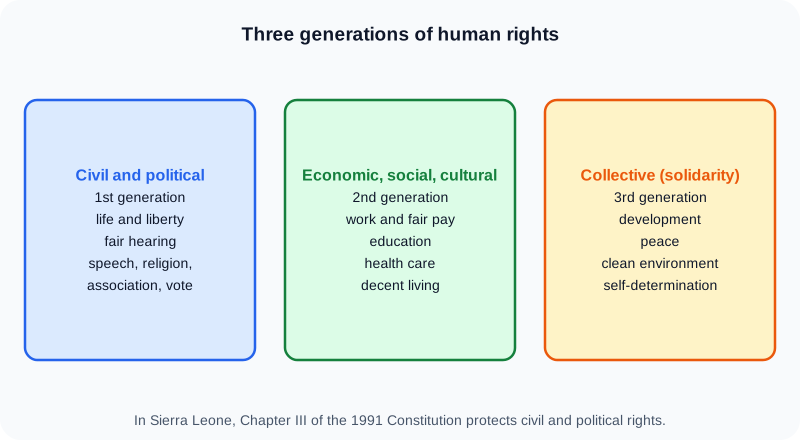
Figure 1. The three generations of human rights. WASSCE Tutor diagram.
| Category | Examples |
|---|---|
| Civil and political rights (first generation) | Life; personal liberty; fair hearing; freedom of speech, religion, assembly, association and movement; privacy; the right to vote and be voted for |
| Economic, social and cultural rights (second generation) | Work and fair wages; education; health care; social security; an adequate standard of living; taking part in cultural life |
| Collective or solidarity rights (third generation) | Development; peace; a healthy environment; self-determination of peoples |
Rights in the 1991 Constitution of Sierra Leone
Chapter III of the Constitution, "The Recognition and Protection of Fundamental Human Rights and Freedoms of the Individual", protects mainly civil and political rights, including:
- the right to life
- personal liberty, and protection from arbitrary arrest and detention
- freedom of movement
- protection from slavery and forced labour
- protection from torture and inhuman treatment
- protection from deprivation of property without compensation
- privacy of the home and other property
- a fair hearing (protection of the law)
- freedom of conscience and religion
- freedom of expression and the press
- freedom of assembly and association
- protection from discrimination
Chapter II, the Fundamental Principles of State Policy, sets out economic, social and educational goals, such as access to education and health care. Unlike Chapter III, these principles are not enforceable in court: they guide government policy.
How human rights are protected
- Entrenchment in the constitution, so that they cannot be removed easily.
- The courts: a person whose rights are violated can apply to the High Court for redress, and the court can order release, compensation or other remedies.
- Independent judiciary and the rule of law.
- The Human Rights Commission of Sierra Leone, set up by an Act of 2004, which investigates complaints and reports on the human rights situation.
- The Ombudsman, who investigates complaints of injustice by public officials.
- Legal aid for those who cannot afford a lawyer.
- A free press that exposes abuses.
- Civil society and pressure groups, such as human rights organisations, the Bar Association and women's groups.
- Regional and international bodies, such as the ECOWAS Court of Justice, the African Commission on Human and Peoples' Rights and the UN Human Rights Council.
- Civic education, so citizens know and claim their rights.
Limitations on human rights
Rights are not absolute. The Constitution allows them to be limited by law where reasonably required for:
- public safety, public order, public morality and public health
- national defence and security
- protecting the rights and freedoms of others
- a lawful state of public emergency
- the sentence or order of a court, such as imprisonment after conviction
- lawful arrest on reasonable suspicion of a crime
How rights are abused
- Arbitrary arrest and detention without trial
- Torture and brutality by security forces
- Restrictions on the press and opposition
- Rigged elections
- Discrimination against women, minorities or people with disabilities
- Military rule and civil war
Sierra Leone has strengthened rights protection in recent years. In 2020 Parliament repealed the criminal libel provisions of the Public Order Act 1965, which had been used to jail journalists. In 2021 it abolished the death penalty. The Gender Equality and Women's Empowerment Act 2022 sets a minimum 30% share for women in many elected and appointed positions, including Parliament.
Do not write that the right to free education or health care is enforceable in Sierra Leone's courts in the same way as freedom of speech. Social and economic goals are in Chapter II (Fundamental Principles of State Policy), which the courts do not enforce; enforceable rights are in Chapter III.
Key points
- Human rights are universal, inalienable rights that belong to every person.
- Three groups: civil and political, economic, social and cultural, and collective rights.
- Key documents: UDHR (10 December 1948); African Charter (1981); Chapter III of Sierra Leone's 1991 Constitution.
- Protected by entrenchment, the courts, the Human Rights Commission (2004), the Ombudsman, a free press and civil society.
- Limited for public safety, order, morality and health, the rights of others, emergencies and court orders.
WASSCE examination focus
Expect to list fundamental human rights in the Sierra Leone Constitution, to explain how they are protected, and to state the circumstances in which they can be limited. Questions may also ask about the UDHR and the African Charter, or how rights are abused under military rule.
Quick check
- When was the Universal Declaration of Human Rights adopted?
- Which chapter of the 1991 Constitution protects fundamental human rights?
- Name two bodies in Sierra Leone that help protect human rights.
- State two circumstances in which rights can lawfully be limited.
Answers:
- 10 December 1948, by the UN General Assembly.
- Chapter III.
- Any two: the courts (especially the High Court); the Human Rights Commission of Sierra Leone; the Ombudsman; the Legal Aid Board; the press; civil society organisations.
- Any two: public safety, order, morality or health; national security; protecting the rights of others; a state of public emergency; a court sentence; lawful arrest on reasonable suspicion.
Keep going with fundamental human rights and citizenship
This is one of 2 lessons in Fundamental Human Rights and Citizenship. Start free with the first lesson of every topic, then unlock them all, plus exam-style practice marked instantly and guided learning tools, from 25 NLe.
- Free account, no card needed
- Everything from 25 NLe
- No automatic renewal
More lessons in Fundamental Human Rights and Citizenship
- Citizenship: acquisition, rights, duties and loss🔒