WASSCE Government · Forms of Government
Unitary government: features, merits and demerits
By the WASSCE Tutor team
Updated 12 November 2026 · 7 min read · Prepared against the WASSCE syllabus.
Whether a bridge is built in Kailahun or a new school opens in Kambia, the final decision rests with the central government in Freetown, even when a district council does the work. That is because Sierra Leone is a unitary state. This lesson compares the three ways power can be divided between the centre and the parts of a state, then looks closely at the unitary system.
Learning objectives
By the end of this lesson you should be able to:
- distinguish unitary, federal and confederal systems
- define unitary government and state its features
- explain why states adopt a unitary system
- state the merits and demerits of unitary government
- give examples of unitary states
Three ways to divide power
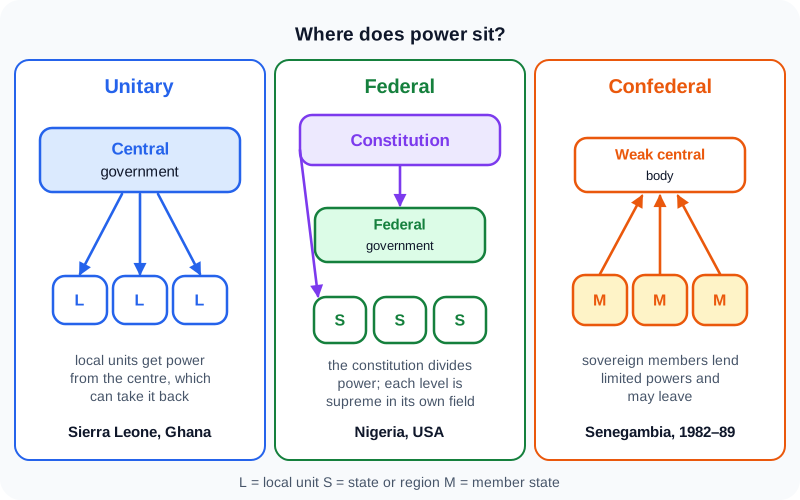
Figure 1. Where power sits in unitary, federal and confederal systems. WASSCE Tutor diagram.
| System | Where power lies | Examples |
|---|---|---|
| Unitary | All power belongs to the central government, which may delegate some to local bodies | Sierra Leone, Ghana, Liberia, Britain, France |
| Federal | The constitution divides power between a central (federal) government and regional (state) governments | Nigeria, USA, India, Canada |
| Confederal | Sovereign member states give a few powers to a weak central body | Senegambia Confederation (1982–1989); the early USA (1781–1789) |
Unitary government
A unitary government is one in which all powers of government are concentrated in a single central authority. Any local or regional authorities exist only because the centre created them, and the centre can enlarge, reduce or abolish their powers.
Features of a unitary government
- One central legislature makes laws for the whole country.
- Supremacy of the central government: local authorities are subordinate and act as its agents.
- Delegated, not divided, power: local bodies hold only the powers given to them by the centre.
- Single constitution, which may be written or unwritten and is often flexible.
- Single citizenship and uniform laws throughout the country.
- One system of courts, headed by a single supreme court.
Why states adopt a unitary system
- Small size of the territory, which can be governed from one centre
- Homogeneous population or a strong wish to build one nation from many ethnic groups
- Colonial inheritance: many former British colonies kept the unitary system they were ruled under
- Need for strong, quick decisions, especially in security and development
- Limited resources, which cannot support many levels of government
Merits
- Strong, stable government: decisions are made and carried out quickly.
- Promotes national unity: one set of laws and institutions binds all regions together.
- Less expensive: there is only one main government and legislature to pay for.
- Uniform laws and policies across the country, reducing confusion.
- No conflict between levels of government over powers.
- Easy to amend the constitution when change is needed.
Demerits
- Danger of dictatorship: concentrated power can be abused.
- Neglect of local needs: distant officials may not understand local problems.
- Overload at the centre: the central government becomes congested with work and slow.
- Weak local initiative: local communities wait for the centre to act.
- Unsuitable for large, diverse states: minority groups may feel ignored and dominated.
Sierra Leone is a unitary state. The Local Government Act 2004 created local councils (now 22 city, municipal and district councils) and passed some functions to them, such as primary health care and local markets. But Parliament created these councils, and Parliament can change their powers: power is delegated, not divided as in a federation.
Unitary or federal? Ghana has ten (now sixteen) regions with regional ministers. Is it federal?
No. Ghana's regions and their officers are created and controlled by the central government, and the constitution does not give them powers of their own. A state is federal only when the constitution itself divides power so that the regions hold powers the centre cannot take away.
Having local councils does not make a state federal. Every unitary state decentralises some work to local bodies; the test is whether the constitution guarantees separate powers to the regions.
Key points
- Unitary: all power at the centre, delegated to local bodies; federal: power divided by the constitution; confederal: sovereign members lend power to a weak centre.
- Features of unitary government: one legislature, central supremacy, delegated power, uniform laws, one court system.
- Adopted because of small size, desire for unity, colonial history, need for quick decisions, limited resources.
- Merits: strong, cheap, uniform, unifying; demerits: risk of dictatorship, neglect of local needs, overload at the centre.
- Sierra Leone is a unitary state with delegated local government.
WASSCE examination focus
Expect to define unitary government, to state its features, merits and demerits, and to compare it with federal government. Questions often ask why a small country like Sierra Leone adopted a unitary system.
Quick check
- In a unitary state, where does all governmental power lie?
- Give two reasons why a country may adopt a unitary system.
- State two demerits of unitary government.
- Name two unitary states in West Africa.
Answers:
- In the central government.
- Any two: small territory; desire for national unity; colonial inheritance; need for strong, quick decisions; limited resources.
- Any two: danger of dictatorship; neglect of local needs; overload at the centre; weak local initiative; unsuitable for large, diverse states.
- Any two: Sierra Leone, Ghana, Liberia, The Gambia, Senegal, Côte d'Ivoire.
Keep going with forms of government
This is one of 2 lessons in Forms of Government. Start free with the first lesson of every topic, then unlock them all, plus exam-style practice marked instantly and guided learning tools, from 25 NLe.
- Free account, no card needed
- Everything from 25 NLe
- No automatic renewal
More lessons in Forms of Government
- Federal and confederal government compared🔒