WASSCE Government · Elections and Electoral Systems
Elections: types, franchise and the conduct of elections
By the WASSCE Tutor team
Updated 12 November 2026 · 7 min read · Prepared against the WASSCE syllabus.
On polling day, a voter in Sierra Leone shows a voter ID card, receives ballot papers, marks them in a private booth and drops them into transparent boxes. That night, the votes are counted in front of party agents and observers. Each step is designed to make the result trustworthy. This lesson explains what elections are, the types of election, the franchise, how elections are conducted and what makes them free and fair.
Learning objectives
By the end of this lesson you should be able to:
- define an election and state its functions
- identify the types of election
- explain the franchise and universal adult suffrage
- describe the stages in the conduct of an election
- state the conditions for free and fair elections and identify electoral malpractices
What is an election?
An election is the process by which qualified citizens choose representatives to hold public office, such as President, Members of Parliament and councillors, by casting votes.
Functions of elections:
- Give legitimacy to government through the consent of the people.
- Allow a peaceful change of government.
- Make leaders accountable: voters can remove them.
- Enable political participation and political education.
- Recruit leaders into public office.
Types of election
| Type | Meaning |
|---|---|
| General election | Elections held throughout the country for the presidency, Parliament or councils at the end of their term |
| By-election | An election to fill a vacancy caused by the death, resignation or removal of a member |
| Primary election | An election within a party to choose its candidates |
| Run-off election | A second round between the leading candidates when no one wins the required share |
| Local government election | Elections for councillors, mayors and council chairpersons |
| Referendum | A direct vote by the electorate on a single question |
| Direct and indirect elections | Voters choose the officeholder themselves (direct) or choose people who then elect the officeholder (indirect) |
The franchise
The franchise (suffrage) is the right to vote. Universal adult suffrage means that all adult citizens can vote, regardless of sex, wealth, education, religion or ethnic group, subject only to reasonable conditions such as age and sanity.
In the past, many countries limited the franchise by property, income, literacy or sex. In Sierra Leone today, every citizen aged 18 or above who is of sound mind and registered may vote.
Arguments for universal adult suffrage: equality of all citizens; government by consent; political education; legitimacy. Arguments against (historically): illiterate voters may be misled; votes can be bought; the uninformed may choose poorly.
Conduct of elections
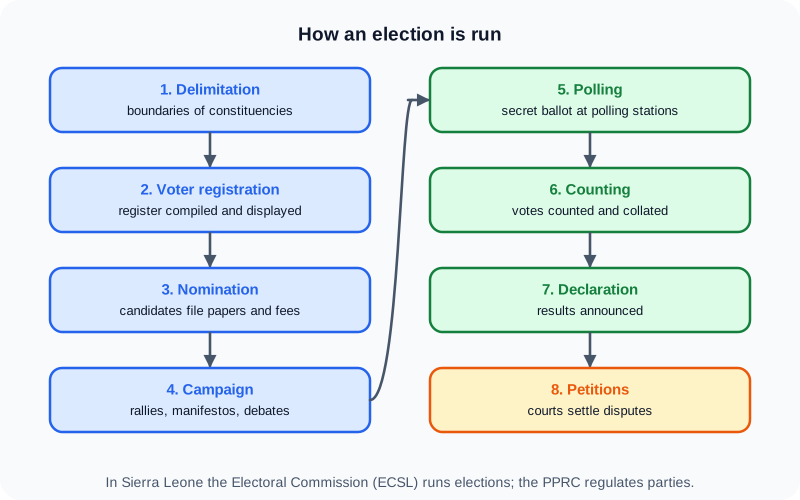
Figure 1. How an election is run. WASSCE Tutor diagram.
- Delimitation of constituencies and wards.
- Registration of voters, display of the provisional register for corrections, and issue of voter ID cards.
- Nomination of candidates, who file papers and pay fees.
- Campaigning by parties and candidates within set dates.
- Polling by secret ballot, supervised by electoral officials, with party agents and observers present.
- Counting and collation of votes, often at polling stations, then at district and national tally centres.
- Declaration of results by the electoral commission.
- Election petitions: disputes are settled in court.
Conditions for free and fair elections
- An independent and impartial electoral commission
- An accurate voters' register
- Secret ballot
- Universal adult suffrage
- Freedom to campaign and equal access to the media
- Neutral security forces
- Independent observers (local and international)
- Transparent counting and quick announcement of results
- Independent courts to hear petitions
- Political education of voters
Electoral malpractices
- Rigging: ballot stuffing, falsifying results
- Multiple voting and voting by under-age or unregistered people
- Vote buying and bribery of officials
- Intimidation and violence against voters and candidates
- Snatching of ballot boxes
- Misuse of state resources by the ruling party
- Manipulation of the register or of constituency boundaries (gerrymandering)
Sierra Leone's elections are run by the Electoral Commission for Sierra Leone (ECSL), known until 2022 as the National Electoral Commission. The Public Elections Act 2022 sets the rules. General elections, for the President, Parliament and local councils, are held together every five years; the most recent were on 24 June 2023. Observers from ECOWAS, the African Union, the European Union and local groups such as National Election Watch monitor the polls.
A by-election and a run-off are different. A by-election fills a vacant seat between general elections; a run-off is a second round held because no candidate won enough votes in the first round.
Key points
- An election is the choosing of representatives by vote; it gives legitimacy, accountability and peaceful change.
- Types: general, by-election, primary, run-off, local, referendum; direct or indirect.
- Universal adult suffrage: all adult citizens may vote (18 and above in Sierra Leone).
- Stages: delimitation → registration → nomination → campaign → polling → counting → declaration → petitions.
- Free and fair elections need an independent commission, accurate register, secret ballot, neutral security and observers.
WASSCE examination focus
Expect to define election and franchise, to distinguish types of election, to explain conditions for free and fair elections, and to list electoral malpractices and their remedies. Questions often ask for the functions of the electoral commission.
Quick check
- What is universal adult suffrage?
- What is a by-election?
- State three conditions for free and fair elections.
- What is the minimum voting age in Sierra Leone?
Answers:
- The right of all adult citizens to vote, regardless of sex, wealth, education, religion or ethnic group, subject only to conditions such as age and sanity.
- An election held to fill a vacancy in a legislature or council caused by death, resignation or removal of a member.
- Any three: independent electoral commission; accurate register; secret ballot; universal adult suffrage; freedom to campaign; neutral security forces; independent observers; transparent counting; independent courts; voter education.
- 18 years.
Keep going with elections and electoral systems
This is one of 2 lessons in Elections and Electoral Systems. Start free with the first lesson of every topic, then unlock them all, plus exam-style practice marked instantly and guided learning tools, from 25 NLe.
- Free account, no card needed
- Everything from 25 NLe
- No automatic renewal
More lessons in Elections and Electoral Systems
- Electoral systems and the electoral commission🔒