WASSCE Government · Democracy and Other Political Ideologies
Democracy: meaning, types, features and conditions
By the WASSCE Tutor team
Updated 12 November 2026 · 7 min read · Prepared against the WASSCE syllabus.
On election day in Sierra Leone, millions of people queue at polling stations, some from before dawn, to choose their President, Members of Parliament and local councillors. That act sits at the heart of democracy: government that rests on the will of the people. This lesson explains what democracy means, its types and features, the conditions it needs to survive, and its strengths and weaknesses.
Learning objectives
By the end of this lesson you should be able to:
- define democracy and explain Abraham Lincoln's definition
- distinguish direct and representative democracy
- explain the features (principles) of democracy
- state the conditions necessary for democracy to work
- state the merits and demerits of democracy
What is democracy?
Democracy is a system of government in which power belongs to the people, who rule either directly or through representatives chosen in free and fair elections. Abraham Lincoln (1863) described it as "government of the people, by the people, for the people."
The word comes from the Greek demos (people) and kratos (rule or power).
- Of the people: power comes from the people; the government's authority rests on their consent.
- By the people: the people take part in government, especially by voting.
- For the people: government serves the welfare of all citizens.
Types of democracy
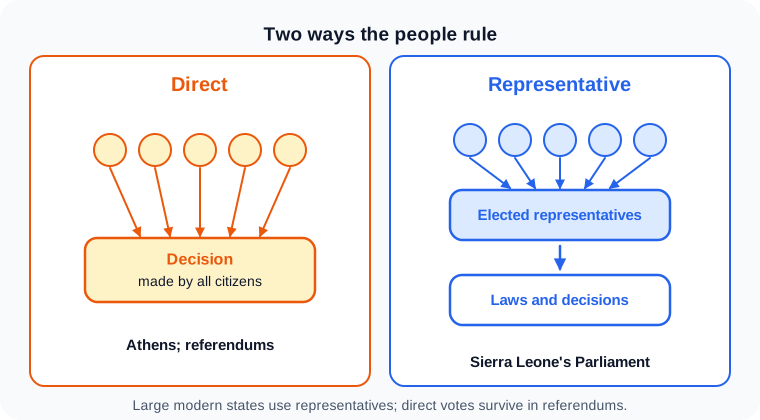
Figure 1. Direct and representative democracy. WASSCE Tutor diagram.
| Direct democracy | Representative (indirect) democracy |
|---|---|
| Citizens meet and decide public matters themselves | Citizens elect representatives to decide for them |
| Practical only in small communities | Practical in large modern states |
| Ancient Athens; referendums; town meetings | Sierra Leone, Ghana, Britain, the USA |
Modern states sometimes add direct elements to representative democracy through referendums (a vote by the electorate on a single question). Sierra Leone held a referendum in 1991 to approve a return to multi-party democracy.
Other terms you may meet: liberal democracy (stresses individual rights, free markets and limited government) and social democracy (stresses equality and welfare through government action).
Features (principles) of democracy
- Popular sovereignty: final power rests with the people.
- Periodic free and fair elections with universal adult suffrage and a secret ballot.
- Majority rule with minority rights: the majority decides, but minorities are protected.
- Rule of law: everyone, including leaders, is subject to the law.
- Protection of fundamental human rights: freedom of speech, association, religion and movement.
- Multi-party system and an opposition that can criticise and replace the government.
- Independent judiciary to protect rights and interpret the law.
- Free press that informs the public and holds leaders to account.
- Separation of powers with checks and balances.
- Accountability and transparency of public officials.
Conditions for democracy to work
- An educated and politically aware citizenry that understands its rights and duties
- A strong economy and a reasonable standard of living, so votes are not easily bought
- Tolerance of opposing views and acceptance of election results
- Independent and impartial institutions: electoral commission, judiciary, police and press
- A democratic political culture among leaders and citizens
- Political neutrality of the armed forces
- Strong civil society: pressure groups, trade unions and religious bodies
Merits and demerits
| Merits | Demerits |
|---|---|
| Government rests on consent, so it is legitimate | Decisions can be slow, because many people are consulted |
| Protects rights and freedoms | Elections are expensive |
| Peaceful change of government through elections | The majority may oppress minorities ("tyranny of the majority") |
| Encourages participation and political education | Voters may lack the knowledge to judge complex issues |
| Leaders are accountable and can be removed | Can encourage ethnic or regional voting and division |
| Reduces the risk of violent revolution | Votes can be bought; money can dominate politics |
Sierra Leone returned to multi-party democracy under the 1991 Constitution. Since the end of the civil war in 2002 it has held regular elections, including the peaceful transfer of power between parties in 2007 (SLPP to APC) and 2018 (APC to SLPP). Peaceful changes of government through the ballot box are one of the strongest signs that democracy is taking root.
Answering "State five conditions necessary for democracy." Give each condition a heading, then one sentence explaining why it matters:
- Independent electoral commission: so that elections are run fairly and losers accept the results.
- Political tolerance: so that opponents are not attacked and can campaign freely.
- Educated citizens: so that voters understand the issues and cannot easily be misled.
- Free press: so that citizens get accurate information and leaders are scrutinised.
- Neutral armed forces: so that soldiers do not overthrow elected governments.
Democracy is not simply majority rule. A government that wins elections but ignores the rule of law, silences the press and persecutes opponents is not democratic: minority rights and limits on power are part of democracy.
Key points
- Democracy is "government of the people, by the people, for the people" (Abraham Lincoln).
- Direct democracy (citizens decide) versus representative democracy (citizens elect representatives); referendums add a direct element.
- Features: popular sovereignty, free and fair elections, majority rule with minority rights, rule of law, rights, opposition, independent judiciary, free press, accountability.
- Needs education, tolerance, independent institutions, economic stability and a neutral military.
- Sierra Leone: 1991 referendum and Constitution; peaceful transfers of power in 2007 and 2018.
WASSCE examination focus
Expect to define democracy, to explain its features or principles, to distinguish direct from representative democracy, and to state conditions for democracy. Essay questions often ask about obstacles to democracy in West Africa: answer with conditions that are missing (such as poverty, illiteracy, rigging and military intervention).
Quick check
- Who defined democracy as "government of the people, by the people, for the people"?
- What is a referendum?
- State three features of democracy.
- Give two demerits of democracy.
Answers:
- Abraham Lincoln.
- A direct vote by the electorate on a single question, such as approving a new constitution.
- Any three: popular sovereignty; periodic free and fair elections; majority rule with minority rights; rule of law; protection of human rights; a multi-party system and opposition; an independent judiciary; a free press; separation of powers; accountability.
- Any two: slow decision-making; expensive elections; tyranny of the majority; ill-informed voters; ethnic or regional voting; vote-buying.
Keep going with democracy and other political ideologies
This is one of 2 lessons in Democracy and Other Political Ideologies. Start free with the first lesson of every topic, then unlock them all, plus exam-style practice marked instantly and guided learning tools, from 25 NLe.
- Free account, no card needed
- Everything from 25 NLe
- No automatic renewal
More lessons in Democracy and Other Political Ideologies
- Political ideologies: capitalism, socialism, communism and fascism🔒