WASSCE Government · Constitutions
Constitutions: meaning, sources and types
By the WASSCE Tutor team
Updated 12 November 2026 · 7 min read · Prepared against the WASSCE syllabus.
Every club, school prefect body and football association has rules saying who leads it, how leaders are chosen and what members may do. A state needs the same, on a much larger scale. Its constitution is the highest law: it creates the organs of government, shares out their powers and protects the rights of citizens. This lesson explains what a constitution is, where its rules come from, the types of constitution and the features of a good one.
Learning objectives
By the end of this lesson you should be able to:
- define a constitution and explain its importance
- explain the sources of a constitution
- distinguish the main types of constitution
- state the features of a good constitution
- describe the main contents of Sierra Leone's 1991 Constitution
What is a constitution?
A constitution is the body of fundamental rules, laws and principles by which a state is governed. It sets out the structure and powers of the organs of government, the relationship between them, and the rights and duties of citizens.
A constitution is often called the supreme law (the grundnorm) of the land: any other law that conflicts with it is void to the extent of the conflict.
Importance (functions) of a constitution
- Establishes the organs of government and their powers.
- Limits the powers of government, preventing arbitrary rule.
- Protects fundamental human rights.
- Defines the relationship between the government and the governed.
- Provides for the transfer of power, for example through elections.
- Defines citizenship and national symbols.
- Provides stability and a framework for settling disputes.
- Sets out how it can be amended.
Sources of a constitution
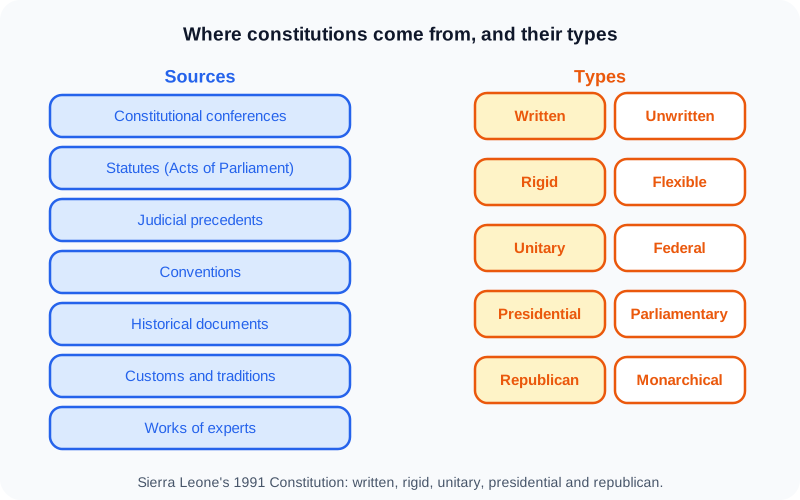
Figure 1. Where constitutions come from, and their types. WASSCE Tutor diagram.
| Source | Explanation |
|---|---|
| Constitutional conferences and constituent assemblies | Representatives meet to draft or agree a constitution, for example the Lancaster House conference of 1960 before Sierra Leone's independence |
| Statutes (Acts of Parliament) | Laws that deal with constitutional matters, such as electoral laws |
| Judicial precedents | Court decisions interpreting the constitution |
| Conventions | Unwritten customs and practices that are followed as if binding, especially in Britain |
| Historical documents | Such as Magna Carta (1215) and the Bill of Rights (1689) in Britain |
| Customs and traditions | Long-standing practices of the people |
| Works of constitutional experts | Writings of scholars such as A. V. Dicey |
| Referendums and decrees | Popular votes, or decrees issued by military governments |
Types of constitution
| Type | Meaning | Example |
|---|---|---|
| Written | Contained mainly in one document | Sierra Leone, USA, Nigeria |
| Unwritten | Not contained in one document; found in statutes, conventions and judicial decisions | Britain |
| Rigid | Requires a special, difficult procedure to amend | Sierra Leone, USA |
| Flexible | Can be amended by the ordinary law-making process | Britain |
| Unitary | Concentrates power in a central government | Sierra Leone, Ghana |
| Federal | Divides power between central and state governments | Nigeria, USA |
| Presidential | Provides for an executive president | Sierra Leone, USA |
| Parliamentary | Provides for a cabinet responsible to parliament | Britain, India |
| Republican | Head of state is elected | Sierra Leone since 1971 |
| Monarchical | Head of state is a hereditary monarch | Britain, Saudi Arabia |
Written and unwritten compared
| Written | Unwritten |
|---|---|
| Found in one document | Found in many sources |
| Usually rigid | Usually flexible |
| Clear and certain; easy to consult | Can adapt easily to change |
| May be too rigid to meet new needs | Can be changed easily by the ruling party |
| Courts can check unconstitutional laws | Parliament is supreme |
Features of a good constitution
- Clear and precise language, so its meaning is not easily disputed
- Comprehensive, covering all essential matters
- Protects fundamental human rights
- Provides for separation of powers and checks and balances
- Adaptable: neither too rigid nor too flexible
- Has the support (legitimacy) of the people
- Provides an independent judiciary
- Reflects the history and needs of the society
Sierra Leone's 1991 Constitution
The 1991 Constitution (Act No. 6 of 1991) was approved in a referendum in 1991 and came into force on 1 October 1991, restoring multi-party democracy after the one-party Constitution of 1978. Its main parts include:
- Chapter II: Fundamental Principles of State Policy
- Chapter III: Fundamental Human Rights and Freedoms
- Chapter V: The Executive
- Chapter VI: The Legislature
- Chapter VII: The Judiciary
It also provides for the Ombudsman, finance, the public service, the police and armed forces, chieftaincy, and the procedure for amendment.
Sierra Leone has had several constitutions: the Independence Constitution of 1961, the Republican Constitution of 1971, the One-Party Constitution of 1978 and the 1991 Constitution. A Constitutional Review Commission reviewed the 1991 Constitution and reported in 2016, and debate about reforming it continues. Later lessons in this course examine each of these constitutions in detail.
"Unwritten constitution" does not mean that nothing is written down. Britain's constitution includes many written statutes and court judgments; it is called unwritten because it is not collected in a single document.
Key points
- A constitution is the body of fundamental rules by which a state is governed; it is the supreme law.
- Sources: conferences, statutes, precedents, conventions, historical documents, customs, experts' works.
- Types: written/unwritten, rigid/flexible, unitary/federal, presidential/parliamentary, republican/monarchical.
- Sierra Leone's 1991 Constitution is written, rigid, unitary, presidential and republican.
WASSCE examination focus
Expect to define a constitution, to state its sources and functions, to distinguish written and unwritten, rigid and flexible constitutions with merits and demerits, and to describe the features of a good constitution. Questions on Sierra Leone often ask you to classify the 1991 Constitution.
Quick check
- What is a constitution?
- Give two sources of a constitution.
- Why is Britain's constitution described as unwritten?
- When did Sierra Leone's 1991 Constitution come into force?
Answers:
- The body of fundamental rules, laws and principles by which a state is governed, setting out the organs of government, their powers and the rights of citizens.
- Any two: constitutional conferences or assemblies; statutes; judicial precedents; conventions; historical documents; customs and traditions; works of experts; referendums or decrees.
- Because its rules are not collected in a single document but found in statutes, conventions, judicial decisions and historical documents.
- 1 October 1991.
Keep going with constitutions
This is one of 2 lessons in Constitutions. Start free with the first lesson of every topic, then unlock them all, plus exam-style practice marked instantly and guided learning tools, from 25 NLe.
- Free account, no card needed
- Everything from 25 NLe
- No automatic renewal
More lessons in Constitutions
- Rigid and flexible constitutions, amendment and constitutionalism🔒