WASSCE Government · Colonial Constitutions of Sierra Leone
Early colonial constitutions: 1863 and the Slater Constitution of 1924
By the WASSCE Tutor team
Updated 12 November 2026 · 6 min read · Prepared against the WASSCE syllabus.
In the early Colony, the Governor ruled with a few British officials, and Sierra Leoneans had almost no say in making the laws that governed them. Change came slowly, through a series of colonial constitutions that gradually admitted Africans into government. This lesson covers the first two milestones: the 1863 Constitution, which created the Executive and Legislative Councils, and the 1924 Slater Constitution, which introduced the first elected members.
Learning objectives
By the end of this lesson you should be able to:
- describe Crown Colony government in Sierra Leone
- state the features of the 1863 Constitution
- state the features, merits and demerits of the 1924 Slater Constitution
- explain the importance of these constitutions in Sierra Leone's political development
Crown Colony government
Crown Colony government was the system under which a British colony was ruled by a Governor appointed by the British Crown, assisted by councils made up mainly of colonial officials, with final authority resting with the Secretary of State for the Colonies in London.
The 1863 Constitution
In 1863, letters patent created two councils for the Colony of Sierra Leone:
| Council | Composition | Functions |
|---|---|---|
| Executive Council | The Governor and senior colonial officials | Advised the Governor on administration and policy |
| Legislative Council (LegCo) | The Governor, official members and a few nominated unofficial members | Made laws (ordinances) for the Colony, subject to the Governor's approval and London's control |
Features of the 1863 Constitution:
- The Governor presided over both councils and had a veto over legislation.
- Official majority in the Legislative Council: colonial officials outnumbered unofficial members.
- Unofficial members were nominated by the Governor, not elected; some were Krio merchants and professionals.
- Laws applied only to the Colony.
- The British Crown could disallow any ordinance.
Significance: for the first time, a few Africans sat in the colonial legislature, even though they had little power.
The 1924 Slater Constitution
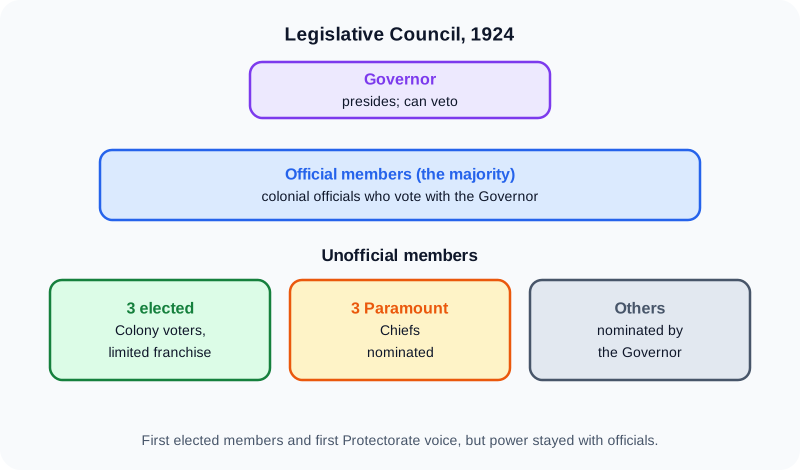
Figure 1. The Legislative Council under the 1924 Slater Constitution. WASSCE Tutor diagram.
The constitution introduced under Governor Alexander Ransford Slater in 1924 followed demands by the National Congress of British West Africa (NCBWA) for elected representation.
Features:
- The Legislative Council kept an official majority.
- For the first time, three members were elected: two for Freetown and one for the rural area of the Colony.
- The franchise was limited by income or property and literacy, so few people could vote.
- Three Paramount Chiefs were nominated to represent the Protectorate: the first Protectorate representation in the legislature.
- Other unofficial members were nominated by the Governor.
- The Governor presided and kept veto and reserved powers.
- The Executive Council remained made up of officials.
Merits
- Introduced the elective principle into Sierra Leone's government for the first time.
- Gave the Protectorate a voice in the legislature for the first time.
- Encouraged political activity: the NCBWA won all three elected seats in 1924.
- Brought Colony and Protectorate representatives together in one council.
Demerits
- The official majority meant officials could always outvote Africans.
- Limited franchise: only a small, wealthy, educated minority could vote.
- Paramount Chiefs were nominated, not elected, and could not easily oppose the Governor who appointed them.
- The Protectorate, with most of the population, had only three nominated members.
- The Governor's veto and London's control remained.
- No African in the Executive Council.
The three elected seats in 1924 were all won by candidates of the National Congress of British West Africa, whose Sierra Leone section included the Krio doctor and politician H. C. Bankole-Bright. He became one of the most outspoken members of the Legislative Council and, in 1950, founded the National Council of Sierra Leone.
The 1924 constitution introduced elections but not an African majority or African control. Officials still held the majority. The first constitution to give Africans a majority in the Legislative Council was the 1951 constitution.
Key points
- Crown Colony government: a Governor ruling with councils of officials, under London.
- 1863: Executive and Legislative Councils created; official majority; nominated unofficial members; Governor's veto.
- 1924 Slater Constitution: first 3 elected members (Colony, limited franchise); 3 Paramount Chiefs nominated for the Protectorate; official majority retained.
- The NCBWA won the first elections; Bankole-Bright was a leading member.
WASSCE examination focus
Expect to state the features of the 1863 and 1924 constitutions, to give the merits and demerits of the Slater Constitution, and to explain its importance in Sierra Leone's constitutional development. Questions often ask what was "new" in 1924: the elective principle and Protectorate representation.
Quick check
- Which two councils did the 1863 Constitution create?
- How many elected members did the 1924 Constitution introduce?
- How was the Protectorate represented under the 1924 Constitution?
- State two demerits of the Slater Constitution.
Answers:
- The Executive Council and the Legislative Council.
- Three, elected by voters in the Colony.
- By three Paramount Chiefs nominated by the Governor.
- Any two: official majority; limited franchise; Paramount Chiefs nominated, not elected; Protectorate under-represented; Governor's veto retained; no African in the Executive Council.
Keep going with colonial constitutions of sierra leone
This is one of 2 lessons in Colonial Constitutions of Sierra Leone. Start free with the first lesson of every topic, then unlock them all, plus exam-style practice marked instantly and guided learning tools, from 25 NLe.
- Free account, no card needed
- Everything from 25 NLe
- No automatic renewal
More lessons in Colonial Constitutions of Sierra Leone
- The 1951, 1956 and 1958 constitutions: towards self-government🔒