WASSCE Government · African Union, ECOWAS, and Regional Cooperation
From the OAU to the African Union
By the WASSCE Tutor team
Updated 12 November 2026 · 7 min read · Prepared against the WASSCE syllabus.
On 25 May 1963, leaders of 32 independent African states met in Addis Ababa, Ethiopia, and founded the Organisation of African Unity (OAU). Its great cause was ending colonial rule and apartheid. Nearly forty years later, Africa's leaders replaced it with the African Union (AU), which aims at deeper unity, development and peace. This lesson explains the OAU and the AU, how they differ, and what they have achieved.
Learning objectives
By the end of this lesson you should be able to:
- explain the origin, aims and principles of the OAU
- describe the organs of the OAU and its achievements and failures
- explain why the OAU was replaced by the African Union
- describe the aims and organs of the AU
- compare the OAU and the AU
The Organisation of African Unity (OAU)
- Founded: 25 May 1963, in Addis Ababa, by 32 independent states. The date is celebrated as Africa Day.
- Leading figures: Emperor Haile Selassie (Ethiopia), Kwame Nkrumah (Ghana), Julius Nyerere (Tanzania), Sékou Touré (Guinea) and others.
- Sierra Leone was a founding member.
Aims:
- To promote the unity and solidarity of African states.
- To coordinate cooperation to improve the lives of Africans.
- To defend the sovereignty, territorial integrity and independence of members.
- To eradicate all forms of colonialism from Africa.
- To promote international cooperation, respecting the UN Charter.
Principles: sovereign equality of members; non-interference in internal affairs; respect for territorial integrity; peaceful settlement of disputes; condemnation of political assassination and subversion; dedication to the liberation of dependent territories; non-alignment.
Organs: the Assembly of Heads of State and Government; the Council of Ministers; the General Secretariat; the Commission of Mediation, Conciliation and Arbitration; and the Liberation Committee, which supported freedom movements.
| Achievements of the OAU | Failures of the OAU |
|---|---|
| Helped end colonialism in Africa and supported liberation movements | Non-interference stopped it acting against dictators and civil wars |
| Helped end apartheid in South Africa | Could not prevent coups and genocide (Rwanda, 1994) |
| Gave Africa a common voice at the UN | Poor funding: many members did not pay their dues |
| Settled some border disputes | No army to enforce decisions |
| Respected colonial borders, avoiding endless border wars | Divisions among members |
The African Union (AU)
Why the OAU was replaced: the end of colonialism and apartheid had achieved its main aims; Africa needed a body that could deal with civil wars, coups, human rights abuses and economic development.
- The Sirte Declaration (Libya, 9 September 1999) called for a new union.
- The Constitutive Act was adopted at Lomé in 2000.
- The AU was launched in Durban, South Africa, on 9 July 2002.
- Headquarters: Addis Ababa. Members: all 55 African states.
Aims: greater unity; defending sovereignty; accelerating political and economic integration; promoting peace, security and stability; promoting democracy, human rights and good governance; promoting sustainable development.
Organs:
| Organ | Role |
|---|---|
| Assembly of Heads of State and Government | Supreme organ |
| Executive Council of ministers | Coordinates policy |
| AU Commission | Secretariat, headed by a Chairperson |
| Pan-African Parliament | Consultative parliament, in Midrand, South Africa |
| Peace and Security Council | Responds to conflicts and crises |
| African Court on Human and Peoples' Rights | Rules on human rights cases |
| Economic, Social and Cultural Council | Voice of civil society |
OAU and AU compared
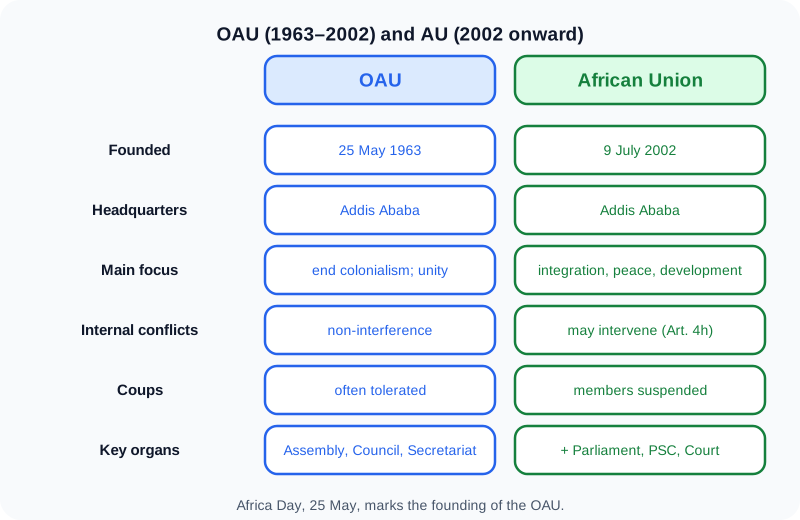
Figure 1. The OAU and the AU compared. WASSCE Tutor diagram.
The AU's Constitutive Act, Article 4(h), gives it the right to intervene in a member state in grave circumstances: war crimes, genocide and crimes against humanity. It also suspends governments that come to power unconstitutionally, as it has done after coups in several West African states.
Major AU programmes: Agenda 2063 (a long-term plan for Africa's development); the African Continental Free Trade Area (AfCFTA); peace-support operations; and the African Peer Review Mechanism.
Sierra Leone hosted the OAU summit in Freetown in 1980, and President Siaka Stevens served as OAU chairman. Under the AU, Sierra Leone coordinates the Committee of Ten (C-10), the group of heads of state that leads Africa's campaign for reform of the UN Security Council, including permanent seats for Africa.
The OAU was founded in 1963 and the AU in 2002. Do not mix up the dates, and remember that the AU, unlike the OAU, can intervene in grave cases and suspends coup governments.
Key points
- OAU: founded 25 May 1963, Addis Ababa, 32 states; aims: unity, sovereignty, end colonialism; principle of non-interference.
- OAU successes: decolonisation, end of apartheid; failures: coups, civil wars, poor funding, no army.
- AU: Sirte Declaration (1999), Constitutive Act (2000), launched 9 July 2002 in Durban; 55 members.
- AU organs: Assembly, Executive Council, Commission, Pan-African Parliament, Peace and Security Council, African Court.
- AU can intervene (Article 4(h)) and suspends unconstitutional governments; programmes: Agenda 2063, AfCFTA.
WASSCE examination focus
Expect to state the aims and principles of the OAU, to explain its achievements and failures, to explain why it was replaced by the AU, and to compare the two. Questions often ask about the AU's organs and its role in conflict resolution.
Quick check
- When and where was the OAU founded?
- State two achievements of the OAU.
- When was the African Union launched?
- Give one important difference between the OAU and the AU.
Answers:
- On 25 May 1963, in Addis Ababa, Ethiopia.
- Any two: helped end colonialism; helped end apartheid; gave Africa a common voice; settled some border disputes; preserved existing borders.
- On 9 July 2002, in Durban, South Africa.
- The OAU followed strict non-interference, while the AU can intervene in cases of war crimes, genocide and crimes against humanity and suspends governments that seize power unconstitutionally.
Keep going with african union, ecowas, and regional cooperation
This is one of 2 lessons in African Union, ECOWAS, and Regional Cooperation. Start free with the first lesson of every topic, then unlock them all, plus exam-style practice marked instantly and guided learning tools, from 25 NLe.
- Free account, no card needed
- Everything from 25 NLe
- No automatic renewal
More lessons in African Union, ECOWAS, and Regional Cooperation
- ECOWAS, the Mano River Union and NEPAD🔒