WASSCE Economics · Supply
What supply is and the law of supply
By the WASSCE Tutor team
Updated 12 November 2026 · 7 min read · Prepared against the WASSCE syllabus.
When the price of pepper doubles, farmers who had been selling to neighbours start hiring transport to Freetown. Higher prices call out more goods. This lesson turns that behaviour into the supply schedule, the supply curve and the law of supply.
Learning objectives
By the end of this lesson you should be able to:
- define supply and distinguish it from stock
- draw a supply schedule and a supply curve
- build a market supply schedule from individual schedules
- state the law of supply and explain why the supply curve slopes upwards
- explain how supply responds over time
What is supply?
Supply is the quantity of a good or service that producers are willing and able to offer for sale at a given price, over a given period of time.
Supply is not the same as stock
Stock is the total quantity of a good that a producer or trader has at a given time. Supply is the part of that stock that is actually offered for sale at a particular price.
A rice trader in Bo may have 200 bags in her store (her stock). At NLe 400 a bag she may be willing to sell only 80 bags (her supply at that price), keeping the rest in the hope that the price will rise later.
The supply schedule
A supply schedule is a table showing the quantities of a good that producers will offer for sale at different prices.
Weekly supply of bunches of plantain to a market in Kenema
| Price per bunch (NLe) | Quantity supplied (bunches) |
|---|---|
| 5 | 20 |
| 10 | 40 |
| 15 | 60 |
| 20 | 80 |
| 25 | 100 |
| 30 | 120 |
As the price rises, farmers bring more bunches to market.
The market supply schedule adds up the quantities offered by all producers at each price.
From individual to market supply. Two farmers sell plantain at a weekly market:
| Price (NLe) | Farmer A | Farmer B | Market supply |
|---|---|---|---|
| 10 | 15 | 25 | 40 |
| 15 | 25 | 35 | 60 |
| 20 | 35 | 45 | 80 |
At NLe 15 the market supply is bunches. Like market demand, market supply is the horizontal sum of the individual curves.
The supply curve
With price on the vertical axis and quantity supplied on the horizontal axis, plot the schedule and join the points. The result is the supply curve, labelled S. It slopes upwards from left to right.
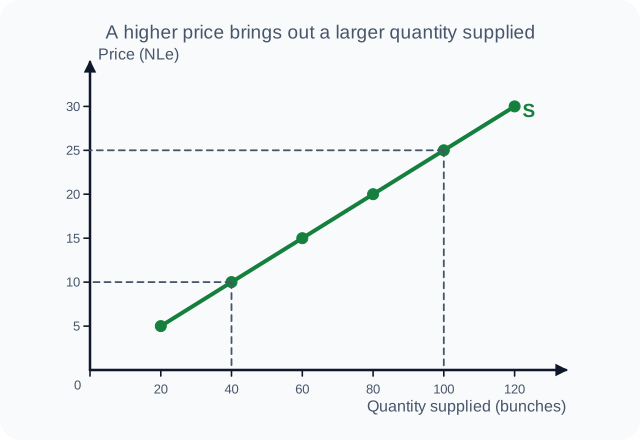
Figure 1. The supply curve for plantain, drawn from the schedule. WASSCE Tutor diagram.
A rise in price from NLe 10 to NLe 25 moves sellers up the curve from 40 to 100 bunches: an extension of supply. A fall in price causes a contraction of supply.
The law of supply
The law of supply states that, other things being equal, the higher the price of a good, the greater the quantity supplied; and the lower the price, the smaller the quantity supplied.
Price and quantity supplied move in the same direction: a direct (positive) relationship.
Why the supply curve slopes upwards
- Higher profit. A higher price makes the good more profitable, so producers want to sell more of it.
- Covering higher costs. Producing more often costs more per unit (diminishing returns), so producers will supply extra only if the price is higher.
- New producers. A higher price attracts new firms or farmers into the market.
- Switching production. Producers move resources from less profitable goods into the one whose price has risen.
- Releasing stock. Traders holding stock sell more of it when the price rises.
When the price of palm oil rises, farmers harvest more of their palm trees, women who process oil work longer hours, and traders release the drums they have been keeping in store. The quantity of palm oil supplied rises.
Do not write that "supply increases when price rises". A rise in the good's own price increases the quantity supplied: a movement along the supply curve. "Supply increases" means the whole curve shifts to the right, which needs another cause (see the next lesson).
Supply over time
How much supply can respond to a price change depends on the time producers have:
| Period | What can change | Supply |
|---|---|---|
| Momentary (market) period | Nothing: only goods already on hand can be sold | Fixed; the curve is vertical. Fish landed at Tombo this morning cannot be increased today |
| Short run | Variable factors (labour, fertiliser, hours) can be increased; land and machinery cannot | Rises a little; the curve is steep |
| Long run | All factors can change; new firms can enter and new land can be cleared | Rises a lot; the curve is flatter |
This is why a sudden rise in the price of a farm crop brings only a small increase in supply at first, and a much larger one after the next planting season.
Key points
- Supply = the quantity producers are willing and able to offer for sale at a given price, over a period.
- Stock is everything held; supply is what is offered at a price.
- A supply curve slopes upwards.
- The law of supply: price up, quantity supplied up (other things being equal).
WASSCE examination focus
Expect to define supply, distinguish supply from stock, state the law of supply and draw a supply curve from a schedule. Give each answer the same care as for demand: labelled axes, a labelled curve S, and other things being equal in the statement of the law.
Quick check
- A fisherman has 50 fish but offers only 30 for sale at today's price. Which figure is his supply, and which his stock?
- From the schedule above, how many bunches are supplied at NLe 20?
- Give two reasons why the supply curve slopes upwards.
Answers: 1. Supply: 30 fish; stock: 50 fish. 2. 80 bunches. 3. For example: a higher price means higher profit; new producers are attracted; extra output costs more to produce.
Keep going with supply
This is one of 2 lessons in Supply. Start free with the first lesson of every topic, then unlock them all, plus exam-style practice marked instantly and guided learning tools, from 25 NLe.
- Free account, no card needed
- Everything from 25 NLe
- No automatic renewal
More lessons in Supply
- Determinants of supply, shifts and types of supply🔒