WASSCE Economics · Production Theory
Types of production and division of labour
By the WASSCE Tutor team
Updated 12 November 2026 · 7 min read · Prepared against the WASSCE syllabus.
A bag of rice passes through many hands before it reaches your pot: a farmer, a miller, a lorry driver, a trader. Each adds value, and each is part of production. This lesson explains the stages of production and why splitting work into small tasks makes everyone more productive.
Learning objectives
By the end of this lesson you should be able to:
- define production and describe the three types (stages) of production
- explain division of labour and specialisation
- state their advantages, disadvantages and limits
- define productivity and explain how it can be raised
What is production?
Production is the creation of goods and services to satisfy human wants. It is complete only when the goods reach the final consumer, so transport, storage and selling are part of production too.
Types of production
Production is usually grouped into three stages:
| Type | What it involves | Examples in Sierra Leone |
|---|---|---|
| Primary (extractive) | Taking resources from nature | Farming rice and cassava, fishing, mining diamonds and iron ore, logging |
| Secondary (manufacturing and construction) | Turning raw materials into finished or semi-finished goods | Milling rice, making palm oil, building houses, bottling drinks |
| Tertiary (services) | Providing services, often to help goods reach consumers | Trading, transport, banking, insurance, teaching, nursing |
Tertiary production is often split into:
- commercial services, which help trade (trade, transport, banking, insurance, warehousing, advertising)
- direct (personal) services, given straight to people (teachers, doctors, lawyers, hairdressers)
Following a bag of rice. A farmer in Torma Bum grows the paddy (primary). A mill dries and husks it (secondary). A lorry carries it to Freetown and a trader sells it at Dove Cut market (tertiary). Only when the rice reaches the family who will eat it is production complete.
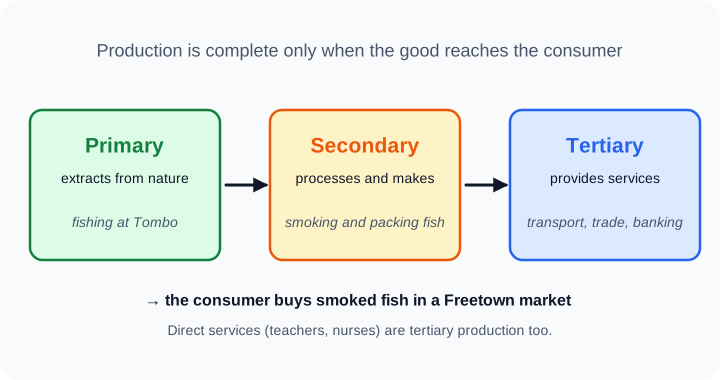
Figure 1. The three stages of production, following fish from Tombo to a Freetown market. WASSCE Tutor diagram.
Division of labour
Division of labour means breaking a production process into separate tasks, with each worker doing one task or a small number of tasks.
In a tailor's workshop, one person may cut the cloth, another sew, another fix buttons and another iron. Each becomes very good at their own task.
Specialisation is the wider idea: individuals, firms, regions or even countries concentrating on what they do best. Division of labour is specialisation within a production process.
Advantages of division of labour
- Greater output: workers become skilled and fast at their task.
- Saving of time: no time is lost moving from one task to another.
- Use of machines: simple, repeated tasks can be done by machines.
- Use of talents: each worker does what suits them best.
- Lower cost per unit, so goods can be cheaper.
- Shorter training: learning one task is quicker than learning the whole craft.
Disadvantages of division of labour
- Monotony: repeating one task all day is boring and lowers morale.
- Loss of craftsmanship: no worker can make the whole product.
- Interdependence: if one stage stops (a strike, an absent worker), the whole process stops.
- Risk of unemployment: a worker with one narrow skill may find it hard to get another job, especially if a machine replaces them.
- Standardised goods: products become uniform, with less variety.
Limits to division of labour
Division of labour cannot be used everywhere. It is limited by:
- the size of the market: if few goods are sold, there is no point splitting the work into many tasks (the most important limit)
- the nature of the product: some goods, such as a hand-carved mask, need one skilled person from start to finish
- the amount of capital: splitting tasks often needs machines and buildings
- the supply of labour: there must be enough workers to fill the separate tasks
Do not write that division of labour "always reduces cost". It reduces cost only when output is large enough. A village tailor making a few shirts a week gains little from splitting the work among five people: the market is too small.
Productivity
Productivity is output per unit of input over a period. Labour productivity is output per worker (or per hour worked).
A tailoring shop with 4 tailors makes 60 school uniforms a week. After buying electric sewing machines, the same 4 tailors make 100 uniforms.
Labour productivity rises from to uniforms per tailor per week, an increase of .
Productivity can be raised by division of labour and specialisation, better tools and machinery, education and training, better management, good health and nutrition of workers, and reliable power and transport. Higher productivity lowers the cost of each unit and is the main source of rising living standards.
Key points
- Production is complete only when goods reach the final consumer.
- Three types: primary (extraction), secondary (manufacturing and construction), tertiary (services).
- Division of labour splits production into tasks; it raises output but causes monotony and interdependence.
- Its main limit is the size of the market.
WASSCE examination focus
Questions ask you to explain the types of production with examples, to state the advantages and disadvantages of division of labour, and to explain the factors that limit it. Use local examples, and remember that commercial services such as transport and trade are part of production.
Quick check
- Is a bus driver engaged in primary, secondary or tertiary production?
- Give two advantages of division of labour.
- What is the main factor that limits division of labour?
Answers: 1. Tertiary (a commercial service: transport). 2. For example: greater output; saving of time; use of machines; lower cost per unit. 3. The size of the market.
Keep going with production theory
This is one of 2 lessons in Production Theory. Start free with the first lesson of every topic, then unlock them all, plus exam-style practice marked instantly and guided learning tools, from 25 NLe.
- Free account, no card needed
- Everything from 25 NLe
- No automatic renewal
More lessons in Production Theory
- Total, average and marginal product; the law of diminishing returns🔒