WASSCE Economics · Price Determination and Market Equilibrium
Equilibrium price, surpluses and shortages
By the WASSCE Tutor team
Updated 12 November 2026 · 6 min read · Prepared against the WASSCE syllabus.
Nobody sets the price of plantain at a weekly lumo. Buyers and sellers bargain, and within an hour the price settles where the quantity people want to buy matches the quantity offered. That settling point is equilibrium, and it is found exactly where two curves cross.
Learning objectives
By the end of this lesson you should be able to:
- explain how the forces of demand and supply determine price
- find the equilibrium price and quantity from a table and a graph
- explain excess demand and excess supply and how the market removes them
The price mechanism
The price mechanism (the market system) is the way the forces of demand and supply interact to determine the price of a good and the quantity bought and sold.
In a free market, nobody sets the price of plantain at Kenema market. It is settled by buyers and sellers bargaining, until the amount buyers want equals the amount sellers offer.
Equilibrium
The equilibrium price is the price at which the quantity demanded equals the quantity supplied. The amount bought and sold at that price is the equilibrium quantity. At equilibrium the market is "cleared": there is no shortage and no surplus, and no pressure for the price to change.
Putting the demand and supply schedules for plantain side by side:
| Price (NLe) | Qty demanded | Qty supplied | Result |
|---|---|---|---|
| 30 | 0 | 120 | Surplus 120 |
| 25 | 20 | 100 | Surplus 80 |
| 20 | 40 | 80 | Surplus 40 |
| 15 | 60 | 60 | Equilibrium |
| 10 | 80 | 40 | Shortage 40 |
| 5 | 100 | 20 | Shortage 80 |
Reading the table:
- Equilibrium price: NLe 15 a bunch, where 60 are demanded and 60 supplied.
- Equilibrium quantity: 60 bunches a week.
- Above NLe 15 there is a surplus (excess supply); below it there is a shortage (excess demand).
On a graph, the equilibrium is where the demand curve crosses the supply curve. Mark the price on the vertical axis () and the quantity on the horizontal axis (), with dotted lines from the crossing point.
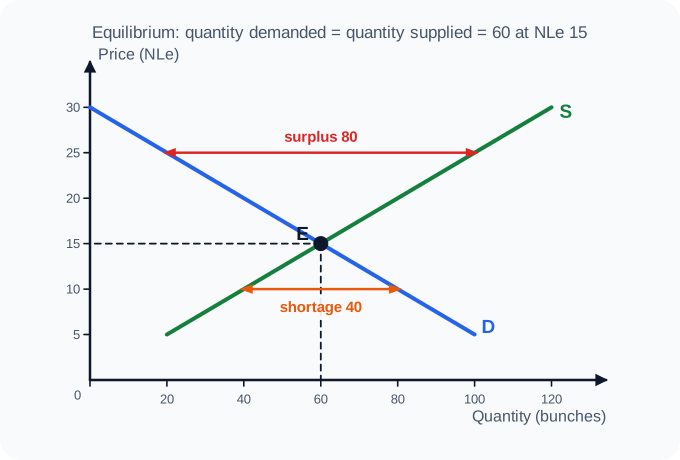
Figure 1. Equilibrium in the plantain market, with a surplus above and a shortage below the equilibrium price. WASSCE Tutor diagram.
Excess supply and excess demand
Excess supply (a surplus) exists when, at a given price, the quantity supplied is greater than the quantity demanded.
Excess demand (a shortage) exists when, at a given price, the quantity demanded is greater than the quantity supplied.
How the market returns to equilibrium
If the price is too high (NLe 20): traders have 80 bunches but buyers want only 40. Unsold plantain starts to ripen, so traders cut their prices. As the price falls, buyers take more (an extension of demand) and traders offer less (a contraction of supply), until the price reaches NLe 15 and the surplus disappears.
If the price is too low (NLe 10): buyers want 80 bunches but only 40 are offered. Buyers compete for the scarce plantain and traders raise their prices. As the price rises, buyers take less and farmers offer more, until the price reaches NLe 15 and the shortage disappears.
Late in the afternoon at a fish market, traders with fish left over lower their prices to clear the stock before it spoils: excess supply pushing the price down. In the early morning, when few boats have landed and many buyers are waiting, prices are high: excess demand pushing the price up.
At the equilibrium price, people still want more of the good than they get, and sellers would like a higher price. "Equilibrium" does not mean everyone is satisfied: it means the quantity demanded equals the quantity supplied, so there is no pressure for the price to change.
Functions of the price mechanism
The price mechanism helps answer the basic economic problems:
- Rationing: a high price limits the use of scarce goods to those willing to pay most.
- Signalling: rising prices tell producers what consumers want more of.
- Incentive: higher prices and profits encourage producers to supply more.
- Allocating resources: factors move to the industries where they earn the most.
Key points
- Price is set where demand meets supply: the equilibrium price.
- Above equilibrium: excess supply, so price falls. Below equilibrium: excess demand, so price rises.
- The price mechanism rations, signals, gives incentives and allocates resources.
WASSCE examination focus
A classic question gives demand and supply schedules and asks you to plot both curves on one graph, find the equilibrium price and quantity, and state the excess demand or supply at another price. Use one set of axes, label D and S, mark and with dotted lines, and quote figures from the table.
Quick check
- In the table above, what is the excess supply at NLe 25?
- What happens to the price when there is excess demand?
- Define equilibrium price.
Answers: 1. bunches. 2. It rises, as buyers compete for the limited supply. 3. The price at which quantity demanded equals quantity supplied.
Keep going with price determination and market equilibrium
This is one of 2 lessons in Price Determination and Market Equilibrium. Start free with the first lesson of every topic, then unlock them all, plus exam-style practice marked instantly and guided learning tools, from 25 NLe.
- Free account, no card needed
- Everything from 25 NLe
- No automatic renewal
More lessons in Price Determination and Market Equilibrium
- Shifts in equilibrium and price controls🔒