WASSCE Economics · Population
Population size, growth, structure and migration
By the WASSCE Tutor team
Updated 12 November 2026 · 8 min read · Prepared against the WASSCE syllabus.
Sierra Leone's 2015 census counted about 7.1 million people, and the number keeps rising. How many of them are children? How many live in towns? How fast is the population growing? The answers shape everything from the number of schools needed to the number of jobs the economy must create.
Learning objectives
By the end of this lesson you should be able to:
- explain what a census is, its uses and the problems of taking one
- calculate birth rate, death rate, natural increase and the growth rate of a population
- describe the age, sex, occupational and geographical structure of a population
- draw and interpret a population pyramid and calculate a dependency ratio
- explain the causes and effects of rural–urban migration
Counting the population: the census
A population census is an official count of all the people in a country at a particular time, recording details such as age, sex, occupation, education and place of residence.
Sierra Leone took censuses in 2004 and 2015, and Statistics Sierra Leone (Stats SL) carried out a mid-term census in 2021.
Uses of a census: planning schools, hospitals, housing and roads; estimating the labour force; sharing government funds between districts; drawing electoral boundaries; projecting future needs; helping firms find markets.
Problems of taking a census in West Africa: high cost; illiteracy and false information (for example about age); poor roads to remote villages; mobile populations; political interference when counts affect seats or funds; lack of trained enumerators; distrust of officials.
How populations grow
A population changes through births, deaths and migration.
- Crude birth rate: live births per 1,000 people in a year.
- Crude death rate: deaths per 1,000 people in a year.
- Natural increase: birth rate minus death rate.
- Net migration: immigrants minus emigrants.
A district has a population of 400,000. In one year there are 14,000 births, 5,200 deaths, 1,000 immigrants and 3,000 emigrants.
- Birth rate per 1,000
- Death rate per 1,000
- Natural increase per 1,000, that is 2.2%
- Net migration (a net outflow)
- Total change people
- Growth rate
Why birth rates are high in West Africa: early marriage; the value placed on large families; children as farm workers and as support in old age; high infant mortality (parents have more children expecting some to die); limited use of family planning; religious and cultural beliefs.
Why death rates have fallen: better medical care and vaccination; cleaner water and sanitation; better nutrition; health education.
Population structure
Age structure and the population pyramid
A population pyramid shows the share of males and females in each age group.
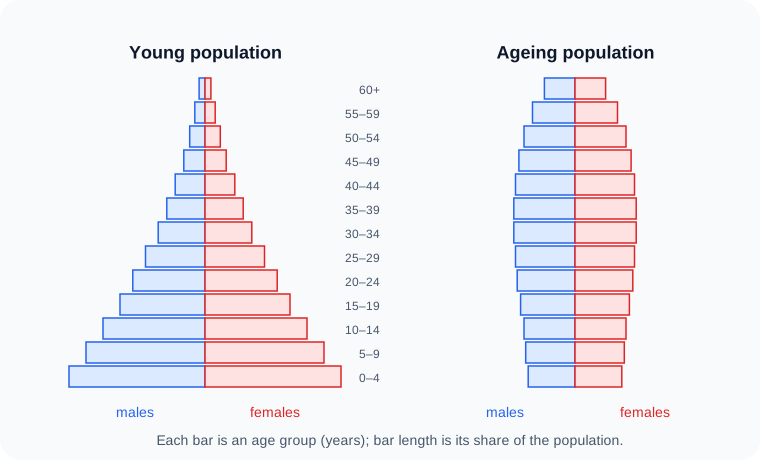
Figure 1. A young population such as Sierra Leone's (left) and an ageing population (right). Illustrative shapes. WASSCE Tutor diagram.
A broad base shows a high birth rate and many children; a narrow top shows that few people live to old age. This is typical of Sierra Leone and most of West Africa, where over 40% of people are under 15.
The dependency ratio
The dependency ratio compares the number of dependants (people under 15 and over 64) with the number of people of working age (15–64).
A town has 42,000 people under 15, 4,000 over 64 and 54,000 aged 15–64.
Every 100 people of working age support about 85 dependants. A high ratio means heavy spending on schools and health, and less income left to save.
Sex, occupational and geographical structure
- Sex structure: the balance of males and females, often given as the number of males per 100 females (the sex ratio).
- Occupational structure: how workers are divided between primary, secondary and tertiary production. In Sierra Leone most people still work in agriculture; richer countries have most workers in services.
- Geographical distribution: where people live. Population is dense in Freetown and the Western Area and in mining and trading towns, and sparser in parts of the provinces.
Rural–urban migration
Many young people move from villages to towns, especially to Freetown.
Causes (pull and push factors): better job prospects and higher wages in towns; schools, hospitals, electricity and water; bright lights and entertainment; poverty, low farm incomes and lack of amenities in villages; land disputes; escape from traditional obligations.
Effects:
| On towns | On rural areas |
|---|---|
| Overcrowding, slums and pressure on housing | Shortage of young farm workers |
| Unemployment and crime | Falling food output |
| Strain on water, power, schools and transport | Ageing population left behind |
| A larger pool of labour for industry | Remittances sent home by migrants |
Remedies: develop rural amenities (roads, schools, clinics, electricity); support farming with credit and better prices; locate industries in provincial towns; encourage agro-processing in rural areas.
Key points
- A census counts the population; it guides planning but is costly and hard to carry out.
- Population changes through births, deaths and migration; rates are per 1,000 people.
- Sierra Leone has a young population: a broad-based pyramid and a high dependency ratio.
- Rural–urban migration brings labour to towns but also slums, unemployment and labour shortages on farms.
WASSCE examination focus
Expect to state the uses and problems of a census, to calculate birth rate, death rate, natural increase or the dependency ratio, to explain the shape of a population pyramid, and to discuss the causes and effects of rural–urban migration and its remedies. Show the formula, substitute the figures and give the unit (per 1,000, or %).
Quick check
- A country of 8 million has 280,000 births in a year. What is its crude birth rate?
- What does a broad base on a population pyramid show?
- Give two reasons why young people move to Freetown.
- Calculate the dependency ratio if there are 30,000 dependants and 50,000 people of working age.
Answers: 1. per 1,000. 2. A high birth rate and a large number of children. 3. Any two: better jobs and wages, schools and hospitals, electricity and water, entertainment, poverty in villages. 4. .
Keep going with population
This is one of 2 lessons in Population. Start free with the first lesson of every topic, then unlock them all, plus exam-style practice marked instantly and guided learning tools, from 25 NLe.
- Free account, no card needed
- Everything from 25 NLe
- No automatic renewal
More lessons in Population
- Population theories: Malthus, the optimum and the demographic transition🔒