WASSCE Economics · National Income
National income: concepts, the circular flow and measurement
By the WASSCE Tutor team
Updated 12 November 2026 · 8 min read · Prepared against the WASSCE syllabus.
How rich is Sierra Leone, and is it getting richer? To answer, economists add up the value of everything the country produces in a year. That total, national income, is the most important number in macroeconomics, and WASSCE expects you to define it, measure it three ways and avoid counting anything twice.
Learning objectives
By the end of this lesson you should be able to:
- define national income, GDP, GNP and NNP and explain how they are related
- explain the circular flow of income
- describe the output, income and expenditure methods of measurement
- convert between market prices and factor cost, and between nominal and real values
- calculate income per head
The main concepts
- Gross Domestic Product (GDP): the total money value of all final goods and services produced within a country in a year, by citizens and foreigners alike.
- Gross National Product (GNP): GDP plus net income from abroad (income earned abroad by citizens, minus income earned at home by foreigners and sent out).
- Net National Product (NNP): GNP minus depreciation (capital consumption, the wearing out of machines and buildings).
- National income (NI): NNP measured at factor cost.
where NFIA is net factor income from abroad: income earned abroad by citizens minus income earned at home by foreigners.
For Sierra Leone, net income from abroad is negative: foreign-owned mining companies, banks and telecoms firms send profits out of the country, so GNP is smaller than GDP.
The circular flow of income
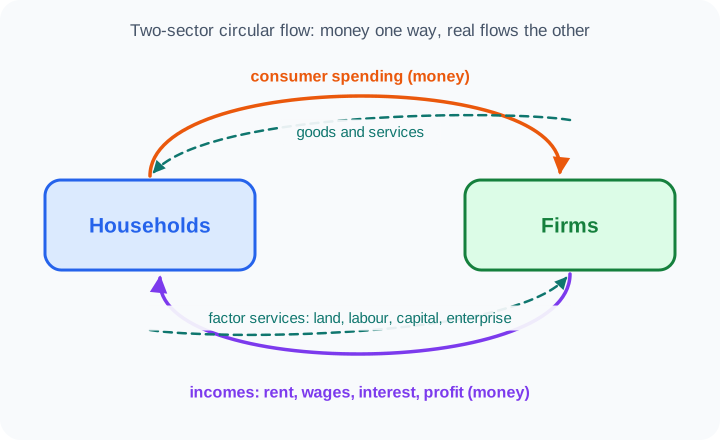
Figure 1. The two-sector circular flow of income. WASSCE Tutor diagram.
In a simple economy of households and firms:
- Households own the factors of production and sell their services to firms.
- Firms pay incomes (rent, wages, interest, profit) to households.
- Households spend their incomes on the goods and services firms produce.
Money flows one way round the circle and real goods and services the other. This shows why national income can be measured in three ways: output = income = expenditure.
Three ways to measure national income
1. The output (product) method
Add the value of the output of every industry. To avoid double counting, count only final goods, or add the value added at each stage of production.
Following a loaf of bread.
| Stage | Value of output (NLe) | Value of inputs bought (NLe) | Value added (NLe) |
|---|---|---|---|
| Farmer grows wheat | 4 | 0 | 4 |
| Miller makes flour | 7 | 4 | 3 |
| Baker bakes bread | 12 | 7 | 5 |
| Shop sells bread | 15 | 12 | 3 |
| Total | 38 | 15 |
Adding every stage's output (NLe 38) counts the wheat four times. The correct contribution to GDP is the value added, NLe 15, which equals the value of the final good.
2. The income method
Add all factor incomes earned from producing the year's output: wages and salaries, rent, interest and profits (including the incomes of the self-employed).
Exclude transfer payments such as pensions, scholarships, gifts and unemployment benefits, because no goods or services are produced in return for them.
3. The expenditure method
Add all spending on final goods and services:
where is consumer spending, is investment by firms, is government spending on goods and services, is exports and is imports.
A country's spending in a year (NLe million): consumption 18,000; investment 4,000; government spending 5,000; exports 6,000; imports 8,000.
GDP is NLe 25,000 million. Imports are subtracted because that spending buys goods produced abroad.
Market prices and factor cost
Spending is measured at market prices, which include indirect taxes and are lowered by subsidies. Incomes are measured at factor cost.
Nominal and real national income
Nominal (money) GDP is measured at current prices. If prices rise, nominal GDP rises even when output does not. Real GDP removes the effect of price changes, using a price index with a base year:
Nominal GDP rises from NLe 25,000 million to NLe 30,000 million, while the price index rises from 100 to 115.
Real GDP in the second year million. Real output grew by about , not the 20% suggested by nominal figures.
Income per head
Per capita income lets us compare living standards between countries and over time, but it is an average: it hides how unequally income is shared.
Do not include second-hand goods, intermediate goods, transfer payments or purely financial transactions (buying shares) in national income. None of them is new production of final goods and services.
Key points
- GDP is the value of final output within the country; GNP = GDP + net income from abroad; NNP = GNP − depreciation.
- The circular flow shows output = income = expenditure.
- Measure by output (value added), income (factor incomes, no transfers) or expenditure ().
- Real GDP removes price changes; income per head = national income ÷ population.
WASSCE examination focus
Expect to define GDP, GNP and NNP, to explain the three methods of measurement and the problem of double counting, and to calculate GDP, GNP, NNP, factor cost or income per head from given figures. Show each step and state the units (NLe million).
Quick check
- GDP is NLe 20,000 million and net income from abroad is −NLe 1,500 million. Find GNP.
- Why are transfer payments left out of national income?
- Using value added, what does a shop that buys goods for NLe 50 and sells them for NLe 65 add to GDP?
- National income is NLe 24,000 million and the population is 8 million. What is income per head?
Answers: 1. NLe 18,500 million. 2. No goods or services are produced in return for them. 3. NLe 15. 4. NLe 3,000 per person.
Keep going with national income
This is one of 2 lessons in National Income. Start free with the first lesson of every topic, then unlock them all, plus exam-style practice marked instantly and guided learning tools, from 25 NLe.
- Free account, no card needed
- Everything from 25 NLe
- No automatic renewal
More lessons in National Income
- Leakages and injections, uses and problems of national income figures🔒