WASSCE Economics · Market Structures
Perfect competition
By the WASSCE Tutor team
Updated 12 November 2026 · 7 min read · Prepared against the WASSCE syllabus.
In a big pepper market, no single trader can raise her price: buyers simply walk to the next stall. That is the world of perfect competition, the benchmark against which every other market structure is judged.
Learning objectives
By the end of this lesson you should be able to:
- define a market and classify market structures
- state the features of perfect competition
- explain short-run and long-run equilibrium of a perfectly competitive firm, using the rule MC = MR
Markets and market structures
A market is any arrangement through which buyers and sellers come into contact to exchange goods and services. It does not need a physical place: mobile money transfers and online sales are markets too.
Market structure describes the degree of competition in a market: the number of sellers, the type of product and how easily firms can enter.
| Structure | Number of sellers | Product | Entry |
|---|---|---|---|
| Perfect competition | Very many | Identical | Free |
| Monopolistic competition | Many | Differentiated | Fairly free |
| Oligopoly | A few | Identical or differentiated | Difficult |
| Monopoly | One | No close substitute | Blocked |
Features of perfect competition
- Very many buyers and sellers: no single one can affect the price.
- Homogeneous (identical) products: buyers cannot tell one seller's product from another's.
- Free entry and exit of firms.
- Perfect knowledge of prices and conditions.
- Perfect mobility of factors of production.
- No transport costs and no government interference.
Because of these features, each firm is a price taker: it must accept the price set by the industry's demand and supply.
Demand and revenue for the firm
The firm can sell any quantity at the market price, so its demand curve is perfectly elastic (horizontal). Every unit sells for the same price, so:
The profit-maximising rule
A firm maximises profit where marginal cost equals marginal revenue (MC = MR), with MC rising.
If the next unit adds more to revenue than to cost (MR > MC), producing it raises profit. If it adds more to cost (MC > MR), it lowers profit.
Worked example: three possible prices
We use the cost figures from Concepts of Cost and Revenue: fixed cost NLe 100.
| Output | Total cost | ATC | AVC | MC |
|---|---|---|---|---|
| 1 | 140 | 140 | 40 | 40 |
| 2 | 170 | 85 | 35 | 30 |
| 3 | 190 | 63.3 | 30 | 20 |
| 4 | 220 | 55 | 30 | 30 |
| 5 | 270 | 54 | 34 | 50 |
| 6 | 340 | 56.7 | 40 | 70 |
The firm keeps adding units while MC is below MR, and stops before a unit whose MC is above MR.
A. Abnormal profit (price NLe 65). The 5th unit costs 50 (below 65); the 6th would cost 70 (above 65). Produce 5 units. TR , TC , profit . Price (65) is above ATC (54), so the firm earns abnormal (supernormal) profit: .
B. Normal profit (price NLe 54). Again produce 5 units (the 5th costs 50, the 6th would cost 70). TR TC. Price equals minimum ATC, so the firm earns normal profit only.
C. Loss (price NLe 45). The 4th unit costs 30 (below 45); the 5th would cost 50 (above 45). Produce 4 units. TR , TC , loss .
Should a loss-making firm close down?
In the short run, fixed costs (NLe 100) must be paid even if the firm produces nothing. In case C:
- Producing 4 units: loss of NLe 40.
- Closing down: loss of NLe 100 (the fixed cost).
The firm should keep producing as long as price covers average variable cost (45 is above the AVC of 30 at 4 units). If the price fell below minimum AVC (NLe 30), it should shut down.
Normal profit is the minimum profit needed to keep a firm in an industry; it is included in average cost. Abnormal (supernormal) profit is any profit above normal profit.
Long-run equilibrium
Abnormal profit in case A attracts new firms (entry is free). Industry supply increases, so the market price falls. This continues until price falls to minimum ATC (case B), where only normal profit is earned. Losses in case C drive some firms out, supply falls and price rises back to the same point.
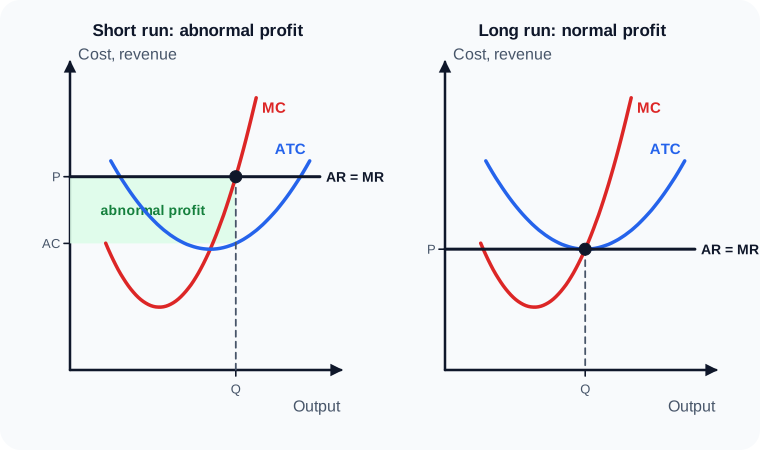
Figure 1. The perfectly competitive firm: abnormal profit in the short run (left) and normal profit in the long run (right). WASSCE Tutor diagram.
In the long run, a perfectly competitive firm is in equilibrium where:
Perfect competition is a model rather than a real market, but a large market for a single farm crop, such as tomatoes or pepper, comes close: many sellers, almost identical produce, and no single trader able to set the price.
Key points
- Perfect competition: many firms, identical products, free entry, perfect knowledge.
- The firm is a price taker: P = AR = MR (horizontal demand curve).
- Profit is maximised where MC = MR.
- Short run: abnormal profit, normal profit or loss. Keep producing while P ≥ AVC.
- Long run: only normal profit, at P = minimum ATC.
WASSCE examination focus
Expect "State five features of perfect competition" and "With the aid of a diagram, explain the short-run (or long-run) equilibrium of a firm under perfect competition." Draw the horizontal line P = AR = MR, U-shaped MC and ATC curves, mark where MC cuts MR from below, and shade abnormal profit or loss where asked.
Quick check
- Why is a perfectly competitive firm called a price taker?
- State the profit-maximising rule.
- In the long run, why can a perfectly competitive firm earn only normal profit?
Answers: 1. It is too small to influence the market price and must accept the price set by the industry. 2. Produce where MC = MR (with MC rising). 3. Abnormal profit attracts new firms, which increases supply and lowers the price until only normal profit remains.
Keep going with market structures
This is one of 2 lessons in Market Structures. Start free with the first lesson of every topic, then unlock them all, plus exam-style practice marked instantly and guided learning tools, from 25 NLe.
- Free account, no card needed
- Everything from 25 NLe
- No automatic renewal
More lessons in Market Structures
- Monopoly, monopolistic competition and oligopoly🔒