WASSCE Economics · Labour and Wages
The labour force, the demand and supply of labour, and wages
By the WASSCE Tutor team
Updated 12 November 2026 · 9 min read · Prepared against the WASSCE syllabus.
Why does a doctor earn more than a market porter, though the porter works harder with his body? Why do so many young people in Freetown look for jobs that are not there? The answers come from the labour market, where the demand for workers meets the supply of them and sets a price called the wage.
Learning objectives
By the end of this lesson you should be able to:
- define the labour force and explain what determines its size
- explain the demand for labour as a derived demand, and what affects it
- explain what affects the supply of labour
- show how the wage rate is determined by demand and supply
- explain why wages differ between occupations
The labour force
The labour force (working population) is the number of people of working age who are able and willing to work, whether they are employed or unemployed and looking for work.
People outside the labour force include children, the very old, full-time students, the sick and disabled, and people who are not looking for work. The labour force supports these dependants.
What determines the size of the labour force?
- The size of the population: more people usually means more workers.
- The age structure: a country with many children (like Sierra Leone) has a smaller share of people of working age.
- The school-leaving and retirement ages: longer schooling or earlier retirement shrinks the labour force.
- Attitudes to women working: where more women take paid work, the labour force is larger.
- Health: disease and disability keep people out of work.
- Migration: emigration of workers shrinks it; immigration enlarges it.
The demand for labour
The demand for labour is the number of workers employers are willing and able to hire at each wage rate. It is a derived demand: firms want workers not for their own sake, but for the goods and services they help to produce.
When people buy more bread, bakeries need more bakers. When a mine closes, the demand for miners falls, even though the miners are as skilled as before.
The demand for labour depends on:
- the demand for the product the workers make (derived demand)
- the productivity of labour: more productive workers are worth hiring
- the wage rate: at a lower wage, firms employ more workers, so the demand curve slopes downwards
- the price of other factors: if machines become cheap, firms may replace workers with them
- the proportion of total cost that is wages: where wages are a small part of cost, firms are less sensitive to wage rises
The supply of labour
The supply of labour is the number of workers (or hours of work) offered at each wage rate. A higher wage usually draws more people into an occupation, so the supply curve slopes upwards.
The supply of labour to an occupation depends on:
- the wage rate and other rewards (allowances, housing, pension)
- working conditions: hours, safety, comfort, status
- the training and skill required: few people can quickly become surgeons or engineers
- the size and age structure of the population
- the mobility of labour: how easily workers can move between jobs and places
- social attitudes, for example to manual work or to women in certain jobs
How wages are determined
In a free labour market, the wage is the price of labour, set where the demand for labour equals the supply of labour.
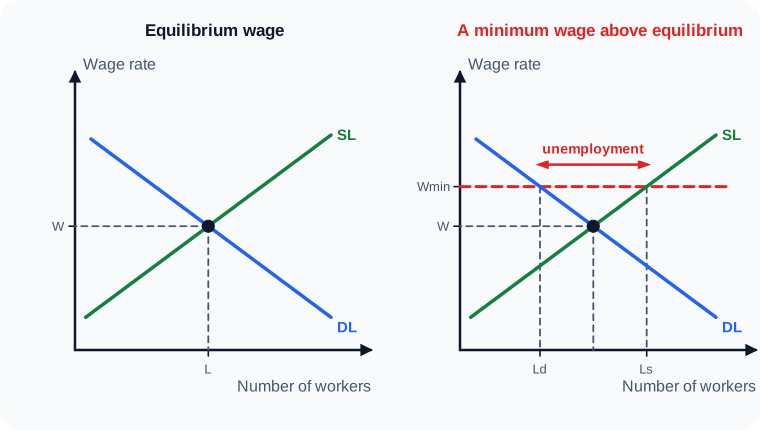
Figure 1. Wage determination (left) and the effect of a minimum wage above the equilibrium (right). WASSCE Tutor diagram.
Construction workers in Freetown. The table shows the demand for and supply of labourers at different daily wages.
| Daily wage (NLe) | Labourers demanded | Labourers offering to work |
|---|---|---|
| 60 | 200 | 1,000 |
| 50 | 400 | 800 |
| 40 | 600 | 600 |
| 30 | 800 | 400 |
- The equilibrium wage is NLe 40, where 600 are demanded and 600 offer to work.
- At NLe 50 there is a surplus of labour (unemployment) of workers.
- At NLe 30 there is a shortage of labour of workers, and employers bid wages up.
If demand for houses rises, the demand for labourers shifts right, and wages and employment both rise. If thousands of young people arrive in the city looking for work, the supply of labour shifts right, and the wage tends to fall.
Why wages differ
| Reason | Example |
|---|---|
| Skill and training: long, costly training limits supply | Doctors, engineers and pilots earn more than unskilled workers |
| Demand for the product | Workers in a booming industry (mining, telecoms) are paid more |
| Unpleasant or dangerous work needs higher pay to attract workers | Miners, deep-sea fishermen |
| Trade union strength | Strong unions can bargain for higher wages |
| Location and cost of living | City jobs often pay more than the same job in a village |
| Responsibility and risk | Managers and bank officials who handle large sums |
| Discrimination and custom | Lower pay for some groups, which is unfair and often illegal |
| Government policy | Minimum wages and public-sector pay scales |
Wages are not paid according to how hard a job is physically. A porter at Dove Cut works very hard, but because almost anyone can do the work, the supply is large and the wage is low. Wages depend on demand and supply, not effort alone.
In Sierra Leone, a large share of workers are in farming and petty trading in the informal sector, where earnings are low and irregular. Wages in the formal sector (government, banks, mining, telecoms) are higher because fewer people have the education and skills these jobs require.
Key points
- The labour force is everyone of working age able and willing to work; its size depends on population, age structure, schooling, retirement age, attitudes and health.
- The demand for labour is a derived demand, depending on the demand for the product and on productivity.
- The equilibrium wage is where the demand for labour equals the supply of labour.
- Wages differ because of skill, training, conditions, demand, union power, location and government policy.
WASSCE examination focus
Expect to define the labour force and explain what determines its size, to explain why the demand for labour is a derived demand, to show wage determination on a diagram, and to give reasons for wage differentials. In diagram questions, label the axes "wage rate" and "number of workers", and mark the equilibrium wage and employment clearly.
Quick check
- Why is the demand for labour called a derived demand?
- Give three factors that affect the size of a country's labour force.
- In the worked example, what happens if the wage is fixed at NLe 50?
- Why do surgeons earn more than market porters?
Answers: 1. Because workers are wanted for the goods and services they help to produce, not for themselves. 2. Any three: population size, age structure, school-leaving age, retirement age, attitudes to women working, health, migration. 3. 800 offer to work but only 400 are demanded, so 400 are unemployed. 4. Surgeons need long, costly training, so few can supply that labour, while demand for their skills is high; almost anyone can work as a porter, so supply is large and the wage low.
Keep going with labour and wages
This is one of 2 lessons in Labour and Wages. Start free with the first lesson of every topic, then unlock them all, plus exam-style practice marked instantly and guided learning tools, from 25 NLe.
- Free account, no card needed
- Everything from 25 NLe
- No automatic renewal
More lessons in Labour and Wages
- Real wages, trade unions and unemployment🔒