WASSCE Economics · International Trade
International trade, comparative advantage and the terms of trade
By the WASSCE Tutor team
Updated 12 November 2026 · 8 min read · Prepared against the WASSCE syllabus.
Sierra Leone exports iron ore and cocoa and imports rice, fuel and machinery. Why not make everything at home? Because countries gain by specialising in what they do relatively best and trading for the rest. This lesson explains that gain, comparative advantage, and how to measure whether trade is moving in a country's favour.
Learning objectives
By the end of this lesson you should be able to:
- define international trade and distinguish it from internal (domestic) trade
- explain the basis of international trade
- explain absolute and comparative advantage, with a numerical example
- state the assumptions and limitations of comparative advantage
- calculate and interpret the terms of trade
What is international trade?
International trade is the exchange of goods and services between countries. Goods sold abroad are exports; goods bought from abroad are imports.
How international trade differs from internal trade:
| Internal trade | International trade |
|---|---|
| One currency | Different currencies must be exchanged |
| Factors of production move fairly freely | Labour and capital move less freely between countries |
| Same laws, taxes and customs | Different laws, tariffs, quotas and customs procedures |
| Shorter distances, lower transport costs | Longer distances and higher transport and insurance costs |
| Similar language and tastes | Different languages, tastes and standards |
| No balance of payments problem | Payments must balance; foreign exchange is needed |
Why countries trade
- Unequal distribution of natural resources: Sierra Leone has iron ore and rutile but no oil fields; Nigeria has oil.
- Differences in climate: tropical countries grow cocoa and coffee; temperate countries grow wheat.
- Differences in skills, capital and technology: some countries make machines more cheaply.
- Specialisation and economies of scale: producing for a world market lowers costs.
- Variety: consumers want goods their own country cannot make.
Absolute advantage
A country has an absolute advantage in a good when it can produce more of it with the same resources than another country.
If Sierra Leone is better at rice and Ghana is better at cloth, both gain by each specialising in its own good and trading. But what if one country is better at both?
Comparative advantage
A country has a comparative advantage in a good when it can produce it at a lower opportunity cost than another country. The law of comparative advantage says that countries gain from trade by specialising in the goods in which they have a comparative advantage, even if one country is better at producing everything.
With one unit of resources, two countries can produce:
| Country | Rice (tonnes) | Cloth (bales) |
|---|---|---|
| Country A | 20 | 10 |
| Country B | 10 | 20 |
Opportunity costs:
- In A, 1 tonne of rice costs bales of cloth; in B it costs bales. A has the comparative advantage in rice.
- In B, 1 bale of cloth costs 0.5 tonnes of rice; in A it costs 2 tonnes. B has the comparative advantage in cloth.
Before specialisation each country splits its 2 units of resources equally:
- A: 20 rice + 10 cloth. B: 10 rice + 20 cloth. Total: 30 rice, 30 cloth.
After specialisation A puts both units into rice and B both into cloth:
- A: 40 rice. B: 40 cloth. Total: 40 rice, 40 cloth.
World output of both goods rises by 10 units. By trading (for example 15 rice for 15 cloth), both countries can consume more than before.
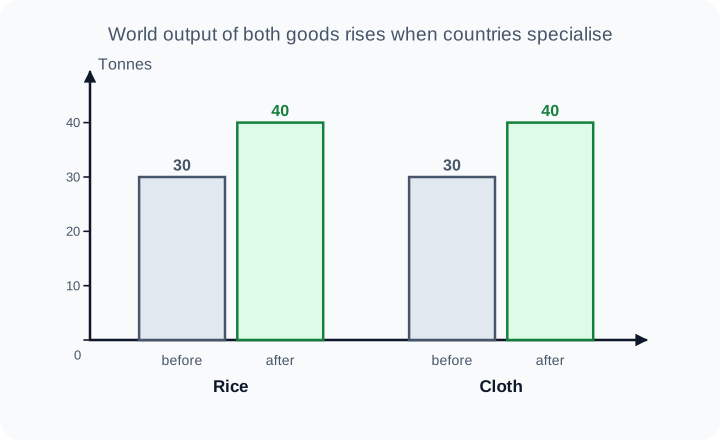
Figure 1. Gains from specialisation and trade in the worked example. WASSCE Tutor diagram.
Assumptions
The theory assumes: only two countries and two goods; constant costs of production; free trade with no tariffs; no transport costs; factors move freely within each country but not between them; full employment.
Limitations
- Transport costs may cancel the gains.
- Tariffs and quotas restrict trade in practice.
- Costs are not constant: diminishing returns raise costs as a country specialises.
- Over-specialisation makes a country dependent on one or two exports whose prices may collapse.
- Factors are not fully mobile between industries.
- Countries may avoid dependence for strategic reasons (food security, defence).
The terms of trade
The terms of trade measure the rate at which a country's exports exchange for its imports, comparing the average price of exports with the average price of imports.
In the base year both indices are 100. Five years later, export prices index = 120, import prices index = 150.
The terms of trade have worsened (deteriorated) by 20%: each unit of exports now buys 20% fewer imports.
- Favourable (improving) terms of trade: the index rises above 100; exports buy more imports.
- Unfavourable (worsening): the index falls below 100.
Why the terms of trade of West African countries often worsen: primary exports (cocoa, minerals) face unstable or falling world prices, while the prices of imported manufactured goods and fuel tend to rise.
"Favourable terms of trade" does not always mean the country is better off. If export prices rise but buyers then purchase much less, export earnings may fall. Look at volumes as well as prices.
Key points
- International trade differs from internal trade in currencies, mobility of factors, laws and distance.
- Countries trade because of differences in resources, climate, skills and technology.
- Comparative advantage: specialise in goods with the lowest opportunity cost; total output rises.
- The theory has assumptions and limitations (transport costs, tariffs, over-specialisation).
- Terms of trade = export price index ÷ import price index × 100.
WASSCE examination focus
WASSCE regularly sets a comparative advantage table: find which country should specialise in which good, using opportunity costs, and show the gain in total output. Also common: distinguish internal from international trade, calculate the terms of trade and say whether they are favourable. Always state the opportunity cost of each good in each country.
Quick check
- What is the difference between absolute and comparative advantage?
- Country X can make 30 radios or 60 shirts; country Y can make 20 radios or 20 shirts. Which should specialise in radios?
- The export price index is 110 and the import price index is 100. Calculate the terms of trade.
- Give two limitations of the theory of comparative advantage.
Answers: 1. Absolute: producing more with the same resources. Comparative: producing at a lower opportunity cost. 2. In X, 1 radio costs 2 shirts; in Y, 1 radio costs 1 shirt. Y has the lower opportunity cost, so Y should specialise in radios (and X in shirts). 3. : favourable. 4. Any two: transport costs, tariffs, rising costs, over-specialisation, immobile factors, strategic dependence.
Keep going with international trade
This is one of 2 lessons in International Trade. Start free with the first lesson of every topic, then unlock them all, plus exam-style practice marked instantly and guided learning tools, from 25 NLe.
- Free account, no card needed
- Everything from 25 NLe
- No automatic renewal
More lessons in International Trade
- Free trade, protection and Sierra Leone's foreign trade🔒