WASSCE Economics · Inflation and Deflation
Inflation: meaning, measurement and causes
By the WASSCE Tutor team
Updated 12 November 2026 · 7 min read · Prepared against the WASSCE syllabus.
In 2022 and 2023 Sierra Leone's shoppers watched the prices of rice, fuel and transport climb month after month, as the leone fell and world food and fuel prices rose. A general, continuous rise in prices is inflation. This lesson explains how it is measured and what causes it.
Learning objectives
By the end of this lesson you should be able to:
- define inflation and describe its types by speed
- construct a simple consumer price index and calculate the rate of inflation
- explain demand-pull, cost-push, imported and monetary causes of inflation
- show demand-pull and cost-push inflation on a diagram
What is inflation?
Inflation is a persistent and general rise in the price level over a period of time, which causes a fall in the value (purchasing power) of money.
A rise in the price of one good (say, tomatoes in the dry season) is not inflation. Inflation means prices in general keep rising.
Types by speed:
| Type | Rate | Effect |
|---|---|---|
| Creeping (mild) | Low, a few per cent a year | Can encourage production; people hardly notice |
| Walking / trotting | Moderate, rising | Begins to erode savings and wages |
| Galloping | High, double or triple figures | Confidence in money falls; people buy goods or foreign currency |
| Hyperinflation | Extremely rapid, prices rising daily | Money becomes almost worthless; people return to barter |
Measuring inflation: the consumer price index
A price index shows the average change in prices of a "basket" of goods and services compared with a base year (index = 100). Each item gets a weight showing its importance in household spending.
A simple consumer price index. Base year 2024 = 100.
| Item | Weight | Price 2024 (NLe) | Price 2025 (NLe) | Price relative | Relative × weight |
|---|---|---|---|---|---|
| Rice (one cup) | 5 | 10 | 12 | 120 | 600 |
| Fuel (one litre) | 3 | 25 | 30 | 120 | 360 |
| Transport (one bus fare) | 2 | 5 | 7 | 140 | 280 |
| Total | 10 | 1,240 |
Prices rose by 24% between 2024 and 2025.
where is this year's price index and is last year's.
If the index rises from 124 to 136.4, inflation .
In Sierra Leone the consumer price index is compiled by Statistics Sierra Leone (Stats SL).
Uses of price indices: measuring inflation; adjusting wages and pensions; finding real income and real GDP; guiding monetary policy.
Limitations: the basket may not match every household's spending; weights go out of date; quality changes are hard to measure; and price collection in markets can be inaccurate.
Causes of inflation
1. Demand-pull inflation
Demand-pull inflation occurs when total (aggregate) demand rises faster than total supply: too much money chasing too few goods.
Causes: increased government spending (especially financed by borrowing from the central bank); rapid growth of bank credit; rising incomes and wages; a big increase in exports or remittances; a rapid rise in population.
2. Cost-push inflation
Cost-push inflation occurs when costs of production rise and firms pass them on in higher prices.
Causes: wage increases above productivity (often won by trade unions); higher fuel and transport costs; dearer imported raw materials; higher indirect taxes; higher interest rates on business loans.
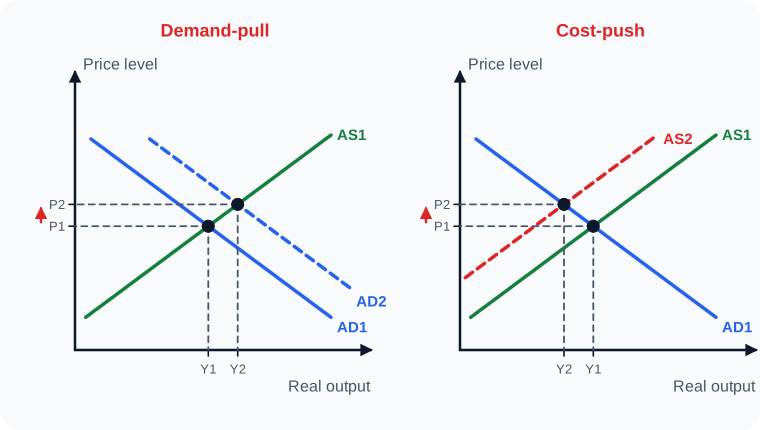
Figure 1. Demand-pull inflation (left) and cost-push inflation (right). WASSCE Tutor diagram.
3. Imported inflation
When a country imports much of its food, fuel and manufactured goods, a rise in world prices or a fall in its own currency raises prices at home. Sierra Leone imports most of its fuel and much of its rice, so a weaker leone quickly pushes up local prices.
4. Monetary causes
An excessive increase in the money supply, for example when the government finances its deficit by borrowing from the central bank, raises spending and prices (see in Money and Banking).
5. Structural causes
In developing countries, bottlenecks such as poor roads, low farm output, power shortages and hoarding by traders mean supply cannot keep up with demand.
Do not explain inflation only as "prices going up". Say why: too much demand, higher costs, imported prices, more money or supply bottlenecks. Examiners award marks for the cause, not the description.
Key points
- Inflation is a persistent rise in the general price level and a fall in the value of money.
- Types by speed: creeping, walking, galloping, hyperinflation.
- A price index uses a weighted basket and a base year; inflation is the percentage change in the index.
- Causes: demand-pull, cost-push, imported, monetary and structural.
WASSCE examination focus
Expect to define inflation, to compute a weighted price index and the rate of inflation from a table, and to explain the causes (demand-pull and cost-push, often with diagrams). In index calculations, set out the price relatives and weights in a table, and state the base year.
Quick check
- Is a rise in the price of tomatoes in the dry season inflation? Why?
- A price index rises from 150 to 165. What is the rate of inflation?
- Distinguish demand-pull from cost-push inflation.
- Why does a fall in the value of the leone raise prices in Sierra Leone?
Answers: 1. No. Inflation is a general, persistent rise in prices, not a seasonal rise in one good. 2. . 3. Demand-pull: total demand exceeds supply. Cost-push: rising costs are passed on in higher prices. 4. Imports such as fuel and rice cost more leones, and firms pass these higher costs on to consumers (imported inflation).
Keep going with inflation and deflation
This is one of 2 lessons in Inflation and Deflation. Start free with the first lesson of every topic, then unlock them all, plus exam-style practice marked instantly and guided learning tools, from 25 NLe.
- Free account, no card needed
- Everything from 25 NLe
- No automatic renewal
More lessons in Inflation and Deflation
- Effects and control of inflation, and deflation🔒