WASSCE Economics · Industrialization
Industrialisation and the location of industries
By the WASSCE Tutor team
Updated 12 November 2026 · 7 min read · Prepared against the WASSCE syllabus.
Sierra Leone exports iron ore, rutile and cocoa, then imports steel, paint and chocolate made from the same kinds of raw materials. Turning raw materials into finished goods at home is industrialisation, and where a factory is built can decide whether it succeeds.
Learning objectives
By the end of this lesson you should be able to:
- define industry and industrialisation and classify industries
- explain the importance of industrialisation to a developing country
- explain the factors that influence the location of industries
- distinguish localisation from dispersal of industry and give their advantages and disadvantages
What is industrialisation?
- An industry is a group of firms producing similar goods or services.
- Industrialisation is the process by which an economy shifts from mainly agriculture and raw-material exports towards manufacturing, processing and modern services, using more capital and technology.
Types of industry:
| Type | Meaning | Examples in Sierra Leone |
|---|---|---|
| Extractive | Takes resources from nature | Mining iron ore, rutile, diamonds and gold; fishing; logging |
| Manufacturing | Turns raw materials into finished goods | Brewing, soap making, rice milling, palm-oil processing, block making |
| Construction | Builds roads, houses, bridges | Road and housing contractors |
| Service (tertiary) | Provides services | Telecoms, banking, transport, hotels |
Manufacturing can also be divided into light industry (consumer goods such as drinks and clothing) and heavy industry (steel, machinery, cement).
Why industrialise?
- More jobs, especially for young school leavers in towns.
- Higher incomes and living standards: manufacturing usually pays more per worker than subsistence farming.
- Value added at home: processing raw materials (cocoa into chocolate, palm fruit into refined oil) earns more than exporting them raw.
- Diversification: less dependence on a few primary exports whose prices swing.
- Saving foreign exchange by producing goods that were imported.
- Use of local resources that would otherwise be idle.
- Linkages: factories create demand for farm raw materials, transport, banking and other services.
- Technology and skills spread through the economy.
- Government revenue from company and other taxes.
Location of industries
The location of industry is the place where a firm chooses to set up its factory. A firm chooses the site where its total costs of production and distribution are lowest, and where it can reach its market.
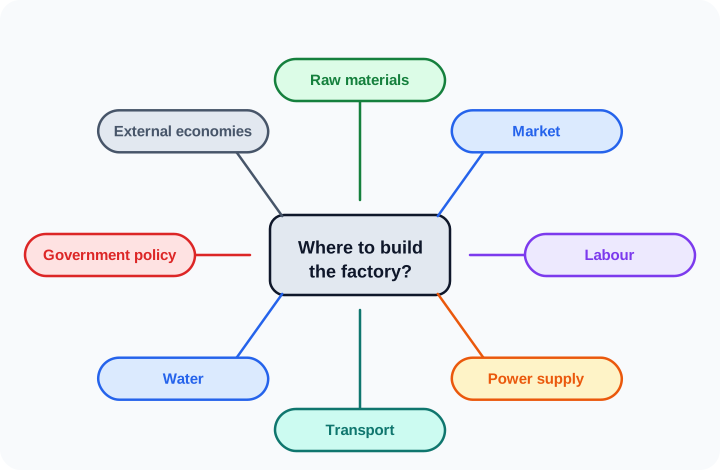
Figure 1. Factors that influence the location of an industry. WASSCE Tutor diagram.
| Factor | Explanation | Example |
|---|---|---|
| Raw materials | Firms whose raw materials are bulky or lose weight in processing locate near them | Rice mills near rice-growing areas; ore processing near mines |
| Market | Firms whose products are bulky, fragile or perishable locate near buyers | Bakeries, breweries and soft-drink bottlers near Freetown |
| Labour | Firms need a supply of workers with the right skills | Factories in towns where workers live |
| Power | Reliable electricity is essential for most factories | Industry clusters where the power supply is steady |
| Transport | Good roads, ports and railways cut the cost of moving inputs and outputs | Industries near the Queen Elizabeth II Quay in Freetown |
| Water | Needed for processing and cooling | Breweries, soap and paper making |
| Government policy | Tax holidays, industrial estates, or rules that steer firms to certain areas | Industrial estates and economic zones |
| External economies | Firms gain from being near related firms: skilled labour, suppliers, repair services | Clusters of firms in an established industrial area |
| Land and climate | Cheap, suitable land; climate for certain processes | Large plants on the edge of towns |
Where should a new fruit-juice factory be built? Fresh fruit is perishable and bulky, so a site near the orchards cuts spoilage and transport costs. But bottled juice is also bulky and is sold mainly in Freetown. The firm compares the cost of carrying fruit to the city with the cost of carrying bottled juice from the farms, and adds labour, power and water costs. If power is unreliable in the provinces, it may still choose a site near Freetown and buy fruit through traders.
Localisation and dispersal of industry
Localisation (concentration) of industry is the grouping of many firms in the same industry in one area.
| Advantages of localisation | Disadvantages of localisation |
|---|---|
| A pool of skilled labour | Unemployment hits the whole area if the industry declines |
| Specialist suppliers and repair services nearby | Congestion, pollution and high land prices |
| Shared research, training institutions and marketing | Uneven development: other regions are left behind |
| A reputation that attracts buyers | Strategic risk: one disaster can hit the whole industry |
Dispersal (decentralisation) spreads industries across the country. Governments encourage it to create jobs in the provinces, reduce rural–urban migration and congestion in the capital, and use local resources. They use tax incentives, industrial estates, infrastructure and direct public investment in less developed regions.
Key points
- Industrialisation shifts an economy towards manufacturing and processing using more capital.
- It creates jobs, value added, diversification and linkages, and saves foreign exchange.
- Industries locate where total costs are lowest: near raw materials, markets, labour, power, transport and water, influenced by government policy and external economies.
- Localisation brings skilled labour and specialist services but also congestion and regional imbalance.
WASSCE examination focus
Common questions: explain the factors that determine the location of industries, distinguish localisation from location, state the advantages and disadvantages of localisation, and explain the benefits of industrialisation to your country. For location, give the reason and an example for each factor.
Quick check
- What is the difference between the location and the localisation of industry?
- Why are bakeries usually built near their customers?
- Give two benefits of industrialisation to Sierra Leone.
- Give one disadvantage of the localisation of an industry.
Answers: 1. Location is the site a single firm chooses; localisation is the concentration of many firms of one industry in an area. 2. Bread is perishable and is bought daily, so it must be near the market. 3. Any two: jobs, higher incomes, value added to raw materials, diversification, foreign exchange saved, linkages, government revenue. 4. Any one: unemployment if the industry declines, congestion, pollution, high land prices, uneven regional development.
Keep going with industrialization
This is one of 2 lessons in Industrialization. Start free with the first lesson of every topic, then unlock them all, plus exam-style practice marked instantly and guided learning tools, from 25 NLe.
- Free account, no card needed
- Everything from 25 NLe
- No automatic renewal
More lessons in Industrialization
- Strategies and problems of industrialisation, small firms and foreign investment🔒