WASSCE Economics · Factors of Production
Land and labour
By the WASSCE Tutor team
Updated 12 November 2026 · 6 min read · Prepared against the WASSCE syllabus.
Every product you buy, from a bag of cement to a haircut, needs land, labour, capital and someone to organise them. These are the factors of production, and each earns its own kind of income.
Learning objectives
By the end of this lesson you should be able to:
- name the four factors of production and the reward each earns
- describe the features of land and of labour
- explain the efficiency and mobility of labour
What are factors of production?
Factors of production are the resources used to produce goods and services. There are four: land, labour, capital and entrepreneurship (the entrepreneur).
| Factor | What it is | Reward (factor income) |
|---|---|---|
| Land | Natural resources | Rent |
| Labour | Human effort, physical and mental | Wages (or salaries) |
| Capital | Man-made goods used to produce other goods | Interest |
| Entrepreneur | The person who organises the other factors and bears the risk | Profit |
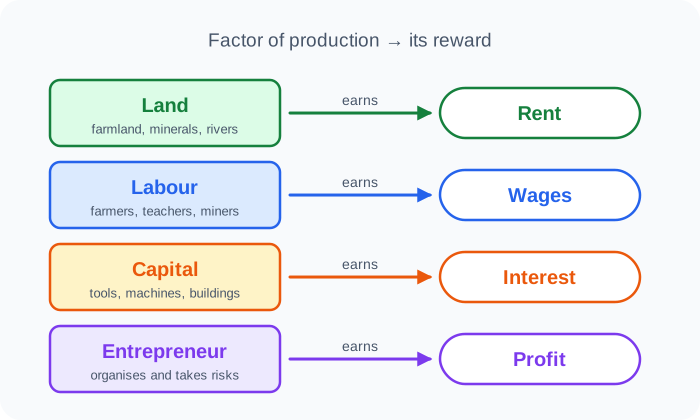
Figure 1. The factors of production and their rewards. WASSCE Tutor diagram.
This lesson covers land and labour; capital and the entrepreneur follow in the next lesson.
Land
In economics, land means all natural resources that are used in production: the soil, rivers and the sea, forests, minerals, and even climate and sunshine.
Sierra Leone's land, in this economic sense, includes its farmland for rice and cassava, its fishing grounds in the Atlantic, its rivers and its mineral deposits such as diamonds, iron ore, rutile and bauxite.
Features of land
- A free gift of nature: it was not made by people.
- Fixed in supply: the total quantity of land cannot be increased (though it can be improved, for example by irrigation).
- Immobile geographically: land cannot be moved from one place to another.
- Subject to diminishing returns: adding more and more labour to a fixed plot eventually adds less and less output.
- Varies in fertility and location: some land is richer or better placed than other land.
- Its reward is rent.
Labour
Labour is any human effort, physical or mental, used in production in return for a reward. A teacher, a farmer, a driver and a doctor all supply labour.
Work done for no reward, such as cooking at home for your own family, is not counted as labour in this sense.
Features of labour
- Labour is human: it cannot be separated from the worker, who has feelings and needs.
- Labour is perishable: a day's work not done today is lost forever.
- Labour is mobile: workers can change jobs and places (see below).
- Its supply can change: through population growth, migration and education.
- It can be trained to become more productive.
- Its reward is wages (or salaries).
Efficiency of labour
The efficiency of labour is the amount a worker can produce in a given time. It depends on:
- education and training: skilled workers produce more
- health and nutrition: a healthy, well-fed worker works better
- tools and machines: a farmer with a power tiller does more than one with a hoe
- working conditions: safe, comfortable conditions raise output
- wages and incentives: fair pay and bonuses encourage effort
- good management: organising work well avoids waste
Mobility of labour
Mobility of labour is the ease with which workers can move from one job to another (occupational mobility) or from one place to another (geographical mobility).
| Type | Example | Things that limit it |
|---|---|---|
| Occupational | A carpenter retrains as an electrician | Lack of skills or training, cost of training, long apprenticeships |
| Geographical | A nurse moves from Kenema to Freetown | Cost of moving, family and social ties, housing costs, language and culture |
Do not confuse efficiency (how much a worker produces) with mobility (how easily a worker can change jobs or places). They are separate ideas and are often asked as separate questions.
Key points
- Four factors: land (rent), labour (wages), capital (interest), entrepreneur (profit).
- Land is natural, fixed in supply and geographically immobile.
- Labour is human effort; its efficiency depends on skills, health, tools and conditions.
- Labour mobility can be occupational or geographical.
WASSCE examination focus
Expect to list the factors of production and their rewards, describe the features of land or labour, and explain the factors affecting the efficiency or mobility of labour. In essay answers, give each point a short heading and one or two sentences of explanation with an example.
Quick check
- What is the reward for land?
- Why is land said to be fixed in supply?
- Give two factors that limit the geographical mobility of labour.
Answers: 1. Rent. 2. Because the total quantity of land on earth cannot be increased by human effort. 3. For example: the cost of moving; family ties; high housing costs in the new place; differences in language or culture.
Keep going with factors of production
This is one of 2 lessons in Factors of Production. Start free with the first lesson of every topic, then unlock them all, plus exam-style practice marked instantly and guided learning tools, from 25 NLe.
- Free account, no card needed
- Everything from 25 NLe
- No automatic renewal
More lessons in Factors of Production
- Capital and the entrepreneur🔒