WASSCE Economics · Elasticity of Demand and Supply
Price elasticity of demand
By the WASSCE Tutor team
Updated 12 November 2026 · 7 min read · Prepared against the WASSCE syllabus.
If the price of salt doubled, would your family stop buying it? Probably not. If the price of one brand of biscuit doubled, you would switch at once. Elasticity measures that difference, and it decides who pays taxes, what firms charge and how farm incomes behave.
Learning objectives
By the end of this lesson you should be able to:
- define price elasticity of demand and calculate it
- interpret elasticity values: elastic, inelastic, unitary, perfectly elastic and perfectly inelastic
- explain the factors that determine price elasticity of demand and the total revenue test
What elasticity measures
The law of demand tells us that quantity demanded falls when price rises. It does not tell us by how much. Elasticity answers that question.
Price elasticity of demand (PED) measures the degree of responsiveness of the quantity demanded of a good to a change in its own price.
(qty is short for quantity.)
An equivalent form, using the original price and original quantity :
Because price and quantity demanded move in opposite directions, the answer is negative. In practice we ignore the minus sign and look at the size of the number.
Two worked examples
Sugar. The price of a bag of sugar rises from NLe 20 to NLe 25. The quantity demanded falls from 100 bags to 90 bags a week.
- % change in price
- % change in quantity
- , so the coefficient is 0.4
Since 0.4 is less than 1, demand for sugar is inelastic: buyers hardly cut back.
A soft drink. The price of a bottle falls from NLe 10 to NLe 8. The quantity demanded rises from 50 to 70 bottles a day.
- % change in price
- % change in quantity
- , so the coefficient is 2
Since 2 is greater than 1, demand is elastic: buyers respond strongly.
Interpreting the number
| Coefficient | Name | Meaning | Shape of demand curve |
|---|---|---|---|
| 0 | Perfectly inelastic | Quantity does not change at all when price changes | Vertical |
| Between 0 and 1 | Inelastic | Quantity changes by a smaller % than price | Steep |
| Exactly 1 | Unitary | Quantity changes by the same % as price | A rectangular hyperbola |
| Greater than 1 | Elastic | Quantity changes by a larger % than price | Flat |
| Infinity () | Perfectly elastic | Any rise in price makes quantity demanded fall to zero | Horizontal |
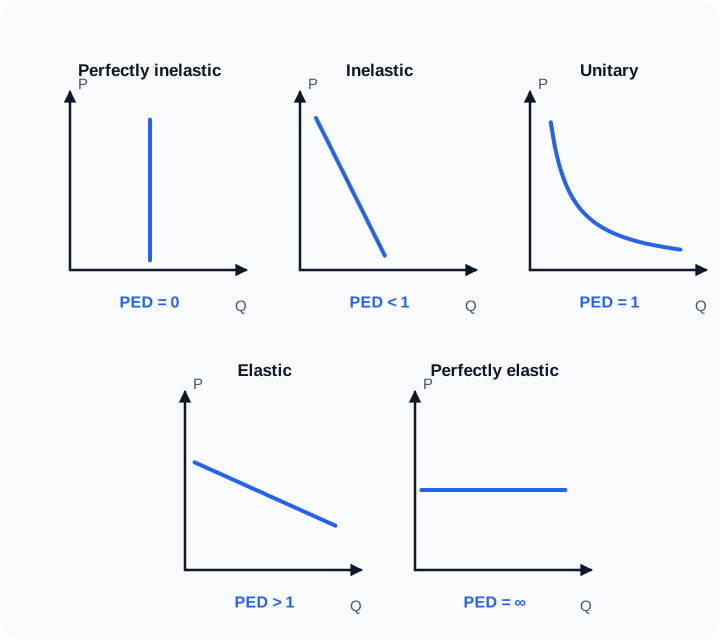
Figure 1. The five degrees of price elasticity of demand. WASSCE Tutor diagram.
Do not judge elasticity from the slope of a curve drawn on a page. A curve can look steep or flat depending on the scale of the axes. Calculate the coefficient from the figures.
Determinants of price elasticity of demand
- Availability of substitutes. Goods with many close substitutes have elastic demand. If one brand of soap becomes dearer, buyers switch to another.
- Necessities versus luxuries. Necessities such as salt, rice and medicine have inelastic demand. Luxuries such as jewellery are more elastic.
- Proportion of income spent. Goods that take a tiny part of income (matches, salt) have inelastic demand; expensive items (cars, fridges) are more elastic.
- Habit and addiction. Cigarettes and alcohol have inelastic demand.
- Number of uses. A good with many uses (palm oil) tends to be more elastic: a lower price brings in new uses.
- Time. Demand becomes more elastic in the long run as buyers find substitutes.
- Durability. Purchases of durable goods can be postponed when prices rise, so demand is more elastic.
When fuel prices rise, okada riders and keke drivers must still buy fuel to work, so demand for fuel is inelastic in the short run. Over a longer period some people may switch to buses or walk shorter journeys, so demand becomes a little more elastic.
The total revenue test
Total revenue (what sellers receive) is price × quantity. Elasticity tells a seller what will happen to revenue when price changes.
| Demand is | Raise the price | Lower the price |
|---|---|---|
| Inelastic | Total revenue rises | Total revenue falls |
| Elastic | Total revenue falls | Total revenue rises |
| Unitary | Total revenue unchanged | Total revenue unchanged |
Check it with the examples:
- Sugar (inelastic): revenue rises from to when the price rises.
- Soft drink (elastic): revenue rises from to when the price falls.
Key points
- PED = % change in quantity demanded ÷ % change in price; ignore the minus sign.
- Greater than 1: elastic. Less than 1: inelastic. Equal to 1: unitary.
- Determinants: substitutes, necessity, share of income, habit, uses, time, durability.
- If demand is inelastic, a price rise raises total revenue; if elastic, it lowers it.
WASSCE examination focus
Expect a calculation (often from a short table) followed by "Is demand elastic or inelastic? Give a reason." Show the formula, the percentage changes and the final coefficient, then interpret it in words. Essay questions ask for five determinants of elasticity of demand, each with an example.
Quick check
- Price rises by 10% and quantity demanded falls by 30%. What is the PED, and is demand elastic or inelastic?
- Give two reasons why demand for salt is inelastic.
- A seller faces inelastic demand. Should she raise or lower her price to increase revenue?
Answers: 1. : elastic. 2. It is a necessity, it takes a very small share of income, and it has no close substitute. 3. Raise it: with inelastic demand, a higher price increases total revenue.
Keep going with elasticity of demand and supply
This is one of 2 lessons in Elasticity of Demand and Supply. Start free with the first lesson of every topic, then unlock them all, plus exam-style practice marked instantly and guided learning tools, from 25 NLe.
- Free account, no card needed
- Everything from 25 NLe
- No automatic renewal
More lessons in Elasticity of Demand and Supply
- Income, cross and supply elasticity; uses of elasticity🔒