WASSCE Economics · Consumer Behaviour
Utility and the law of diminishing marginal utility
By the WASSCE Tutor team
Updated 12 November 2026 · 7 min read · Prepared against the WASSCE syllabus.
The first cold drink on a hot afternoon in Kenema is wonderful; the fourth, much less so. That everyday experience is one of the most useful laws in economics, and it explains why demand curves slope downwards.
Learning objectives
By the end of this lesson you should be able to:
- define utility and distinguish total, average and marginal utility
- calculate utility from a table and describe the shape of the curves
- state and explain the law of diminishing marginal utility and the paradox of value
What is utility?
Utility is the satisfaction a consumer gets from consuming a good or service. A good has utility if it can satisfy a want, whether or not it is useful or healthy.
Utility is personal: a cold drink gives great satisfaction to a thirsty footballer and very little to someone who has just had three. Utility cannot be measured exactly, but economists use imaginary units called utils to explain consumer behaviour. This is called the cardinal approach.
Total, average and marginal utility
- Total utility (TU) is the total satisfaction from consuming a given quantity of a good.
- Average utility (AU) is total utility per unit: .
- Marginal utility (MU) is the extra satisfaction from consuming one more unit: .
Fatmata eats oranges on a hot afternoon
| Oranges | TU (utils) | AU | MU |
|---|---|---|---|
| 1 | 10 | 10 | 10 |
| 2 | 18 | 9 | 8 |
| 3 | 24 | 8 | 6 |
| 4 | 28 | 7 | 4 |
| 5 | 30 | 6 | 2 |
| 6 | 30 | 5 | 0 |
| 7 | 28 | 4 |
- The 3rd orange adds utils.
- Average utility of 4 oranges utils.
The shape of the curves
Plot TU and MU against the number of oranges:
- While MU is positive, TU rises, but more and more slowly.
- When MU is zero, TU is at its maximum (the 6th orange). This is the point of satiety: Fatmata is fully satisfied.
- When MU is negative, TU falls. The 7th orange makes her feel worse (disutility).
The MU curve slopes downwards and crosses the quantity axis where TU is at its peak.
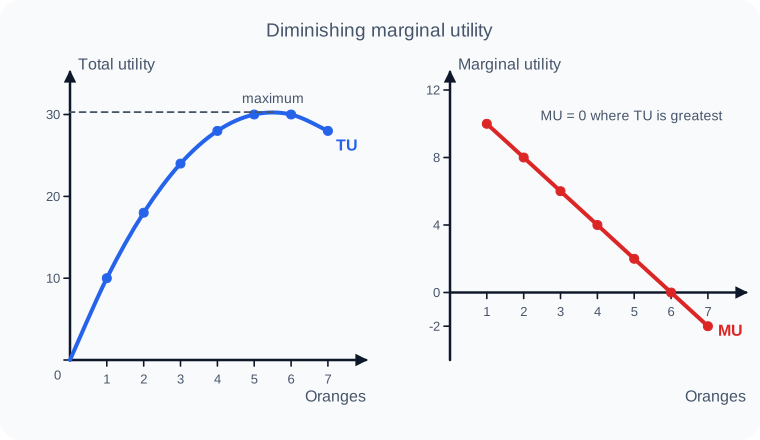
Figure 1. Total and marginal utility of oranges. WASSCE Tutor diagram.
Utility here is measured in imaginary units called utils, as if satisfaction could be counted. This is the cardinal approach to utility. In reality satisfaction cannot be measured exactly, but consumers can still rank what they prefer, which is the ordinal approach. WASSCE questions use utils, as in this table.
"Diminishing marginal utility" does not mean total utility falls. Total utility keeps rising as long as marginal utility is positive; it is only the addition to satisfaction that gets smaller.
The law of diminishing marginal utility
The law of diminishing marginal utility states that, as a consumer consumes more and more units of a good in a given period, the extra satisfaction (marginal utility) from each additional unit eventually falls, other things being equal.
Assumptions of the law
- The units are identical in size and quality.
- Consumption is continuous: the oranges are eaten one after another, not one today and one next month.
- The consumer's tastes and income do not change.
- The consumer is rational.
Exceptions
- Collections and hobbies: a stamp or coin collector may gain more satisfaction from each new item that completes a set.
- Addictive goods: alcohol or drugs may seem to give rising satisfaction.
- Money: many people never feel they have enough (although each extra leone matters less to a rich person than to a poor one).
The law and the demand curve
Because each extra unit gives less satisfaction, a consumer will buy more units only if the price falls. This is one reason the demand curve slopes downwards.
The paradox of value
Water is essential for life, yet it is cheap. Diamonds are not needed for survival, yet they are very expensive. Why?
Sierra Leone mines diamonds, and its rivers and taps provide water. Water is plentiful, so people consume a great deal of it and the marginal utility of the last cup is very low, even though its total utility is enormous. Diamonds are scarce, so few are consumed and the marginal utility of one more diamond is high. Price reflects marginal utility, not total utility. This explains the "diamond–water paradox".
Key points
- Utility = satisfaction. TU = total, AU = TU ÷ Q, MU = extra satisfaction from one more unit.
- When MU is positive, TU rises; when MU is zero, TU is at its maximum; when MU is negative, TU falls.
- Law of diminishing MU: extra satisfaction from each extra unit eventually falls.
- Price depends on marginal utility, which explains the diamond–water paradox.
WASSCE examination focus
Expect a utility table with gaps to fill in (TU, AU or MU), a question asking you to plot TU and MU on graphs and to state the law of diminishing marginal utility. Show each subtraction or division, and describe the relationship between TU and MU when MU is positive, zero and negative.
Quick check
- If TU from 4 units is 40 and from 5 units is 45, what is the MU of the 5th unit?
- What is total utility doing when marginal utility is zero?
- Why are diamonds dearer than water?
Answers: 1. utils. 2. It is at its maximum. 3. Diamonds are scarce, so their marginal utility is high; water is plentiful, so the marginal utility of the last unit is low. Price reflects marginal, not total, utility.
Keep going with consumer behaviour
This is one of 2 lessons in Consumer Behaviour. Start free with the first lesson of every topic, then unlock them all, plus exam-style practice marked instantly and guided learning tools, from 25 NLe.
- Free account, no card needed
- Everything from 25 NLe
- No automatic renewal
More lessons in Consumer Behaviour
- Consumer equilibrium and consumer surplus🔒