WASSCE Economics · Concepts of Cost and Revenue
Fixed, variable, average and marginal costs
By the WASSCE Tutor team
Updated 12 November 2026 · 7 min read · Prepared against the WASSCE syllabus.
A baker in Makeni pays rent on her shop whether she bakes one loaf or a thousand, but she buys more flour for every extra batch. Telling those two kinds of cost apart is the key to every cost calculation WASSCE sets.
Learning objectives
By the end of this lesson you should be able to:
- distinguish fixed costs from variable costs
- calculate total, average and marginal cost from a table
- explain the U shape of the average cost curve
- distinguish money, opportunity, private and social costs
Fixed and variable costs
A firm's costs of production are what it pays for the factors and materials it uses. In the short run they fall into two groups.
Fixed costs (FC) do not change with the level of output. They must be paid even if nothing is produced. Examples: rent, insurance, a watchman's salary, repayments on a loan for machinery.
Variable costs (VC) change with the level of output. They are zero when nothing is produced. Examples: raw materials, fuel, electricity used by machines, wages of casual workers paid per day.
For a baker in Makeni, the rent on the bakery is a fixed cost: it is the same whether she bakes 100 loaves or 1,000. Flour, sugar, yeast and the firewood for the oven are variable costs: the more she bakes, the more she spends on them.
The cost formulas
| Cost | Formula |
|---|---|
| Total cost | |
| Average fixed cost | |
| Average variable cost | |
| Average (total) cost | , or |
| Marginal cost | (the extra cost of one more unit) |
Here is the quantity of output.
A small factory has fixed costs of NLe 100 a day. Its variable costs at each level of output are given; the rest is calculated.
Total costs
| Output () | FC | VC | TC |
|---|---|---|---|
| 0 | 100 | 0 | 100 |
| 1 | 100 | 40 | 140 |
| 2 | 100 | 70 | 170 |
| 3 | 100 | 90 | 190 |
| 4 | 100 | 120 | 220 |
| 5 | 100 | 170 | 270 |
| 6 | 100 | 240 | 340 |
Average and marginal costs
| Output () | AFC | AVC | ATC | MC |
|---|---|---|---|---|
| 1 | 100 | 40 | 140 | 40 |
| 2 | 50 | 35 | 85 | 30 |
| 3 | 33.3 | 30 | 63.3 | 20 |
| 4 | 25 | 30 | 55 | 30 |
| 5 | 20 | 34 | 54 | 50 |
| 6 | 16.7 | 40 | 56.7 | 70 |
Sample calculations:
- TC at :
- ATC at :
- MC of the 5th unit:
What the table shows
- AFC falls continuously as output rises: the same NLe 100 is spread over more units.
- MC first falls (40, 30, 20) and then rises (30, 50, 70), because of diminishing returns: as more variable factors are added to the fixed factory, each extra unit eventually costs more to make.
- ATC falls while MC is below it (ATC drops from 140 to 54), and rises once MC is above it (the 6th unit's MC of 70 pulls ATC up to 56.7).
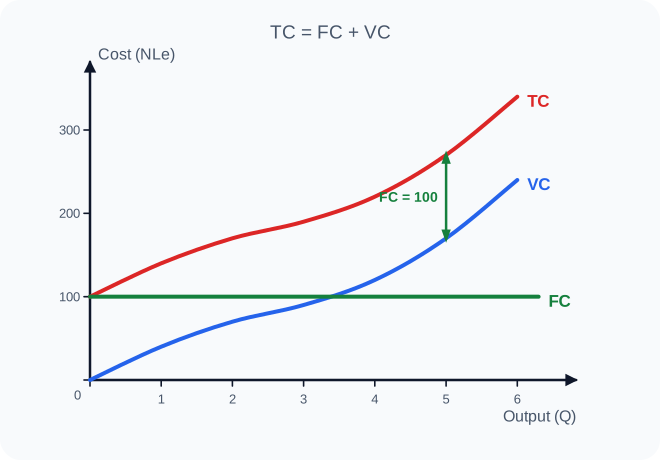
Figure 1. Total, variable and fixed cost. WASSCE Tutor diagram.
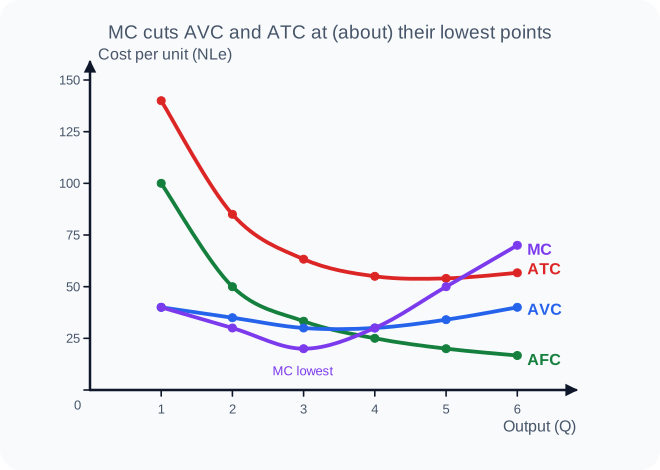
Figure 2. Average and marginal cost curves. WASSCE Tutor diagram.
The average cost curve is U-shaped in the short run. It falls at first because fixed costs are spread over more output and because of increasing returns, then rises because of diminishing returns. The marginal cost curve cuts the average cost curve at its lowest point.
Marginal cost is the change in total cost, not the change in average cost. Always subtract one TC figure from the next: .
Other cost concepts
| Concept | Meaning | Example |
|---|---|---|
| Money (explicit) cost | Actual payments made for factors of production | Wages, rent, fuel, raw materials |
| Implicit cost | The value of the owner's own resources used in the business, for which no payment is made | A trader using her own shop instead of renting it out |
| Opportunity (real) cost | The next best alternative given up | Land used for a car park instead of a market |
| Private cost | The cost borne by the firm itself | A sawmill's spending on logs and labour |
| Social cost | Private cost plus the cost the activity imposes on the rest of society | Noise, dust or river pollution from a mine or sawmill |
When social cost is greater than private cost, the firm does not pay for all the harm it causes. This is one reason governments regulate or tax activities such as mining and logging.
Short run and long run
- In the short run, at least one factor (and so some cost) is fixed.
- In the long run, all factors can be changed, so all costs are variable. A firm can build a bigger factory or move to a new site.
Key points
- Fixed costs do not vary with output; variable costs do. .
- ; MC is the extra total cost of one more unit.
- AFC always falls; MC and ATC are U-shaped; MC cuts ATC at its minimum.
WASSCE examination focus
You will often get a cost table to complete and questions such as "at what output is average cost lowest?" or "explain why the average cost curve is U-shaped". Show sample calculations, keep columns neat, and use the words fixed costs spread over more output and diminishing returns in your explanation.
Quick check
- Is the rent on a shop a fixed or a variable cost?
- If TC is NLe 300 at 6 units and NLe 360 at 7 units, what is the marginal cost of the 7th unit?
- In the table above, at what output is ATC lowest?
Answers: 1. A fixed cost. 2. NLe 60. 3. At 5 units, where ATC is NLe 54.
Keep going with concepts of cost and revenue
This is one of 2 lessons in Concepts of Cost and Revenue. Start free with the first lesson of every topic, then unlock them all, plus exam-style practice marked instantly and guided learning tools, from 25 NLe.
- Free account, no card needed
- Everything from 25 NLe
- No automatic renewal
More lessons in Concepts of Cost and Revenue
- Revenue and profit maximisation🔒