WASSCE Economics · Basic Concepts of Economics
Wants, scarcity, choice and opportunity cost
By the WASSCE Tutor team
Updated 12 November 2026 · 10 min read · Prepared against the WASSCE syllabus.
Every day you choose: data or lunch, a taxi or the walk, revising or football. Economics begins with the reason you cannot have everything. This lesson covers the four ideas every other topic builds on: wants, scarcity, choice and opportunity cost.
Learning objectives
By the end of this lesson you should be able to:
- explain human wants, scarcity and choice, and how they are linked
- state the characteristics of human wants
- distinguish free goods from economic goods
- draw up a scale of preference
- define opportunity cost, identify it in simple cases and explain why it matters
Wants
Wants are the desires people have for goods and services. Human wants are unlimited: as soon as one want is satisfied, another appears.
A pupil who gets a new pair of school shoes soon wants a bag, then a calculator, then a phone. A family that buys a radio soon wants a television. Wants also recur: you eat today, and you will want food again tomorrow.
Wants are often grouped as:
- necessities: things needed to live, such as food, water, clothing and shelter
- comforts: things that make life easier, such as a fan or a mattress
- luxuries: things that are not needed but give extra satisfaction, such as jewellery or an expensive car
What counts as a comfort or a luxury depends on income and place: a fan is a comfort in Freetown, but a refrigerator may be a luxury for a family in a remote village.
Characteristics of human wants
| Characteristic | Meaning | Example |
|---|---|---|
| Unlimited | There is no end to wants | After a phone, you want a better phone |
| Recurrent | Many wants come back again and again | Food, transport, phone credit |
| Competitive | Wants compete for the same limited money | School fees or a new radio? |
| Complementary | Some wants go together | A car needs fuel; a phone needs credit |
| Varying | Wants differ with age, sex, income, religion and culture | A baby needs milk; a student needs books |
| Habit-forming | Some wants become habits | Tea every morning |
Scarcity
Scarcity means that the resources available to satisfy wants are limited compared with the wants themselves.
Scarcity does not mean that something is rare. Rice is common in Sierra Leone, but it is still scarce in the economic sense: no family has enough money to buy all the rice, clothes, school fees and other things it would like. Money, land, time, labour and raw materials are all scarce.
Scarcity is relative: it compares what is available with what people want. A country rich in diamonds and fish still faces scarcity, because its people want more schools, roads, hospitals and jobs than its resources can provide at once.
Free goods and economic goods
- A free good is available in such quantity that it is not scarce and has no price: no one has to give anything up to get it. Examples: air, sunshine, sea water.
- An economic good is scarce: it has a price, and getting it means giving something else up. Examples: rice, books, electricity, and even clean, treated water piped to a house.
A good can change category. Water in a river is a free good to a farmer in the provinces, but bottled or treated water sold in Freetown is an economic good, because resources were used to collect, clean and deliver it. Economics studies economic goods, because only they involve choice.
Choice
Because wants are unlimited and resources are scarce, people must choose which wants to satisfy now and which to leave for later. Firms choose what to produce, and governments choose what to spend on.
The scale of preference
To choose sensibly, people rank their wants in order of importance.
A scale of preference is a list of wants arranged in order of importance, with the most pressing want first.
Aminata has NLe 300 this month. Her wants, in order of importance, are:
| Rank | Want | Cost (NLe) | Running total (NLe) |
|---|---|---|---|
| 1 | Food for the month | 180 | 180 |
| 2 | Transport to school | 60 | 240 |
| 3 | Exercise books | 40 | 280 |
| 4 | New sandals | 70 | 350 |
| 5 | Phone data | 30 | 380 |
With NLe 300 she can satisfy wants 1 to 3 (NLe 280). She cannot also afford the sandals, so they are left unsatisfied this month, even though she has NLe 20 left over.
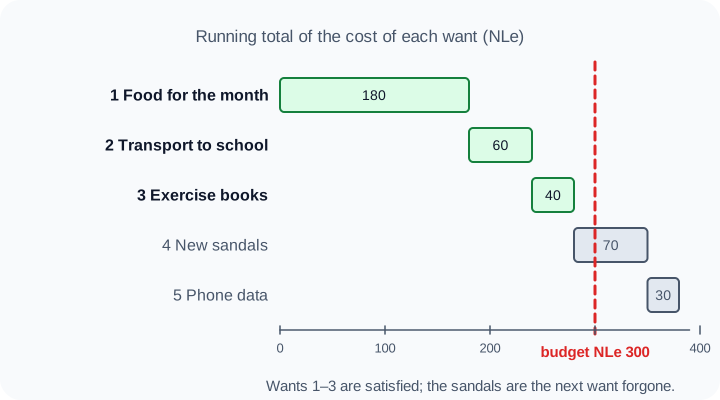
Figure 1. Aminata's scale of preference against her budget. WASSCE Tutor diagram.
Uses of a scale of preference: it helps a person, a firm or a government to spend limited money on the most pressing needs first, to plan ahead, and to see clearly what is being given up (the opportunity cost) with each choice.
Opportunity cost
Every choice means giving something up.
Opportunity cost is the value of the next best alternative that is given up when a choice is made. It is also called real cost.
In the example above, if Aminata had chosen sandals instead of exercise books, the opportunity cost of the sandals would be the exercise books, her next best alternative, not everything else on the list.
A farmer in Kambia has one acre of land. He can plant either rice or groundnuts on it. He chooses rice.
- Opportunity cost of the rice: the groundnuts he could have grown on the same acre.
- Money cost: the seed, fertiliser and labour he paid for.
The money cost and the opportunity cost are different ideas. Economists care most about opportunity cost, because it shows what was really sacrificed.
Opportunity cost is only the next best alternative, not the sum of all the alternatives. If you choose A over B, C and D, and B was your second choice, the opportunity cost of A is B alone.
Why opportunity cost matters
| Who | How the idea helps |
|---|---|
| A household | Decides how to spend a limited income: the money spent on a new phone cannot also pay the electricity bill |
| A student | Weighs uses of time: an evening of television costs an evening of revision |
| A firm | Chooses what to produce: land used for a palm-oil mill cannot also be a warehouse |
| A government | Ranks projects: a new hospital may mean delaying a road. Every budget is a list of choices |
When the Government of Sierra Leone spends more on free quality school education, that money cannot also be spent on, say, extra feeder roads in the same year. The roads forgone are the opportunity cost of the school spending, which is why budget debates in Parliament are about priorities, not just totals.
Key points
- Wants are unlimited, recurrent, competitive and complementary; resources are scarce.
- Free goods have no price and involve no sacrifice; economic goods are scarce and have a price.
- Scarcity forces choice.
- A scale of preference ranks wants in order of importance.
- Opportunity cost is the next best alternative forgone.
WASSCE examination focus
Define each term exactly, then show how they are linked: unlimited wants + scarce resources → choice → opportunity cost. Questions often give a short case (a student, a farmer, a government) and ask you to identify the opportunity cost. Name only the next best alternative.
Quick check
- Why is rice called "scarce" even though it is sold in every market?
- Musa can spend his Saturday working on his father's farm, revising Chemistry or playing football. He would most like to revise; his second choice is the farm. What is the opportunity cost of revising?
- What is a scale of preference used for?
- Give one example of a free good and explain why it has no price.
- State three characteristics of human wants.
Answers: 1. Because people's wants for it (and for everything else) are greater than the money and resources available. 2. Working on the farm, his next best alternative. 3. To rank wants in order of importance so that the most pressing are satisfied first. 4. Air (or sunshine): there is so much of it that no one gives anything up to use it, so it is not scarce. 5. Any three: unlimited, recurrent, competitive, complementary, varying with age and income, habit-forming.
Keep going with basic concepts of economics
This is one of 2 lessons in Basic Concepts of Economics. Start free with the first lesson of every topic, then unlock them all, plus exam-style practice marked instantly and guided learning tools, from 25 NLe.
- Free account, no card needed
- Everything from 25 NLe
- No automatic renewal
More lessons in Basic Concepts of Economics
- The basic economic problems and the production possibility curve🔒