WASSCE Economics · Balance of Payments and Exchange Rates
The balance of payments
By the WASSCE Tutor team
Updated 12 November 2026 · 8 min read · Prepared against the WASSCE syllabus.
When Sierra Leone imports more than it exports, how does it pay the difference? Every payment between Sierra Leone and the rest of the world, from a cargo of fuel to a remittance from a relative in London, is recorded in one set of accounts: the balance of payments. WASSCE expects you to read it, calculate its balances and explain how a deficit is corrected.
Learning objectives
By the end of this lesson you should be able to:
- define the balance of trade and the balance of payments
- describe the parts of the balance of payments
- calculate the balance of trade and the current account balance
- explain the causes of a balance of payments deficit
- explain the measures used to correct a deficit
Balance of trade and balance of payments
- The balance of trade (visible balance) is the difference between the value of a country's exports and imports of goods.
- The balance of payments (BOP) is a systematic record of all economic transactions between the residents of a country and the rest of the world over a period, usually a year.
The balance of trade is only one part of the balance of payments.
The structure of the balance of payments
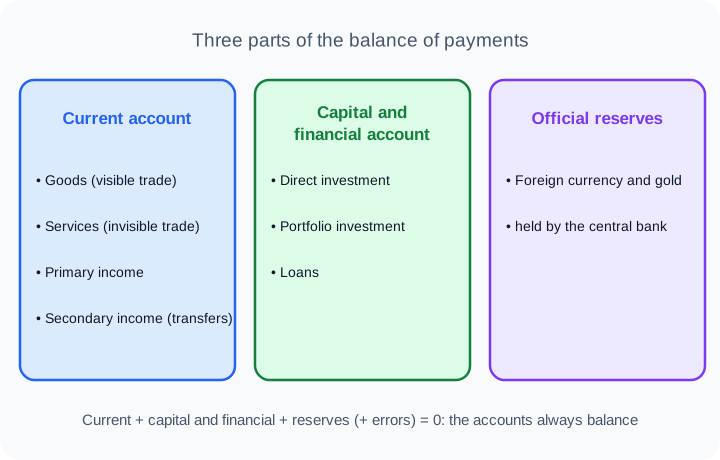
Figure 1. The three main parts of the balance of payments. WASSCE Tutor diagram.
| Account | What it records | Examples |
|---|---|---|
| Current account | Trade in goods and services, income and transfers | |
| – Visible trade (goods) | Exports and imports of goods | Iron ore exports; rice and fuel imports |
| – Invisible trade (services) | Exports and imports of services | Shipping, insurance, tourism, banking |
| – Primary income | Wages, interest and profits paid to or from abroad | Profits sent home by foreign mining firms |
| – Secondary income (transfers) | One-way transfers with nothing in return | Remittances from Sierra Leoneans abroad; aid grants |
| Capital and financial account | Flows of investment and loans | Foreign direct investment in a mine; loans from abroad; portfolio investment |
| Official reserves | Changes in the central bank's foreign currency and gold | Reserves fall to pay for a deficit |
Because every transaction is recorded twice (as a credit and a debit), the balance of payments always balances in an accounting sense. A "deficit" or "surplus" refers to the balance of particular accounts, usually the current account, before official financing.
Calculating the balances
A country's transactions in a year (US$ million):
| Item | Value |
|---|---|
| Exports of goods | 900 |
| Imports of goods | 1,300 |
| Exports of services | 150 |
| Imports of services | 350 |
| Primary income received | 40 |
| Primary income paid (profits sent abroad) | 160 |
| Secondary income (remittances and grants) received, net | 420 |
- Balance of trade (visible balance) : a deficit of US$400 million.
- Balance on services .
- Net primary income .
- Current account balance : a current account deficit of US$300 million.
This deficit must be financed by inflows on the capital and financial account (investment, loans) or by drawing on official reserves.
Causes of a balance of payments deficit
- Heavy dependence on imports of food, fuel and manufactured goods.
- Low and unstable export earnings from a few primary products.
- Worsening terms of trade.
- High domestic inflation, which makes exports dear and imports cheap.
- Large payments of profits, interest and debt service abroad.
- An overvalued exchange rate.
- Large government spending abroad (embassies, imports for projects).
- Capital flight: residents moving money out of the country.
- Natural disasters, epidemics or conflict that cut exports.
Correcting a deficit
| Measure | How it works |
|---|---|
| Devaluation or depreciation | Makes exports cheaper abroad and imports dearer at home |
| Tariffs, quotas and import controls | Directly reduce imports |
| Exchange control | Rations foreign currency for essential imports |
| Deflationary policies (higher interest rates, less government spending, higher taxes) | Reduce total demand, and so imports, and slow inflation |
| Export promotion | Subsidies, credit, better quality and marketing to raise exports |
| Import substitution | Produce at home goods that were imported |
| Attracting foreign investment and remittances | Brings in foreign exchange |
| Borrowing (including from the IMF) | Finances the deficit in the short run |
Measures that cut spending (deflation) are called expenditure-reducing; measures that shift spending from imports to home goods (devaluation, tariffs) are called expenditure-switching.
Sierra Leone usually has a trade deficit: imports of fuel, rice and machinery exceed exports, except in years of very high iron ore output. Remittances from Sierra Leoneans abroad and grants from development partners are an important source of foreign exchange that helps to finance the current account.
Do not use "balance of trade" and "balance of payments" as if they mean the same thing. The balance of trade covers goods only; the balance of payments covers all transactions, including services, income, transfers and capital flows.
Key points
- The balance of trade is exports minus imports of goods.
- The balance of payments records all transactions with the rest of the world: current account, capital and financial account, and official reserves.
- Current account balance = visible + invisible balances + net primary income + net transfers.
- Deficits arise from heavy imports, weak exports, inflation and profit outflows.
- Corrections are expenditure-reducing (deflation) or expenditure-switching (devaluation, tariffs).
WASSCE examination focus
Expect to distinguish the balance of trade from the balance of payments, to state the components of the balance of payments, to calculate the visible balance and current account balance from a table, and to explain the causes and remedies of a deficit. Show each balance separately with its sign.
Quick check
- Exports of goods are $500 million and imports of goods $650 million. What is the balance of trade?
- In which account are remittances from relatives abroad recorded?
- Give two causes of a balance of payments deficit in a West African country.
- What is an expenditure-switching policy?
Answers: 1. : a deficit of $150 million. 2. The current account (secondary income / transfers). 3. Any two: dependence on imports, low or unstable export earnings, worsening terms of trade, inflation, profit and debt payments abroad, overvalued currency, capital flight. 4. A policy that shifts spending from imports to home-produced goods, such as devaluation or tariffs.
Keep going with balance of payments and exchange rates
This is one of 2 lessons in Balance of Payments and Exchange Rates. Start free with the first lesson of every topic, then unlock them all, plus exam-style practice marked instantly and guided learning tools, from 25 NLe.
- Free account, no card needed
- Everything from 25 NLe
- No automatic renewal
More lessons in Balance of Payments and Exchange Rates
- Exchange rates, devaluation and international financial institutions🔒