WASSCE Commerce · Wholesale Trade
Wholesale trade: the wholesaler's services
By the WASSCE Tutor team
Updated 12 November 2026 · 6 min read · Prepared against the WASSCE syllabus.
A soap factory produces thousands of cartons a week; a kiosk sells a few bars a day. Between them stands the wholesaler, who buys by the lorry-load and sells by the carton. This lesson explains what wholesalers do for manufacturers, retailers and consumers, and the different kinds of wholesalers.
Learning objectives
By the end of this lesson you should be able to:
- define wholesale trade and the wholesaler
- explain the functions of the wholesaler to manufacturers, retailers and consumers
- describe the types of wholesalers, including cash-and-carry
- state the features of a good wholesaler
What is wholesale trade?
Wholesale trade is the buying of goods in very large quantities from manufacturers or importers and selling them in smaller quantities to retailers (and sometimes to large users). The wholesaler is the middleman between producers and retailers.
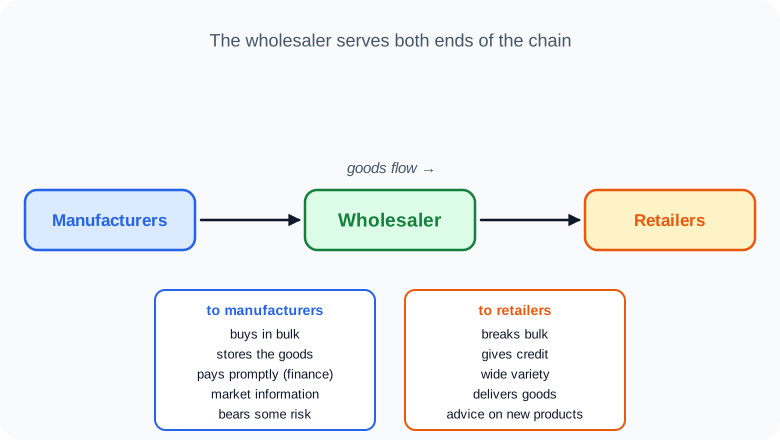
Figure 1. The services of the wholesaler to both ends of the chain. WASSCE Tutor diagram.
Functions of the wholesaler
To manufacturers (and importers)
- Buys in bulk, so the manufacturer can produce on a large scale.
- Stores goods (warehousing), saving the manufacturer storage space and cost.
- Finances production: pays promptly, often before the goods are sold to retailers.
- Bears risks of price falls, changes in fashion and damage after buying.
- Gives market information about demand, prices and complaints.
- Distributes the goods to many retailers the manufacturer could not reach.
- Advertises and promotes some products.
To retailers
- Breaks bulk: sells in quantities small retailers can afford.
- Grants credit, so retailers can buy now and pay after selling.
- Offers variety: goods from many manufacturers in one place.
- Delivers goods to retailers' shops.
- Advises retailers on new products, display and pricing.
- Keeps a steady supply from stock, so retailers need not hold large stocks.
To consumers and the economy
- Stabilises prices by holding stock in times of plenty and releasing it in times of scarcity.
- Grades, packs and branding: some wholesalers sort, pack and label goods.
- Ensures goods are available all year round in many places.
Why one wholesaler saves trips. Suppose 5 manufacturers each sell to 40 retailers directly. That needs separate sales contacts. With one wholesaler, each manufacturer deals only with the wholesaler (5 contacts) and the wholesaler deals with the 40 retailers (40 contacts): contacts. The wholesaler cuts the number of transactions, and so the cost of distribution.
Types of wholesalers
| Type | Description |
|---|---|
| General wholesaler | Stocks a wide range of goods (provisions, toiletries, drinks) |
| Specialist wholesaler | Deals in one line of goods (medicines, building materials, textiles) |
| Regional / national wholesaler | Serves one region, or the whole country through branches |
| Cash-and-carry wholesaler | Retailers come to the warehouse, select goods themselves, pay cash and carry them away; no credit or delivery, so prices are lower |
| Importer-wholesaler | Imports goods in bulk and sells them to local retailers |
| Producer's own depot | A manufacturer runs its own wholesale branch |
Cash-and-carry: advantages to retailers are lower prices, the chance to choose goods themselves and quick service. Disadvantages: no credit, no delivery, and the retailer pays the cost of transport.
Features of a good wholesaler
- Adequate capital to buy in bulk and give credit.
- Warehouse facilities and good stock control.
- Knowledge of the market: what sells, at what price.
- Reliable transport and delivery.
- Location convenient to both suppliers (ports, factories) and retailers.
- Honesty and good relations with suppliers and retailers.
Wholesale trade in Freetown clusters around the port and the commercial areas of Kissy Road, Sani Abacha Street and the East End, where importers and wholesalers sell rice, sugar, flour, onions and provisions in bags and cartons to retailers who come in from across the city and the provinces.
The wholesaler does not "increase prices for nothing". The wholesaler's margin pays for real services: storage, transport, credit, risk-bearing and breaking bulk. If the wholesaler is removed, someone else must perform and pay for these services.
Key points
- The wholesaler buys in bulk from producers and sells in smaller lots to retailers.
- To manufacturers: bulk buying, storage, finance, risk-bearing, market information, distribution.
- To retailers: breaking bulk, credit, variety, delivery, advice, steady supply.
- Types: general, specialist, regional, cash-and-carry, importer-wholesaler.
WASSCE examination focus
A classic question: "Explain the services of the wholesaler to (a) the manufacturer and (b) the retailer." Other questions ask about cash-and-carry and the types of wholesalers. Set out services under separate headings for each group served.
Quick check
- Give three services of the wholesaler to the manufacturer.
- Give three services of the wholesaler to the retailer.
- What is a cash-and-carry wholesaler?
- How does a wholesaler help to stabilise prices?
Answers: 1. Any three: bulk buying, storage, prompt payment (finance), risk-bearing, market information, distribution, promotion. 2. Any three: breaking bulk, credit, variety, delivery, advice, steady supply. 3. A wholesaler from whom retailers select goods themselves, pay cash and transport them away, without credit or delivery. 4. By storing goods when they are plentiful and releasing them when they are scarce.
Keep going with wholesale trade
This is one of 2 lessons in Wholesale Trade. Start free with the first lesson of every topic, then unlock them all, plus exam-style practice marked instantly and guided learning tools, from 25 NLe.
- Free account, no card needed
- Everything from 25 NLe
- No automatic renewal
More lessons in Wholesale Trade
- Agents, middlemen and the case for eliminating the wholesaler🔒