WASSCE Commerce · Warehousing
Warehousing: functions and importance
By the WASSCE Tutor team
Updated 12 November 2026 · 8 min read · Prepared against the WASSCE syllabus.
Most of Sierra Leone's rice is harvested in a few months at the end of the year, yet families buy rice every week. Imported goods arrive by the shipload, but shops sell them a few cartons at a time. Something must hold goods between the time they are produced and the time they are wanted. That is the work of warehousing.
Learning objectives
By the end of this lesson you should be able to:
- define warehousing and explain how it removes the hindrance of time
- explain the functions of a warehouse
- explain the importance of warehousing to producers, traders, consumers and government
- state the features of a good warehouse
- work out whether storing goods is profitable
Meaning of warehousing
A warehouse is a building where goods are stored until they are needed. Warehousing is the storing of goods, and their care, from the time they are produced or imported until the time they are sold or used. It removes the hindrance of time and creates time utility.
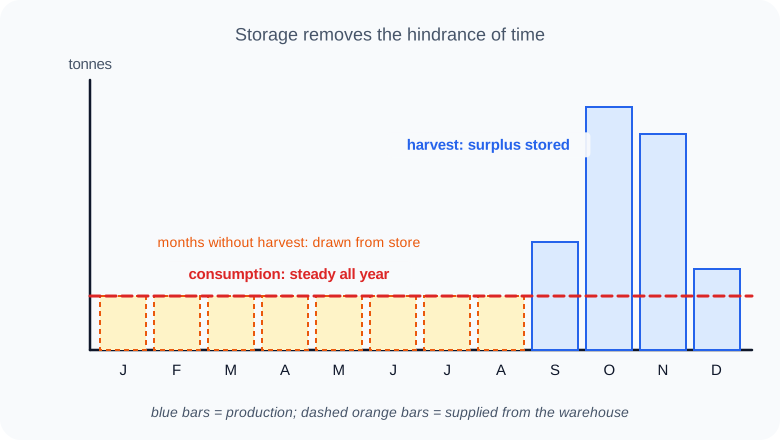
Figure 1. Warehousing bridges the gap between seasonal production and steady consumption. WASSCE Tutor diagram.
Production and consumption rarely happen at the same time:
- Seasonal production, all-year demand: rice, cocoa, coffee, groundnuts.
- All-year production, seasonal demand: umbrellas and raincoats (rainy season), school uniforms (September), Christmas goods.
- Production in anticipation of demand: factories produce continuously and store until orders come.
Functions of a warehouse
- Storage: keeps goods safely until they are needed.
- Protection: shields goods from rain, heat, pests, theft and fire.
- Price stabilisation: goods stored when plentiful are released when scarce, so prices do not swing so sharply.
- Continuous supply: consumers get goods all year, not only at harvest.
- Continuous production: factories can keep producing even when sales are slow, and keep stocks of raw materials so work never stops.
- Breaking bulk: large consignments are divided into smaller lots for retailers.
- Preparing goods for sale: grading, sorting, blending, packing, labelling and branding.
- Seasoning and ripening: some goods improve with storage (timber dries, some fruits ripen, rice ages).
- Collateral for loans: a warehouse warrant can be used as security for a bank loan.
- Customs control: bonded warehouses hold imported goods until duty is paid.
- Display: some warehouses act as showrooms where buyers inspect goods.
Is storage worth it? At harvest a trader buys 200 bags of rice at NLe 400 a bag. Storage and insurance cost NLe 15 per bag per month. Four months later the price is NLe 500 a bag.
- Cost of the rice NLe 80,000
- Storage and insurance NLe 12,000
- Total cost NLe 92,000
- Sales revenue NLe 100,000
- Profit from storing NLe 8,000
Storage pays only if the price rise is greater than the cost of storing. Here the price rose by NLe 100 a bag and storage cost NLe 60 a bag. The trader also bears the risk that prices fall or rats damage the stock. That risk is why the reward exists.
Importance of warehousing
| To | Importance |
|---|---|
| Producers and manufacturers | Continuous production; store raw materials and finished goods; produce in anticipation of demand |
| Wholesalers and retailers | Hold stock to meet orders promptly; buy in bulk when prices are low; prepare goods for sale |
| Consumers | Goods available all year; steadier prices; fresher seasonal goods from cold stores |
| Importers and exporters | Store goods at ports while documents and transport are arranged; delay duty in bonded warehouses |
| Government | Food security reserves; customs control of imports; jobs and taxes |
| Farmers | Avoid selling everything at low harvest prices; reduce post-harvest losses |
Features of a good warehouse
- Good location: near roads, railways or ports, and near markets or factories.
- Adequate space and the right design for the goods (shelves, racks, cold rooms, tanks).
- Security: strong doors, fences, guards, alarms and CCTV.
- Protection from fire: extinguishers, sprinklers and fire exits.
- Ventilation, dryness and temperature control, so goods do not spoil.
- Pest control against rats and insects.
- Handling equipment: forklifts, pallets, conveyors and trolleys.
- Loading bays for lorries.
- Proper records: stock cards and computer systems showing goods received and issued.
- Insurance of the building and its contents.
In Sierra Leone, cocoa and coffee are stored and graded before export, and rice is stored by importers and wholesalers in Freetown and the provincial towns. Cold stores keep fish landed at Tombo and Goderich fresh. At the Queen Elizabeth II Quay, port warehouses and bonded warehouses hold imported goods until customs duties are paid. Poor storage on farms means some harvest is lost to rot and pests every year: a strong case for more community stores.
Warehousing removes the hindrance of time, not of place. Transport removes the hindrance of place. WASSCE answers often confuse the two.
Key points
- Warehousing stores goods from production until use; it removes the hindrance of time and creates time utility.
- Functions: storage, protection, price stabilisation, continuous supply and production, breaking bulk, preparing goods, collateral, customs control.
- Storing is profitable only if the price rise exceeds the cost of storage, and the trader bears the risk.
- A good warehouse is well located, secure, fire-protected, ventilated, equipped and well recorded.
WASSCE examination focus
WASSCE often asks: "State the functions of a warehouse", "Explain the importance of warehousing to (producers, traders, consumers)" and "What are the features of a good warehouse?" Explain each point in a sentence; one-word lists score little.
Quick check
- Which hindrance to trade does warehousing remove?
- Give three functions of a warehouse.
- A trader buys 50 bags at NLe 300, stores them for 3 months at NLe 10 per bag per month and sells at NLe 360. Find the profit.
- Give three features of a good warehouse.
Answers: 1. The hindrance of time. 2. Any three: storage, protection, price stabilisation, continuous supply, continuous production, breaking bulk, preparing goods for sale, seasoning, collateral, customs control, display. 3. Cost ; storage ; revenue ; profit NLe 1,500. 4. Any three: good location, adequate space, security, fire protection, ventilation and temperature control, pest control, handling equipment, loading bays, proper records, insurance.
Keep going with warehousing
This is one of 2 lessons in Warehousing. Start free with the first lesson of every topic, then unlock them all, plus exam-style practice marked instantly and guided learning tools, from 25 NLe.
- Free account, no card needed
- Everything from 25 NLe
- No automatic renewal
More lessons in Warehousing
- Types of warehouses, stock control and warehouse documents🔒