WASSCE Commerce · Transportation
Transport: importance and modes
By the WASSCE Tutor team
Updated 12 November 2026 · 9 min read · Prepared against the WASSCE syllabus.
Cocoa grown near Kenema is worth little until it reaches the ship at Freetown, and imported rice is no use in the port when families in Makeni need it. Transport moves goods and people from where they are to where they are wanted. It is the aid to trade that removes the hindrance of place, and every other part of commerce depends on it.
Learning objectives
By the end of this lesson you should be able to:
- define transport and explain its importance to commerce
- name the modes of transport and their main forms
- state the advantages and disadvantages of road, rail, water, air and pipeline transport
- distinguish liners from tramps and inland, coastal and ocean shipping
- describe transport in Sierra Leone and its problems
Meaning and importance of transport
Transport is the movement of goods and people from one place to another. It removes the hindrance of place (distance) between producers and consumers and creates place utility: goods are more useful where they are needed.
Importance of transport to commerce:
- Links producers and consumers in different places.
- Widens the market: producers can sell all over the country and abroad, making large-scale production possible.
- Makes specialisation possible: each area can specialise because goods can be moved in and out.
- Helps to stabilise prices by moving goods from areas of surplus to areas of shortage.
- Carries perishable goods quickly (fish, vegetables, fruit).
- Moves raw materials to factories and finished goods to markets.
- Makes foreign trade possible: imports and exports travel by sea and air.
- Creates employment for drivers, seamen, pilots, mechanics and port workers.
- Mobility of labour: workers can travel to where jobs are.
- Supports other aids to trade: tourism, mail, insurance and warehousing all depend on transport.
The modes of transport
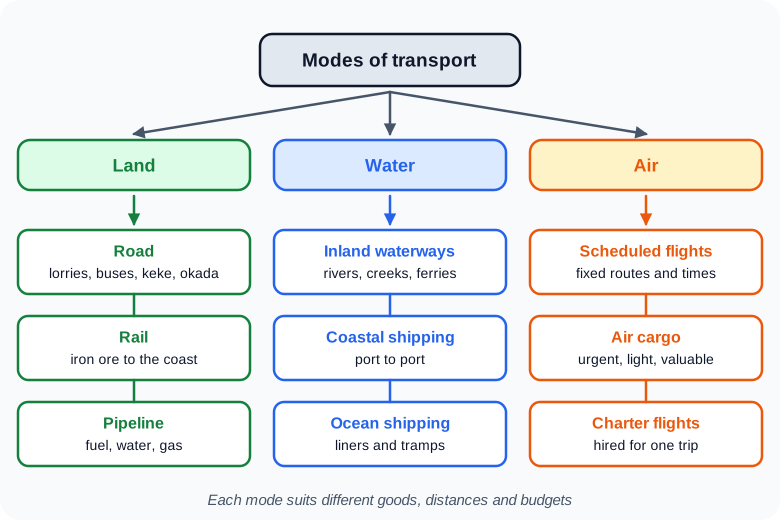
Figure 1. The modes of transport and their main forms. WASSCE Tutor diagram.
Road transport
Lorries, vans, buses, taxis, poda-podas, kekes (tricycles) and okadas (motorbikes).
| Advantages | Disadvantages |
|---|---|
| Door-to-door service; reaches villages, markets and shops | Slow and costly for bulky goods over long distances |
| Flexible: routes and times can change | Affected by bad roads, rain and traffic jams |
| Cheap and quick over short distances | High rate of accidents |
| Good for perishable goods over short distances | Limited carrying capacity |
| Less packing needed than for sea or air | Pollution and wear on roads |
Rail transport
| Advantages | Disadvantages |
|---|---|
| Carries heavy, bulky goods (ore, timber, cement) cheaply over long distances | Very costly to build and maintain |
| Not delayed by road traffic | Not door-to-door: goods need lorries at both ends |
| Fewer accidents than road | Inflexible: fixed routes and timetables |
| Can carry many passengers at once | Uneconomical for small loads and short distances |
Water transport
- Inland waterways: rivers, lakes, creeks and canals; canoes, boats, barges and ferries.
- Coastal shipping: ships moving goods between ports of the same country or nearby countries.
- Ocean shipping: ships crossing the oceans in foreign trade.
| Advantages | Disadvantages |
|---|---|
| Cheapest for very heavy, bulky goods over long distances | Slow: unsuitable for urgent or perishable goods |
| Huge carrying capacity (thousands of containers) | Needs ports, docks and harbours, which are costly |
| Main carrier of foreign trade | Risk of storms, piracy and sinking |
| Rivers need little construction | Not door-to-door; goods must be handled at ports |
Liners and tramps
| Liners | Tramps |
|---|---|
| Sail on fixed routes to a fixed timetable | Have no fixed route or timetable; go wherever cargo is |
| Charge fixed published rates | Rates are agreed for each trip and change with demand |
| Carry passengers, mail and general cargo for many shippers | Usually carry bulk cargo (ore, grain, coal) for one or a few shippers |
| Sail whether full or not | Often hired (chartered) under a charter party |
Air transport
| Advantages | Disadvantages |
|---|---|
| Fastest mode; best over long distances | Most expensive mode |
| Ideal for urgent, light, valuable or perishable goods (medicines, documents, flowers, gold) | Small carrying capacity; unsuitable for bulky goods |
| Crosses seas, mountains and forests | Needs airports, often far from towns |
| Less packing and lower insurance; less theft | Affected by bad weather; accidents are often fatal |
Pipeline transport
Pipes carry liquids and gases: water, crude oil, petrol and natural gas.
| Advantages | Disadvantages |
|---|---|
| Cheap to run once built; continuous flow | Very costly to build |
| Not affected by weather or traffic | Carries only liquids and gases |
| Few workers needed; little loss or theft | Leaks are hard to find; risk of sabotage and fire |
| Saves road traffic | Fixed route; inflexible |
Transport in Sierra Leone.
- Road carries most goods and passengers. Lorries link Freetown with Bo, Kenema, Makeni and Koidu, and poda-podas, kekes and okadas serve short trips. The Sierra Leone Road Transport Corporation (SLRTC) runs buses.
- The national railway closed in 1974, so rail now serves mainly mining: ore trains carry iron ore to the port at Pepel.
- The Queen Elizabeth II Quay in Freetown handles most imports and exports, under the Sierra Leone Ports and Harbours Authority.
- Ferries and water taxis cross the Sierra Leone River between Freetown and Lungi, where the international airport is.
- Canoes and boats still carry goods and fish along rivers, creeks and the coast.
Problems of transport in West Africa
- Bad and narrow roads, especially in the rainy season.
- Few railways; many lines have closed.
- Congested ports and slow clearing of goods.
- High cost of fuel and spare parts.
- Accidents from poor vehicles, overloading and careless driving.
- Traffic jams in large towns such as Freetown.
- Many checkpoints and delays on the roads.
- Poor maintenance of vehicles, ships and infrastructure.
Solutions: build and maintain roads and bridges; revive railways; modernise ports; enforce road safety; train drivers and mechanics; encourage private investment in transport.
Do not say "air transport is the best". Each mode is best for certain goods: air for urgent, light and valuable goods; water for heavy bulky goods over long distances; road for door-to-door delivery over short distances.
Key points
- Transport removes the hindrance of place and creates place utility.
- Modes: road, rail, water (inland, coastal, ocean), air and pipeline.
- Road: flexible, door-to-door; rail: bulky goods over land; water: cheapest for bulk; air: fastest, dearest; pipeline: liquids and gases.
- Liners follow fixed routes and timetables; tramps go wherever cargo is and are often chartered.
WASSCE examination focus
Expect to explain the importance of transport to commerce, to state advantages and disadvantages of a named mode (especially road, rail and air), to distinguish liners from tramps, and to discuss problems of transport in your country with solutions. Give each point a short explanation, not just a word.
Quick check
- Which hindrance to trade does transport remove?
- Give two advantages of road transport over rail.
- Distinguish a liner from a tramp.
- Which mode would you choose for (a) iron ore, (b) urgent medicines?
Answers: 1. The hindrance of place (distance). 2. Any two: door-to-door service, flexibility of route and time, cheaper over short distances, reaches remote areas. 3. A liner sails on fixed routes to a fixed timetable at published rates; a tramp has no fixed route, carries bulk cargo wherever it is needed and is often chartered. 4. (a) Rail or sea; (b) air.
Keep going with transportation
This is one of 2 lessons in Transportation. Start free with the first lesson of every topic, then unlock them all, plus exam-style practice marked instantly and guided learning tools, from 25 NLe.
- Free account, no card needed
- Everything from 25 NLe
- No automatic renewal
More lessons in Transportation
- Choosing transport, containerisation and transport documents🔒