WASSCE Commerce · The Stock Exchange and Capital Market
The stock exchange and how it works
By the WASSCE Tutor team
Updated 12 November 2026 · 8 min read · Prepared against the WASSCE syllabus.
A large company wants to build a factory costing millions. A teacher in Kenema has NLe 5,000 of savings and wants it to grow. The stock exchange brings them together: the company sells shares, the teacher buys some, and later the teacher can sell them to someone else. This lesson explains the capital market and how a stock exchange works.
Learning objectives
By the end of this lesson you should be able to:
- distinguish the capital market from the money market
- distinguish the primary market from the secondary market
- define a stock exchange and explain its functions
- describe the members of the stock exchange and how shares are bought and sold
- describe stock exchanges in West Africa and their problems
The capital market and the money market
| Capital market | Money market |
|---|---|
| Market for long-term funds (more than one year) | Market for short-term funds (up to one year) |
| Instruments: shares, debentures, long-term government bonds, mortgages | Instruments: treasury bills, bills of exchange, call money, certificates of deposit |
| Institutions: stock exchange, issuing houses, development banks, insurance companies, pension funds | Institutions: central bank, commercial banks, discount houses |
| Finances factories, buildings and infrastructure | Finances working capital and short-term government needs |
Primary and secondary markets
- Primary market: where new securities are sold for the first time, so the company or government receives the money. Examples are a public issue of shares, an offer for sale and a rights issue.
- Secondary market: where existing securities are bought and sold between investors; the company receives nothing. The stock exchange is the main secondary market.
The stock exchange
A stock exchange is an organised market where existing securities (shares, debentures and government bonds) of listed (quoted) companies and the government are bought and sold through licensed stockbrokers, under strict rules.
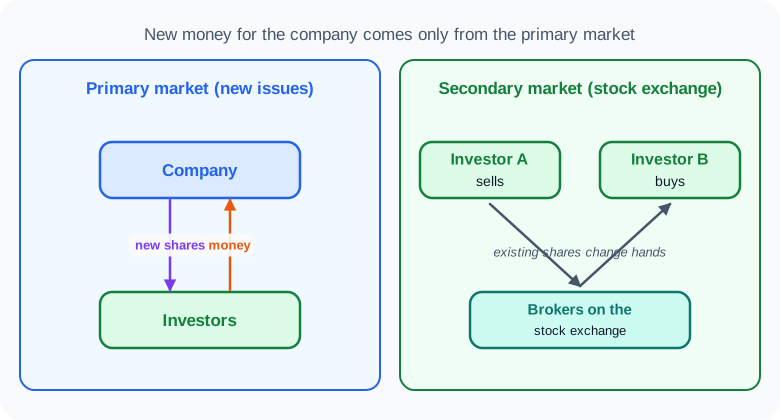
Figure 1. The primary market raises new capital; the stock exchange lets investors trade existing securities. WASSCE Tutor diagram.
Functions of the stock exchange
- A market for existing securities: investors can sell shares at any time, making them liquid. People are more willing to buy shares they can easily sell.
- Helps companies and government raise capital: because shares can be resold, people buy new issues more readily.
- Mobilises savings for productive investment.
- Fixes the prices of securities by demand and supply, and publishes them daily.
- Protects investors: companies must meet listing requirements and publish accounts; dealing follows strict rules.
- An economic barometer: share prices reflect confidence in companies and the economy.
- Encourages wider share ownership and a savings culture.
- Attracts foreign investment.
- Helps government borrow through bonds and manage the economy.
- Facilitates mergers and takeovers through the buying of shares.
Members and procedure
| Member | Role |
|---|---|
| Stockbroker | An agent who buys and sells securities on behalf of the public, for a commission (brokerage) |
| Dealer (jobber or market maker) | Buys and sells securities on their own account, making a profit from the difference between buying and selling prices |
| Issuing house | Arranges new issues of shares for companies (primary market) |
| Registrar | Keeps the register of shareholders and issues certificates |
| Central securities depository | Holds shares electronically and records transfers |
How an investor buys shares:
- The investor instructs a stockbroker, stating the company, the number of shares and the price limit.
- The broker buys the shares on the exchange.
- The investor receives a contract note showing the price, number of shares, brokerage and other charges.
- The investor pays, and the shares are registered in their name: a share certificate is issued, or the shares are held electronically.
Contract note. An investor buys 2,000 shares at NLe 1.50 each. Brokerage is 1.5% and other charges are NLe 25.
- Cost of shares NLe 3,000
- Brokerage NLe 45
- Total cost NLe 3,070
If the shares are later sold at NLe 1.80 each, the proceeds before charges are NLe 3,600, a capital gain of NLe 600 on the share price.
Listing (quotation) requirements usually include: being a public limited company, a minimum capital and number of shareholders, audited accounts for several years, and agreeing to publish information regularly.
Stock exchanges in West Africa
| Exchange | Location |
|---|---|
| Sierra Leone Stock Exchange | Freetown; launched in 2009 |
| Nigerian Exchange | Lagos |
| Ghana Stock Exchange | Accra |
| BRVM (regional exchange for French-speaking West Africa) | Abidjan, Côte d'Ivoire |
The Sierra Leone Stock Exchange opened in Freetown in 2009, and Rokel Commercial Bank was the first company listed. Very few companies are listed, so most Sierra Leoneans who invest in securities buy government treasury bills and bonds through banks. More listings would give local firms a new source of long-term capital.
Problems of stock exchanges in West Africa:
- Few listed companies: most businesses are small or family-owned.
- Low public awareness of shares.
- Low incomes and savings.
- Illiquidity: few buyers and sellers, so shares are hard to sell.
- Lack of confidence after company failures or fraud.
- Inflation and exchange-rate instability, which discourage long-term investment.
- Weak regulation and information in some markets.
A company does not receive money when its existing shares are sold on the stock exchange; the money goes to the selling shareholder. The company receives money only from new issues in the primary market.
Key points
- Capital market: long-term funds (shares, debentures, bonds); money market: short-term funds (treasury bills, bills of exchange).
- Primary market sells new securities; the stock exchange is a secondary market for existing securities.
- Functions: liquidity, raising capital, mobilising savings, pricing securities, protecting investors, economic barometer.
- Stockbrokers act for the public; dealers (jobbers) trade on their own account.
WASSCE examination focus
WASSCE asks you to state the functions of the stock exchange, to distinguish the capital market from the money market, to describe the procedure for buying shares, and to distinguish a stockbroker from a jobber. Questions on why few companies are quoted in your country are common.
Quick check
- Distinguish the primary market from the secondary market.
- Give three functions of the stock exchange.
- What is the role of a stockbroker?
- Give two instruments of the money market.
Answers: 1. The primary market sells new securities, so the issuer receives the money; the secondary market trades existing securities between investors. 2. Any three: market for existing securities (liquidity), helps raise capital, mobilises savings, fixes prices, protects investors, economic barometer, encourages share ownership, attracts foreign investment, helps government borrowing. 3. To buy and sell securities on behalf of investors, for a commission. 4. Any two: treasury bills, bills of exchange, call money, certificates of deposit.
Keep going with the stock exchange and capital market
This is one of 2 lessons in The Stock Exchange and Capital Market. Start free with the first lesson of every topic, then unlock them all, plus exam-style practice marked instantly and guided learning tools, from 25 NLe.
- Free account, no card needed
- Everything from 25 NLe
- No automatic renewal
More lessons in The Stock Exchange and Capital Market
- Shares, debentures, dividends and investors🔒