WASSCE Commerce · Sources of Business Capital
Business capital: types and sources
By the WASSCE Tutor team
Updated 12 November 2026 · 7 min read · Prepared against the WASSCE syllabus.
Every business, from a roadside kiosk to a mining company, needs money before it can earn any: to buy stock, rent premises and pay workers. That money is the business's capital. This lesson explains the different kinds of capital and where a business can get it.
Learning objectives
By the end of this lesson you should be able to:
- define business capital
- distinguish fixed, working, owned, borrowed and employed capital
- explain the types of share capital in a company
- describe the internal and external sources of business capital
- classify sources of finance as short, medium or long term
What is business capital?
Business capital is the money and other assets used to start and run a business. It includes cash, stock, equipment, buildings and vehicles owned by the business.
Types of capital
| Type | Meaning | Example |
|---|---|---|
| Fixed capital | Assets kept for a long time and used to produce or sell; not bought to resell | Buildings, machinery, vehicles, furniture |
| Working (circulating) capital | Current assets minus current liabilities: the funds that keep day-to-day operations going | Stock, debtors and cash, less creditors and overdraft |
| Liquid capital | Cash and assets quickly turned into cash | Cash in hand and at the bank |
| Capital owned | The owner's investment in the business: total assets minus liabilities | The trader's own money plus retained profit |
| Borrowed capital | Funds obtained from outsiders that must be repaid | Bank loans, debentures |
| Capital employed | Fixed assets plus working capital: the total funds used in the business |
Share capital (companies)
| Term | Meaning |
|---|---|
| Authorised (nominal or registered) capital | The maximum share capital the company may issue, stated in its Memorandum of Association |
| Issued capital | The part of the authorised capital actually offered to shareholders |
| Called-up capital | The part of the issued capital that shareholders have been asked to pay so far |
| Paid-up capital | The amount actually paid by shareholders |
| Uncalled capital | Issued capital not yet called up |
A company's share capital. A company is authorised to issue 1,000,000 shares of NLe 1 each. It issues 600,000 shares and calls up NLe 0.75 per share; shareholders have paid NLe 420,000.
- Authorised capital = NLe 1,000,000
- Issued capital = NLe 600,000
- Called-up capital = NLe 450,000
- Paid-up capital = NLe 420,000
- Calls in arrear (called but unpaid) NLe 30,000
- Uncalled capital NLe 150,000
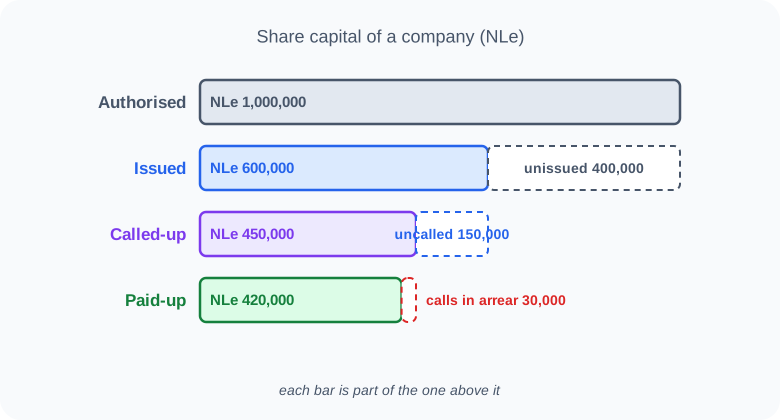
Figure 1. Each kind of share capital is part of the one above it. WASSCE Tutor diagram.
Sources of business capital
Internal sources (from within the business)
- Personal savings of the owner.
- Retained (ploughed-back) profit: profit kept in the business instead of being withdrawn or paid as dividends.
- Sale of unwanted assets.
- Depreciation provisions set aside to replace assets.
External sources (from outside)
| Source | How it works | Period |
|---|---|---|
| Family and friends | Informal loans or gifts | Short to medium |
| Bank overdraft | Permission to withdraw more than is in a current account, up to a limit | Short |
| Bank loan | A fixed sum repaid with interest over an agreed period | Short to long |
| Trade credit | Suppliers allow goods now and payment later (for example 30 days) | Short |
| Hire purchase | Use an asset while paying in instalments; ownership passes at the end | Medium |
| Leasing | Renting an asset (vehicle, machine) instead of buying it | Medium |
| Shares | Selling part-ownership of a company to investors | Long (permanent) |
| Debentures | Long-term loans to a company at a fixed interest | Long |
| Microfinance and cooperatives | Small loans to traders and small firms, often in groups | Short to medium |
| Government grants and schemes | Grants or cheap loans for priority sectors | Medium to long |
| Venture capital | Investors fund new, risky firms in exchange for a share of ownership | Long |
Choosing a source
A business considers: the amount needed; the purpose and period (a building needs long-term funds; stock needs short-term); the cost (interest, dividends); security demanded by the lender; and whether the owners are willing to share control (selling shares brings in new owners).
A woman who sells cooking gas in Bo may start with her own savings, add stock on trade credit from the depot, take a microfinance loan for a second set of cylinders, and later borrow from a commercial bank to buy a delivery tricycle on hire purchase. As her firm grows, so do the sources open to her.
Do not confuse working capital with capital employed. Working capital is only current assets minus current liabilities; capital employed adds the fixed assets as well.
Key points
- Capital is the money and assets used to run a business.
- Types: fixed, working (circulating), liquid, owned, borrowed, employed; companies also have authorised, issued, called-up and paid-up capital.
- Internal sources: savings, retained profit, sale of assets. External sources: overdrafts, loans, trade credit, hire purchase, leasing, shares, debentures, microfinance, grants.
- Sources are short, medium or long term; the choice depends on amount, purpose, cost, security and control.
WASSCE examination focus
Common questions: define and distinguish types of capital (especially fixed and working capital, or authorised, issued, called-up and paid-up capital), and explain the sources of capital for a sole trader or a company. Calculations on share capital often appear; set out each figure clearly with its name.
Quick check
- What is working capital?
- Distinguish called-up capital from paid-up capital.
- Give two internal and two external sources of capital for a sole trader.
- Why is an overdraft unsuitable for buying a building?
Answers: 1. Current assets minus current liabilities. 2. Called-up capital is the amount shareholders have been asked to pay; paid-up capital is the amount they have actually paid. 3. Internal: personal savings, retained profit (or sale of assets). External: any two of bank loan, overdraft, trade credit, hire purchase, family loans, microfinance. 4. An overdraft is short-term and repayable on demand, while a building is a long-term asset that needs long-term finance.
Keep going with sources of business capital
This is one of 2 lessons in Sources of Business Capital. Start free with the first lesson of every topic, then unlock them all, plus exam-style practice marked instantly and guided learning tools, from 25 NLe.
- Free account, no card needed
- Everything from 25 NLe
- No automatic renewal
More lessons in Sources of Business Capital
- Capital, turnover and profit: the key calculations🔒