WASSCE Commerce · Retail Trade
Retail trade: functions and small-scale retailers
By the WASSCE Tutor team
Updated 12 November 2026 · 7 min read · Prepared against the WASSCE syllabus.
The woman selling groundnuts by the cup, the boy hawking cold water in traffic and the provision shop on the corner are all retailers: the last link between producers and the families who use their goods. This lesson explains what retailers do for everyone in the chain and why small retailers thrive even beside supermarkets.
Learning objectives
By the end of this lesson you should be able to:
- define retail trade and locate the retailer in the chain of distribution
- explain the functions (services) of the retailer to consumers, wholesalers and manufacturers
- describe the types of small-scale retailers
- explain why small-scale retailers survive
What is retail trade?
Retail trade is the buying of goods in large quantities from wholesalers or producers and selling them in small quantities to final consumers. A retailer is the last link in the chain of distribution.
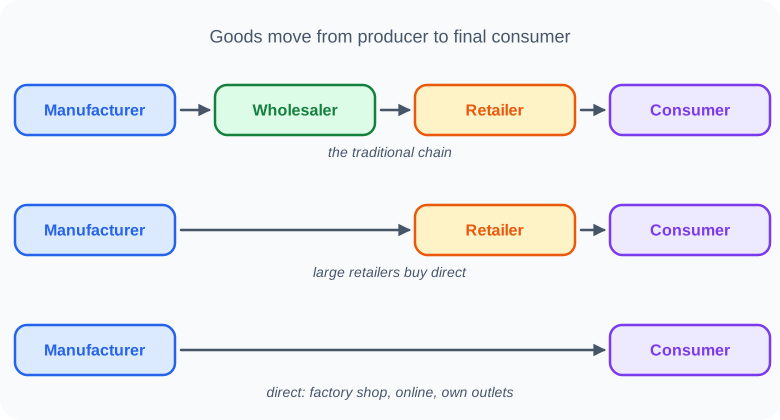
Figure 1. The retailer is the last link before the consumer. WASSCE Tutor diagram.
Functions (services) of the retailer
To consumers
- Breaks bulk: sells in the small quantities households can afford (a cup of rice, a single sachet).
- Convenient location: shops close to homes and workplaces.
- Variety and choice: stocks goods from many producers in one place.
- Advice and information on products and how to use them.
- Credit to regular, trusted customers.
- Delivery and after-sales service for some goods.
- Displays goods, so customers can compare before buying.
To wholesalers and manufacturers
- Distributes goods to final consumers, so producers need not deal with thousands of buyers.
- Provides market information: tells suppliers what customers want and complain about.
- Bears risks of holding stock: changes in fashion, damage, theft.
- Advertises and promotes products in the shop.
- Buys in reasonable quantities, helping producers plan.
Small-scale retailers
Itinerant (mobile) traders
They move from place to place.
| Type | Description |
|---|---|
| Hawkers | Carry goods on the head, in hand or on a tray, selling in streets, buses and traffic |
| Peddlers | Carry goods from house to house or village to village |
| Street (roadside) vendors | Sell along busy roads and at junctions, often from movable stands |
| Mobile shops | Sell from a van, cart or tricycle that moves around neighbourhoods |
Fixed-shop traders
| Type | Description |
|---|---|
| Market traders (stall-holders) | Sell from a stall in a market, such as Big Market, Dove Cut or a weekly lumo |
| Kiosks | Small fixed booths selling provisions, phone credit, cold drinks |
| Unit (single) shops | One independent shop owned by a sole trader: provisions, chemicals, hardware |
| Tied shops | Shops that sell mainly one supplier's products in return for support |
Features of small-scale retailers: small capital; owned by one person or a family; limited range; personal service; often sell on credit; long opening hours; located close to customers.
Why small-scale retailers survive
- Personal service: the owner knows customers and their needs.
- Credit to trusted customers until payday.
- Convenience: near homes, open early and late, even on public holidays.
- Very small quantities: they split packs (a few cubes of seasoning, one cigarette, one sachet).
- Low capital and costs: easy to start; low rent.
- Flexibility: quick to change what they sell.
- Bargaining: customers can negotiate prices.
- Delivery to nearby customers.
- Market too small or scattered for large retailers, especially in rural areas.
Problems of small-scale retailers: limited capital; bad debts from credit sales; competition from large stores; poor record keeping; theft and damage; high prices from buying in small quantities; harassment and levies.
In Freetown, a family can buy a single egg, a cup of rice, one sachet of milk and a top-up of phone credit within a few metres of home. This breaking of bulk into tiny quantities, matched to daily incomes, is the main reason small retailers dominate retail trade in Sierra Leone.
Do not say the retailer "produces nothing". Retailing is tertiary production: it adds place, time and possession utility by getting goods to consumers where, when and in the quantities they want.
Key points
- Retail trade sells goods in small quantities to final consumers; the retailer is the last link in the chain.
- Retailers break bulk, offer variety, convenience, advice and credit to consumers, and give market information to producers.
- Small-scale retailers include hawkers, peddlers, street vendors, mobile shops, market traders, kiosks and unit shops.
- They survive through personal service, credit, convenience, tiny quantities and low costs.
WASSCE examination focus
WASSCE often asks for the functions of the retailer (to consumers and to producers), the types and features of small-scale retailers, and reasons why small-scale retailers survive despite large retailers. Give local examples (markets, kiosks, hawkers) for each type.
Quick check
- What is meant by "breaking bulk"?
- Distinguish a hawker from a market trader.
- Give three functions of the retailer to the consumer.
- Give three reasons why small retailers survive.
Answers: 1. Buying in large quantities and selling in small quantities that consumers can afford. 2. A hawker moves about selling goods; a market trader sells from a fixed stall in a market. 3. Any three: breaking bulk, convenient location, variety, advice, credit, delivery, display. 4. Any three: personal service, credit, convenience, tiny quantities, low capital, flexibility, bargaining, delivery, small or scattered markets.
Keep going with retail trade
This is one of 2 lessons in Retail Trade. Start free with the first lesson of every topic, then unlock them all, plus exam-style practice marked instantly and guided learning tools, from 25 NLe.
- Free account, no card needed
- Everything from 25 NLe
- No automatic renewal
More lessons in Retail Trade
- Large-scale retailing and modern trends in retailing🔒