WASSCE Commerce · Nature and Scope of Commerce
What commerce is: meaning, branches and scope
By the WASSCE Tutor team
Updated 12 November 2026 · 7 min read · Prepared against the WASSCE syllabus.
A bag of rice grown in Torma Bum is no use to a family in Freetown until someone buys it, stores it, moves it, insures it, pays for it and tells buyers it is for sale. All of that activity is commerce. This lesson explains what commerce is, what it covers and how its branches fit together.
Learning objectives
By the end of this lesson you should be able to:
- define commerce and distinguish it from trade and industry
- describe the branches of commerce: trade and aids to trade
- explain the scope of commerce
- explain the relationship between commerce, industry and direct services
What is commerce?
Commerce is the branch of production concerned with the distribution and exchange of goods and services. It covers trade (buying and selling) and all the aids to trade (transport, communication, banking, insurance, warehousing and advertising) that help goods move from producers to consumers.
Production is not complete until goods reach the final consumer. A farmer can grow rice, and a mill can husk it, but until it is carried, stored, financed, advertised and sold, no one can eat it. Commerce links producers and consumers.
Commerce is wider than trade. Trade is only the buying and selling of goods; commerce includes trade and every service that helps trade to take place.
The branches of commerce
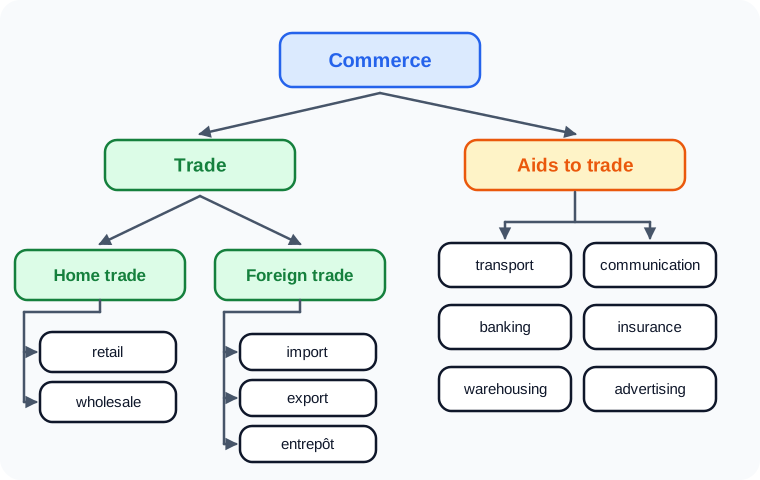
Figure 1. The branches of commerce. WASSCE Tutor diagram.
1. Trade
Trade is the buying and selling of goods and services.
| Branch | Meaning | Example in Sierra Leone |
|---|---|---|
| Home (domestic) trade | Trade within one country | Selling cassava from Moyamba in Freetown markets |
| – Retail trade | Selling in small quantities to final consumers | A provision shop, a market woman, a supermarket |
| – Wholesale trade | Buying in bulk from producers and selling in smaller lots to retailers | Wholesalers on Kissy Road or in Bo selling cartons to shops |
| Foreign (international) trade | Trade between countries | |
| – Import trade | Buying goods from other countries | Rice, fuel, vehicles |
| – Export trade | Selling goods to other countries | Iron ore, cocoa, coffee, diamonds |
| – Entrepôt (re-export) trade | Importing goods and re-exporting them to another country | Goods passing through a port to a neighbouring country |
2. Aids to trade
Aids to trade are services that make trade easier by removing its hindrances:
| Aid | The hindrance it removes |
|---|---|
| Transport | Distance between producers and consumers (the hindrance of place) |
| Warehousing | The gap between production and consumption (the hindrance of time) |
| Insurance | The risk of loss through fire, theft or accident |
| Banking | Lack of finance and the difficulty of making payments |
| Advertising | Ignorance: consumers not knowing what is available |
| Communication | Traders being far apart and needing to exchange information |
The scope of commerce
The scope of commerce means the range of activities it covers. It includes:
- Trade: retail, wholesale, import, export and entrepôt.
- The aids to trade: transport, communication, banking, insurance, warehousing, advertising and marketing.
- Business units that carry on commerce: sole traders, partnerships, companies, cooperatives and public enterprises.
- Business documents and terms used in buying and selling.
- Business finance: capital, the stock exchange and credit.
- The legal and ethical framework: contracts, consumer protection and government regulation.
- Modern methods: e-commerce, mobile money and online marketing.
Commerce, industry and direct services
Production is usually divided into three groups of occupations:
| Group | What it does | Examples |
|---|---|---|
| Industry | Extracts raw materials, manufactures goods and builds | Mining, farming, fishing, rice milling, block making, construction |
| Commerce | Distributes goods and services and helps exchange | Traders, transporters, bankers, insurers |
| Direct services | Gives personal services directly to people | Teachers, nurses, doctors, police, lawyers |
The three depend on one another. Industry makes goods; commerce distributes them; direct services keep the workers of both educated, healthy and safe.
Tracing commerce in a single sale. A trader in Makeni orders 50 cartons of soap from a wholesaler in Freetown.
- She telephones the order (communication).
- The wholesaler stores the soap until it is ordered (warehousing).
- A lorry carries it to Makeni (transport), and the goods are covered against accident on the way (insurance).
- She pays by bank transfer or mobile money (banking).
- The soap maker's radio advertisement makes customers ask for it (advertising).
- She sells bars to households (retail trade), having bought from a wholesaler (wholesale trade).
Every branch of commerce has played a part in one transaction.
Big Market and Dove Cut in Freetown, the weekly lumo markets in the provinces and the busy streets of Abacha Street and Kissy Road show commerce at work every day: wholesalers break bulk, retailers sell to households, transporters move goods and mobile money agents handle payments.
Key points
- Commerce is the distribution and exchange of goods and services: trade plus aids to trade.
- Trade is home trade (retail, wholesale) and foreign trade (import, export, entrepôt).
- Aids to trade remove the hindrances of place, time, risk, finance, ignorance and distance between traders.
- Industry makes goods, commerce distributes them, direct services serve people directly.
WASSCE examination focus
WASSCE commonly asks you to define commerce, to draw or describe the branches of commerce, to explain how each aid to trade helps trade, and to distinguish commerce from trade or industry. Drawing the branches as a tree diagram and labelling each part earns marks quickly.
Quick check
- Why is commerce wider than trade?
- What is entrepôt trade?
- Which aid to trade removes the hindrance of time?
- Give one example each of industry, commerce and a direct service.
Answers: 1. Commerce includes trade and the aids to trade that make trade possible. 2. Importing goods and re-exporting them to another country. 3. Warehousing. 4. Industry: mining or rice milling. Commerce: retail trade or banking. Direct service: teaching or nursing.
Keep going with nature and scope of commerce
This is one of 2 lessons in Nature and Scope of Commerce. Start free with the first lesson of every topic, then unlock them all, plus exam-style practice marked instantly and guided learning tools, from 25 NLe.
- Free account, no card needed
- Everything from 25 NLe
- No automatic renewal
More lessons in Nature and Scope of Commerce
- Functions and importance of commerce, and its problems in West Africa🔒