WASSCE Commerce · Money and Currency
Money: evolution, functions and qualities
By the WASSCE Tutor team
Updated 12 November 2026 · 7 min read · Prepared against the WASSCE syllabus.
Imagine a fisherman in Tombo who wants rice. Under barter he must find a rice farmer who wants fish, today, in exactly the right amount. Money ends that search: the fisherman sells fish to anyone for leones and buys rice from anyone with them. This lesson explains how money developed, what it does and what makes a good money.
Learning objectives
By the end of this lesson you should be able to:
- define barter and explain its problems
- define money and trace its evolution
- explain the functions of money
- explain the qualities (characteristics) of good money
Barter and its problems
Barter is the direct exchange of goods and services for other goods and services, without the use of money.
Problems of barter:
| Problem | Explanation | Example |
|---|---|---|
| Double coincidence of wants | Each trader must want exactly what the other has | The fisherman must find a rice farmer who wants fish |
| No common measure of value | No way to state the value of every good in one unit | How many fish equal one goat? |
| Indivisibility | Some goods cannot be divided without losing value | A cow cannot be split to buy a bag of rice |
| Difficulty of storing value | Many goods are perishable and lose value if kept | Fish rots; wealth cannot be saved |
| No standard for deferred payment | Future payments are hard to agree | Should a loan of rice be repaid in rice or goats? |
| Transport and portability | Goods are bulky and heavy to carry to market | Carrying cattle to trade |
| Time wasted searching for trading partners | Trade is slow and limited | |
| Limits specialisation | People must produce much of what they need |
The evolution of money
Money is anything that is generally acceptable as a means of payment for goods and services and in the settlement of debts.
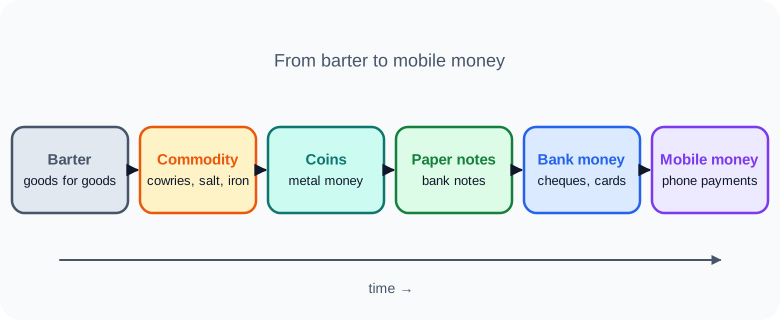
Figure 1. From barter to mobile money. WASSCE Tutor diagram.
| Stage | Description |
|---|---|
| Barter | Goods exchanged directly |
| Commodity money | Goods that everyone wanted were used as money: cowries, salt, cattle, cloth, beads, iron bars |
| Metallic money | Gold, silver and copper, weighed at first and later shaped into coins stamped with their value |
| Paper money | Receipts for gold deposited with goldsmiths became bank notes; today notes are issued by the central bank |
| Bank (credit) money | Deposits in bank accounts, transferred by cheques, transfers and cards |
| Electronic and mobile money | Money held and moved electronically: debit cards, online banking and mobile money on phones |
Before coins and notes, people in parts of present-day Sierra Leone, Guinea and Liberia used "Kissi pennies": thin twisted iron rods used as money, especially among the Kissi people. Cowrie shells were also used across West Africa. Sierra Leone later used British West African currency, until the leone was introduced in 1964. Today many Sierra Leoneans hold money as mobile money on their phones.
Functions of money
Primary (main) functions
- Medium of exchange: money is accepted in exchange for goods and services. It removes the need for a double coincidence of wants.
- Measure (unit) of value: the value of every good is stated in money, as a price, so goods can be compared and accounts kept.
Secondary functions
- Store of value: money can be saved and used later, because it does not rot.
- Standard of deferred payment: future payments (loans, credit sales, salaries) can be stated in money.
Other functions
- It makes specialisation and division of labour possible.
- It allows borrowing and lending, through banks and credit.
- It is a means of transferring value from one place to another, through banks and mobile money.
- It is a basis of credit.
How money solves barter's problems.
| Barter problem | Money's function that solves it |
|---|---|
| Double coincidence of wants | Medium of exchange |
| No common measure of value | Measure of value |
| Difficulty of storing wealth | Store of value |
| No standard for future payments | Standard of deferred payment |
| Indivisibility | Money is divisible into small units |
| Bulky goods hard to carry | Money is portable |
Qualities (characteristics) of good money
| Quality | Meaning |
|---|---|
| General acceptability | Everyone accepts it in payment; the most important quality |
| Portability | Easy to carry, even large values |
| Divisibility | Can be divided into smaller units (leones into cents) without losing value |
| Durability | Lasts a long time without wearing out |
| Homogeneity (uniformity) | Every unit of the same value is identical |
| Scarcity (limited supply) | Its supply is controlled so it keeps its value |
| Recognisability (cognisability) | Easily recognised and hard to forge |
| Stability of value | Its value does not change sharply over time |
| Malleability | For coins: metal can be shaped and stamped easily |
Do not confuse functions of money (what money does: medium of exchange, measure of value, store of value, standard of deferred payment) with qualities of money (what money should be: acceptable, portable, divisible, durable, homogeneous, scarce, recognisable, stable).
Key points
- Barter suffers from the double coincidence of wants, no measure of value, indivisibility and difficulty of storing value.
- Money evolved from commodity money (cowries, Kissi pennies) to coins, notes, bank money and mobile money.
- Functions: medium of exchange, measure of value, store of value, standard of deferred payment.
- Qualities: acceptability, portability, divisibility, durability, homogeneity, scarcity, recognisability, stability.
WASSCE examination focus
WASSCE commonly asks you to explain the problems of barter, to state and explain the functions of money, and to list the qualities of good money. Matching each barter problem to the function of money that solves it is a strong way to answer.
Quick check
- What is the double coincidence of wants?
- Name the two primary functions of money.
- Which quality of money makes forging difficult?
- Give two examples of commodity money used in West Africa.
Answers: 1. The need, under barter, for each trader to want exactly what the other has to offer, at the same time. 2. Medium of exchange and measure (unit) of value. 3. Recognisability (cognisability). 4. Any two: cowries, Kissi pennies (iron rods), salt, cattle, cloth, beads.
Keep going with money and currency
This is one of 2 lessons in Money and Currency. Start free with the first lesson of every topic, then unlock them all, plus exam-style practice marked instantly and guided learning tools, from 25 NLe.
- Free account, no card needed
- Everything from 25 NLe
- No automatic renewal
More lessons in Money and Currency
- Legal tender, the leone and the value of money🔒