WASSCE Commerce · Legal Aspects of Business
Contracts and the law of business
By the WASSCE Tutor team
Updated 12 November 2026 · 9 min read · Prepared against the WASSCE syllabus.
Buying bread, hiring a taxi, ordering goods from a wholesaler and renting a shop are all contracts. Most are made without a written word, yet the law will enforce them if something goes wrong. Business depends on contracts, so every trader needs to know when an agreement is legally binding and what happens when it is broken.
Learning objectives
By the end of this lesson you should be able to:
- define a contract and explain its essential elements
- distinguish an offer from an invitation to treat
- explain how an offer ends
- describe the types of contract: valid, void, voidable, unenforceable and illegal
- explain how contracts are discharged and the remedies for breach
What is a contract?
A contract is a legally binding agreement between two or more parties, which the courts will enforce.
All contracts are agreements, but not all agreements are contracts. An agreement to meet a friend is not a contract, because there is no intention to create legal relations.
Essential elements of a valid contract
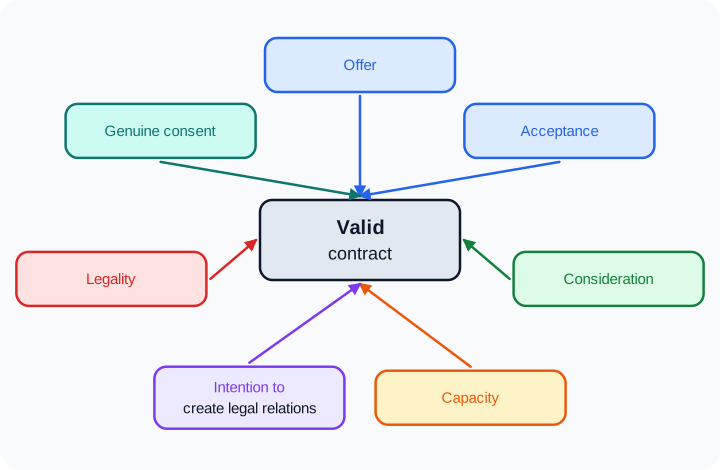
Figure 1. The elements of a valid contract. WASSCE Tutor diagram.
| Element | Meaning | Example |
|---|---|---|
| Offer | A definite promise by one party (the offeror) to be bound on stated terms | "I will sell you my generator for NLe 3,000" |
| Acceptance | Unconditional agreement to all the terms of the offer, communicated to the offeror | "I accept" |
| Consideration | Something of value given by each side: price, goods, services or a promise | The NLe 3,000 and the generator |
| Intention to create legal relations | Both parties mean the agreement to be legally binding; presumed in business deals | Business agreements, unlike most family or social arrangements |
| Capacity | Both parties must be legally able to contract | Minors, people of unsound mind and drunk people have limited capacity |
| Legality | The purpose must be lawful | A contract to sell stolen goods or drugs is illegal |
| Genuine consent | Agreement must be freely given, without misrepresentation, mistake, duress or undue influence | A contract signed under threat is not genuine |
| Certainty and possibility | The terms must be clear, and performance possible | "Some goods at a fair price" is too vague |
Offer and invitation to treat
An invitation to treat is an invitation to others to make an offer. It is not itself an offer.
| Invitation to treat (not an offer) | Offer |
|---|---|
| Goods displayed in a shop window or on shelves with price tags | The customer offering to buy at the till |
| Advertisements, catalogues and price lists | A specific promise to a specific person |
| An auctioneer asking for bids | The bid is the offer; the fall of the hammer is acceptance |
So a shopkeeper who has mistakenly priced goods too low need not sell at that price: the price tag is only an invitation to treat.
How an offer ends
- Acceptance: it becomes a contract.
- Rejection by the offeree.
- Counter-offer: a new offer on different terms rejects the original.
- Revocation (withdrawal) by the offeror before acceptance, communicated to the offeree.
- Lapse of time: a stated time, or a reasonable time, has passed.
- Death of either party before acceptance.
- Failure of a condition on which the offer depended.
Is there a contract?
- Fatmata offers to sell her phone to Ibrahim for NLe 1,200. Ibrahim replies, "I'll give you NLe 1,000." Fatmata refuses. Ibrahim then says, "All right, I accept NLe 1,200." No contract yet. Ibrahim's counter-offer ended the first offer, so his "acceptance" is now a new offer, which Fatmata may accept or refuse.
- A shop displays a radio priced NLe 50 by mistake (it should be NLe 500). A customer insists on buying at NLe 50. No contract. The display is an invitation to treat; the customer's offer to pay NLe 50 can be refused.
- A 15-year-old buys a necessary school uniform on credit. Binding. Minors are bound by contracts for necessaries at a reasonable price.
Types of contract
By form
- Simple contracts: oral, written or implied by conduct. Most everyday contracts are simple.
- Specialty contracts (deeds): written, signed and sealed. Examples are the sale of land and long leases.
- Express contracts state their terms in words; implied contracts arise from conduct, as when a passenger boards a taxi.
By validity
| Type | Meaning | Example |
|---|---|---|
| Valid | Has all the essential elements; fully enforceable | A normal sale of goods |
| Void | Has no legal effect at all from the start | A contract with a person of unsound mind; a contract about goods that no longer existed |
| Voidable | Valid until the injured party chooses to cancel it | A contract induced by misrepresentation or duress |
| Unenforceable | Valid but cannot be enforced in court because of a technical defect | A contract that needed to be in writing but was not |
| Illegal | Its purpose is against the law; void, and the parties may be punished | Smuggling, selling stolen goods |
Discharge of contract
A contract ends (is discharged) by:
- Performance: both sides do what they promised. This is the most common way.
- Agreement: both sides agree to end it.
- Frustration: an event beyond either party's control makes performance impossible, such as destruction of the subject matter, death or a change in the law.
- Breach: one party fails to perform, or refuses to.
- Operation of law: bankruptcy, or the expiry of the time limit for claims.
Remedies for breach of contract
| Remedy | Meaning |
|---|---|
| Damages | Money compensation for the loss caused; the usual remedy |
| Specific performance | A court order to carry out the contract, used where money is not enough (e.g. sale of a particular piece of land) |
| Injunction | A court order stopping a party from doing something in breach of contract |
| Rescission | Cancelling the contract and restoring both parties to their original positions |
| Quantum meruit | Payment for work already done ("as much as it is worth") |
| Refusal to perform | The injured party may refuse to carry out its own side |
A contractor agrees to build a shop in Makeni by December for NLe 200,000 but stops halfway. The owner can claim damages for extra costs and lost rent, and the contractor may claim quantum meruit for the work already done. If the land were flooded and the site washed away, the contract might be frustrated, and neither side would be liable.
A void contract never had legal effect; a voidable contract is valid until the injured party cancels it. Do not use the words interchangeably.
Key points
- A contract is a legally binding agreement.
- Elements: offer and acceptance, consideration, intention, capacity, legality, genuine consent, certainty.
- Shop displays, adverts and catalogues are invitations to treat, not offers.
- Contracts may be valid, void, voidable, unenforceable or illegal.
- Discharge: performance, agreement, frustration, breach, operation of law. Remedies: damages, specific performance, injunction, rescission, quantum meruit.
WASSCE examination focus
Expect to explain the essential elements of a valid contract, to distinguish an offer from an invitation to treat, to distinguish void from voidable contracts, and to state ways a contract may be discharged and remedies for breach. Short scenarios ("Is there a contract?") are common: name the rule and apply it.
Quick check
- Give four essential elements of a valid contract.
- Is a price tag in a shop window an offer? Explain.
- What is frustration of contract?
- Name two remedies for breach of contract.
Answers: 1. Any four: offer, acceptance, consideration, intention to create legal relations, capacity, legality, genuine consent, certainty. 2. No. It is an invitation to treat; the customer makes the offer, which the seller may accept or refuse. 3. The ending of a contract because an event beyond the parties' control makes performance impossible. 4. Any two: damages, specific performance, injunction, rescission, quantum meruit.
Keep going with legal aspects of business
This is one of 2 lessons in Legal Aspects of Business. Start free with the first lesson of every topic, then unlock them all, plus exam-style practice marked instantly and guided learning tools, from 25 NLe.
- Free account, no card needed
- Everything from 25 NLe
- No automatic renewal
More lessons in Legal Aspects of Business
- Agency, sale of goods and hire purchase🔒