WASSCE Commerce · Insurance
Insurance: meaning and principles
By the WASSCE Tutor team
Updated 12 November 2026 · 9 min read · Prepared against the WASSCE syllabus.
A fire in a market stall can wipe out a trader's savings in an hour. Fires are rare for any one trader, but across thousands of traders some happen every year. Insurance turns that unpredictable, ruinous loss into a small, predictable payment. It is the aid to trade that removes the hindrance of risk.
Learning objectives
By the end of this lesson you should be able to:
- define insurance and explain how the pooling of risk works
- distinguish insurance from assurance
- explain the key terms used in insurance
- distinguish insurable from non-insurable risks
- explain the principles of insurance: utmost good faith, insurable interest, indemnity, contribution, subrogation and proximate cause
- explain the importance of insurance to business
Meaning of insurance
Insurance is a contract in which one party (the insurer) agrees, in return for a payment called a premium, to compensate another party (the insured) for a loss caused by a specified risk.
Pooling of risk
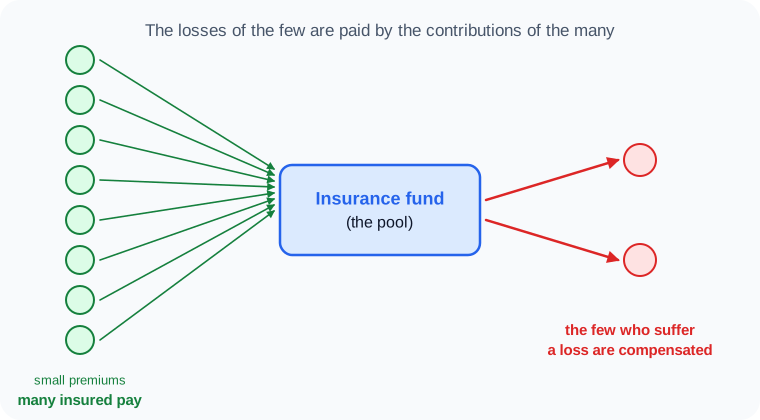
Figure 1. The pooling of risk: the premiums of many pay the losses of the few. WASSCE Tutor diagram.
Setting a premium. 2,000 shop owners in Freetown each have a shop worth NLe 50,000. Past records show that on average 6 shops a year are destroyed by fire.
- Expected yearly losses NLe 300,000
- Share per shop owner NLe 150
- Add 20% for the insurer's expenses and profit: NLe 180 premium a year
Each owner pays NLe 180 a year, a small certain cost, instead of risking an uncertain loss of NLe 50,000. The law of large numbers lets the insurer predict losses accurately across many policyholders.
Insurance and assurance
| Insurance | Assurance |
|---|---|
| Covers a risk that may or may not happen (fire, theft, accident) | Covers an event that will certainly happen (death), or a fixed date |
| Compensates for the actual loss (indemnity) | Pays an agreed sum |
| Examples: fire, motor, marine, burglary | Examples: life assurance, endowment policies |
Key terms
| Term | Meaning |
|---|---|
| Insurer (underwriter) | The company that accepts the risk |
| Insured (policyholder) | The person or firm whose risk is covered |
| Premium | The payment for cover, usually yearly |
| Proposal form | The form the person seeking insurance fills in, giving full details of the risk |
| Cover note | A temporary document giving cover until the policy is issued |
| Policy | The written contract, stating the terms and the risks covered |
| Sum insured | The maximum the insurer will pay |
| Claim | A demand by the insured for compensation after a loss |
| Actuary | An expert who calculates risks and premiums from statistics |
| Insurance broker | An agent who arranges insurance for clients with insurers, for a commission |
| Loss adjuster / assessor | A person who investigates a claim and assesses the loss |
| Excess | The first part of any loss, which the insured pays |
| Renewal notice | A reminder that the policy is due for renewal |
Insurable and non-insurable risks
| Insurable risks | Non-insurable risks |
|---|---|
| Losses that can be calculated from past records | Losses that cannot be calculated |
| Fire, theft, burglary, accidents, death, damage to goods at sea | Changes in fashion or taste, trade losses from poor management or competition, speculation and gambling losses, a fall in demand, war (normally excluded), new inventions that make products out of date |
Non-insurable risks are borne by the entrepreneur; profit is the reward for bearing them.
The principles of insurance
| Principle | Meaning | Example |
|---|---|---|
| Utmost good faith (uberrimae fidei) | Both parties must disclose all material facts honestly. Hiding a fact makes the contract voidable. | A trader who hides that the shop stores petrol cannot claim after a fire |
| Insurable interest | The insured must suffer a financial loss if the event happens; you can insure only what you have an interest in. | You can insure your own shop but not your neighbour's |
| Indemnity | The insured is restored to the same financial position as before the loss, no better. Insurance must not be a source of profit. (Does not apply to life assurance.) | Goods worth NLe 10,000 destroyed: the claim is NLe 10,000, not their price new |
| Contribution | If the same property is insured with several insurers, they share the loss; the insured cannot collect from each. | Two insurers each covering half pay half the loss each |
| Subrogation | After paying a claim, the insurer takes over the insured's rights against third parties, and any salvage. | The insurer sues the driver who caused the accident |
| Proximate cause | The insurer pays only if the main (nearest) cause of the loss is a risk covered by the policy. | A fire policy pays for fire damage, including water used to put it out, but not for theft during the fire |
Indemnity does not apply to life assurance, because a human life cannot be valued in money. The agreed sum is paid instead. Contribution and subrogation follow from indemnity, so they also do not apply to life policies.
Importance of insurance to business
- Removes the hindrance of risk: traders can operate knowing losses will be met.
- Encourages investment and large-scale production, because risks are spread.
- Security for loans: banks lend more readily on insured assets.
- Foreign trade: marine insurance makes shipping goods possible.
- Mobilises savings: premiums are invested in government securities, shares and property.
- Promotes loss prevention: insurers advise on fire safety and security, and charge lower premiums for safer premises.
- Creates employment for insurers, brokers, agents and loss adjusters.
- Peace of mind for business owners and their families.
In Sierra Leone, insurance companies are licensed and supervised by the Sierra Leone Insurance Commission (SLICOM). Motor third-party insurance is compulsory, so every vehicle on the road must carry it. Many market traders still do not insure their stock. Fires in markets therefore often ruin traders, a strong case for affordable micro-insurance.
Key points
- Insurance compensates for loss from a specified risk in return for a premium; it works by pooling risk.
- Insurance covers possible events (indemnity); assurance covers certain events (agreed sum).
- Only calculable risks are insurable; fashion changes, trade losses and gambling are not.
- Principles: utmost good faith, insurable interest, indemnity, contribution, subrogation, proximate cause.
WASSCE examination focus
Every WASSCE Commerce paper tests insurance. Expect to explain the principles of insurance with examples, to distinguish insurance from assurance, to distinguish insurable from non-insurable risks, and to explain insurance terms (premium, policy, cover note, proposal form). Give an example with each principle.
Quick check
- What is the pooling of risk?
- State the principle of indemnity.
- Give two examples of non-insurable risks.
- What is subrogation?
Answers: 1. Many people pay small premiums into a common fund, from which the few who suffer a loss are compensated. 2. The insured should be restored to the same financial position as before the loss, and no better. 3. Any two: changes in fashion, trade losses from poor management or competition, speculation or gambling, fall in demand, war, new inventions. 4. After paying a claim, the insurer takes over the insured's rights against third parties who caused the loss, and any salvage.
Keep going with insurance
This is one of 2 lessons in Insurance. Start free with the first lesson of every topic, then unlock them all, plus exam-style practice marked instantly and guided learning tools, from 25 NLe.
- Free account, no card needed
- Everything from 25 NLe
- No automatic renewal
More lessons in Insurance
- Types of insurance, claims and the average clause🔒