WASSCE Commerce · Forms of Business Units
Sole proprietorship and partnership
By the WASSCE Tutor team
Updated 12 November 2026 · 8 min read · Prepared against the WASSCE syllabus.
Most businesses in Sierra Leone start small: one person with a stall, a kiosk or a workshop. As they grow, owners often take in partners to raise more money and share the work. This lesson covers the two simplest forms of business ownership, the sole proprietorship and the partnership, and the trade-offs each involves.
Learning objectives
By the end of this lesson you should be able to:
- define a business unit and distinguish the private and public sectors
- describe the features, advantages and disadvantages of a sole proprietorship
- describe the features, advantages and disadvantages of a partnership
- state the contents of a partnership deed and name the types of partners
- explain why small businesses survive alongside large firms
Business units
A business unit is an organisation set up to produce or distribute goods and services. Business units are found in two sectors:
| Private sector | Public sector |
|---|---|
| Owned by individuals or groups | Owned by the government |
| Sole proprietorships, partnerships, companies, cooperatives | Government departments, public corporations |
| Main aim: profit | Main aim: service to the public |
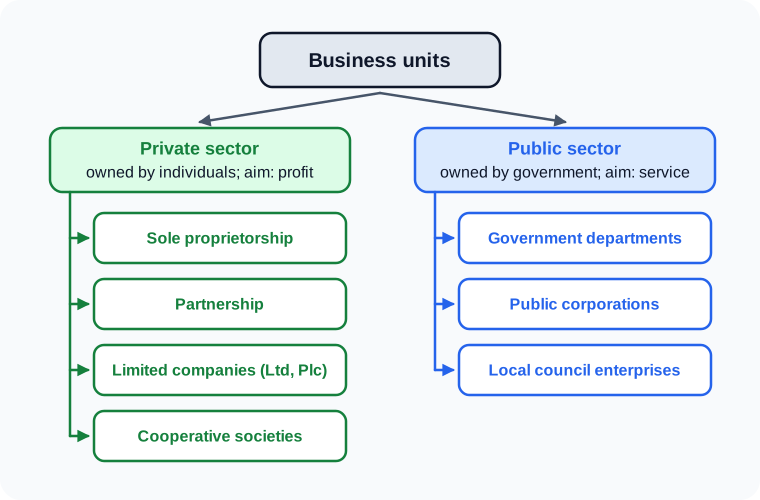
Figure 1. Forms of business units in the private and public sectors. WASSCE Tutor diagram.
The sole proprietorship (sole trader)
A sole proprietorship is a business owned, financed and controlled by one person, who takes all the profit and bears all the losses.
It is the oldest and most common form of business: market traders, kiosk owners, tailors, hairdressers, mechanics and small shopkeepers.
Features:
- Owned by one person (who may employ others).
- Unlimited liability: the owner's personal property can be taken to pay business debts.
- Capital comes mainly from personal savings, family and small loans.
- Easy to start, with few legal formalities (registration of a business name).
- No separate legal entity: the owner and the business are the same in law.
| Advantages | Disadvantages |
|---|---|
| Easy and cheap to form | Unlimited liability |
| Owner keeps all the profit | Limited capital, so growth is slow |
| Quick decisions; flexible | Owner bears all losses and risks |
| Close contact with customers | Long hours; no one to share the work |
| Personal attention and secrecy of affairs | Lack of continuity: the business may end with the owner's illness or death |
| Strong motivation to work hard | Limited skills: one person cannot be expert in everything |
The partnership
A partnership is an association of two to twenty persons who agree to carry on a business together with a view to profit, sharing the capital, management and profits or losses.
Partnerships are common among lawyers, accountants, doctors, estate agents and family businesses.
The partnership deed
Partners should sign a partnership deed (agreement) setting out:
- the name and address of the business and the partners
- the nature of the business
- the capital contributed by each partner
- how profits and losses are shared
- the duties and powers of each partner
- interest on capital and drawings, and partners' salaries
- how disputes are settled
- how a partner may leave and how new partners are admitted
- what happens on dissolution
If there is no deed, the law usually treats partners as sharing profits and losses equally.
Types of partners
| Type | Meaning |
|---|---|
| Active (general) partner | Contributes capital and takes part in managing the business; unlimited liability |
| Sleeping (dormant) partner | Contributes capital but takes no part in management |
| Nominal partner | Lends their name (reputation) but contributes no capital and takes no profit |
| Limited partner | Liability limited to their capital; cannot take part in management (only in a limited partnership, which must have at least one general partner) |
| Minor | A person under the age of majority admitted to the benefits of a partnership |
| Advantages of a partnership | Disadvantages |
|---|---|
| More capital than a sole trader | Unlimited liability (for general partners) |
| Shared work, skills and ideas | Profits are shared |
| Losses are shared | Disagreements can paralyse the business |
| Easy to form | Slow decisions: partners must agree |
| Continuity is better than a sole trader's | Limited life: death or withdrawal of a partner may dissolve it |
| Business affairs remain private | Capital is still limited (maximum of 20 partners) |
Sharing partnership profit. Fatu and Musa run a shop. Fatu contributed NLe 30,000 and Musa NLe 20,000. Their deed says profits are shared in the ratio of capital. The profit for the year is NLe 15,000.
Ratio .
- Fatu's share NLe 9,000.
- Musa's share NLe 6,000.
Why small businesses survive
Despite competition from supermarkets and large companies, small firms remain the majority because:
- they need little capital to start
- they give personal service and often sell on credit to regular customers
- they open long hours and are close to customers' homes
- they sell in very small quantities (a single cube of seasoning, a cup of rice)
- some goods and services need individual attention (tailoring, hairdressing, repairs)
- the market may be too small for large firms
- many people prefer to be their own boss
Unlimited liability means the owner can lose personal property, not that the business has unlimited money. A sole trader with a debt of NLe 50,000 and business assets worth NLe 20,000 may have to sell personal property to pay the remaining NLe 30,000.
Key points
- A sole proprietorship has one owner, unlimited liability, quick decisions and limited capital.
- A partnership has 2 to 20 partners, more capital and skill, but unlimited liability and possible disagreements.
- A partnership deed sets out capital, profit-sharing, duties and dissolution.
- Partners may be active, sleeping, nominal or limited.
- Small businesses survive through personal service, credit, convenience and low capital needs.
WASSCE examination focus
Expect to state the features, advantages and disadvantages of a sole proprietorship or partnership, to compare the two, to list the contents of a partnership deed, to explain types of partners, and to explain why small firms survive. Use a two-column table for comparisons.
Quick check
- What is unlimited liability?
- State four items found in a partnership deed.
- What is a sleeping partner?
- A profit of NLe 12,000 is shared between two partners in the ratio 2 : 1. How much does each get?
Answers: 1. The owner is personally responsible for all the debts of the business, even beyond the capital invested. 2. Any four: names of partners, nature of business, capital of each partner, profit-sharing ratio, duties, interest on capital and drawings, salaries, settlement of disputes, admission and retirement, dissolution. 3. A partner who contributes capital but takes no part in management. 4. NLe 8,000 and NLe 4,000.
Keep going with forms of business units
This is one of 2 lessons in Forms of Business Units. Start free with the first lesson of every topic, then unlock them all, plus exam-style practice marked instantly and guided learning tools, from 25 NLe.
- Free account, no card needed
- Everything from 25 NLe
- No automatic renewal
More lessons in Forms of Business Units
- Companies, cooperatives, public enterprises and business combinations🔒