WASSCE Commerce · Foreign Trade
Foreign trade: imports, exports and entrepôt trade
By the WASSCE Tutor team
Updated 12 November 2026 · 6 min read · Prepared against the WASSCE syllabus.
The rice in your pot may have come from Asia, the fuel in the bus from the Middle East and the phone in your pocket from China, while Sierra Leone's iron ore and cocoa travel the other way. Trade across borders brings goods no country could make alone, but it also brings extra difficulties. This lesson explains foreign trade and how traders overcome its problems.
Learning objectives
By the end of this lesson you should be able to:
- define foreign trade and describe import, export and entrepôt trade
- distinguish foreign trade from home trade
- explain the reasons for and advantages of foreign trade
- explain the difficulties of foreign trade and how they are overcome
What is foreign trade?
Foreign (international) trade is the buying and selling of goods and services between countries.
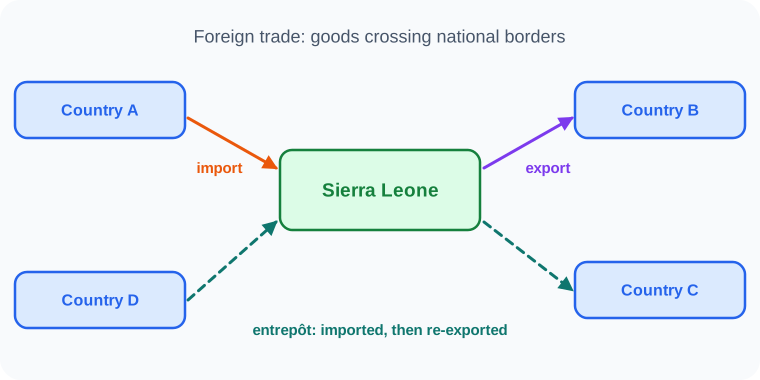
Figure 1. Import, export and entrepôt trade. WASSCE Tutor diagram.
| Type | Meaning | Examples for Sierra Leone |
|---|---|---|
| Import trade | Buying goods and services from other countries | Rice, fuel, vehicles, machinery, medicines, cement |
| Export trade | Selling goods and services to other countries | Iron ore, rutile, bauxite, diamonds, gold, cocoa, coffee, cashew |
| Entrepôt (re-export) trade | Importing goods and re-exporting them to other countries, often with little processing | Goods passing through a West African port to a landlocked neighbour |
Visible trade is trade in goods; invisible trade is trade in services (shipping, insurance, banking, tourism).
Home trade and foreign trade
| Home trade | Foreign trade |
|---|---|
| Within one country | Between countries |
| One currency | Different currencies must be exchanged |
| Same language, laws and customs | Different languages, laws and customs |
| Shorter distances; lower transport costs | Longer distances; higher transport and insurance costs |
| Few documents | Many documents (bill of lading, certificate of origin, customs forms) |
| No customs duties at borders | Import and export duties, quotas, licences |
| Less risk | Greater risks: delays, damage at sea, non-payment |
| Payment is simple | Payment needs foreign exchange, letters of credit or bills of exchange |
Why countries trade
- Unequal distribution of natural resources: Sierra Leone has iron ore and rutile; other countries have oil.
- Differences in climate: tropical crops (cocoa, coffee) and temperate crops (wheat, apples).
- Differences in skills, capital and technology: some countries make machinery and vehicles more cheaply.
- Specialisation: countries gain by producing what they do best and trading for the rest.
- Surplus production that cannot all be consumed at home.
Advantages of foreign trade
- Countries obtain goods they cannot produce (or produce only at great cost).
- Wider markets for producers, allowing large-scale production.
- Earns foreign exchange to pay for imports.
- Government revenue from import and export duties.
- Higher living standards: variety of goods for consumers.
- Spreads technology and ideas.
- Creates jobs in ports, transport, banking, insurance and processing.
- Promotes international cooperation (for example through ECOWAS).
Difficulties of foreign trade and their solutions
| Difficulty | How it is overcome |
|---|---|
| Different currencies | Foreign exchange from banks; payment through banks |
| Different languages | Interpreters, translators, a common business language (English, French) |
| Distance and long delays | Air and sea transport, containerisation, courier services |
| Risk of loss or damage | Marine and transit insurance |
| Risk of non-payment | Letters of credit, bills of exchange, del credere agents |
| Many documents and procedures | Clearing and forwarding agents |
| Customs duties and trade restrictions | Customs agents; trade agreements (ECOWAS) |
| Different laws and customs | Legal advice; agents and chambers of commerce |
| Lack of information about foreign markets | Chambers of commerce, embassies, trade fairs, export promotion agencies |
Sierra Leone's exports are dominated by minerals (iron ore, rutile, bauxite, diamonds and gold), with cocoa, coffee and cashew as important farm exports. Its imports are mainly food (especially rice), fuel, machinery, vehicles and manufactured goods. The Sierra Leone Investment and Export Promotion Agency (SLIEPA) helps local firms find export markets.
Entrepôt trade is not the same as ordinary exporting. In entrepôt trade the goods were imported first and are then re-exported, often with little or no processing.
Key points
- Foreign trade is trade between countries: import, export and entrepôt trade.
- It differs from home trade in currency, language, distance, documents, duties and risk.
- Countries trade because of differences in resources, climate, skills and technology.
- Its difficulties are overcome by banks, insurance, agents, transport, documents and trade agreements.
WASSCE examination focus
Expect to distinguish home trade from foreign trade, to state the advantages of foreign trade, and to explain the problems of foreign trade and how they are solved. A two-column table for differences, and "difficulty → solution" pairs, are the clearest way to answer.
Quick check
- What is entrepôt trade?
- Give three differences between home trade and foreign trade.
- Give two of Sierra Leone's main exports and two main imports.
- How do traders overcome the risk of non-payment in foreign trade?
Answers: 1. Importing goods and re-exporting them to another country, often with little processing. 2. Any three: currency, language, distance, documents, customs duties, risk, laws, payment methods. 3. Exports: any two of iron ore, rutile, bauxite, diamonds, gold, cocoa, coffee, cashew. Imports: any two of rice, fuel, machinery, vehicles, manufactured goods. 4. By using letters of credit, bills of exchange or del credere agents.
Keep going with foreign trade
This is one of 2 lessons in Foreign Trade. Start free with the first lesson of every topic, then unlock them all, plus exam-style practice marked instantly and guided learning tools, from 25 NLe.
- Free account, no card needed
- Everything from 25 NLe
- No automatic renewal
More lessons in Foreign Trade
- Balance of trade, balance of payments and trade restrictions🔒