WASSCE Commerce · Documents and Terms in Foreign Trade
Documents and terms in home trade
By the WASSCE Tutor team
Updated 12 November 2026 · 7 min read · Prepared against the WASSCE syllabus.
Every sale between businesses leaves a paper (or digital) trail: an enquiry, a quotation, an order, an invoice, a receipt. These documents prove what was agreed, what was delivered and what was paid. WASSCE Commerce tests them every year, together with the trade terms and discounts printed on them.
Learning objectives
By the end of this lesson you should be able to:
- describe the documents used in home trade in the order they are used
- explain the purpose of each document
- distinguish an invoice from a pro forma invoice, and a debit note from a credit note
- explain common trade terms
- calculate trade and cash discounts
The order of documents in home trade
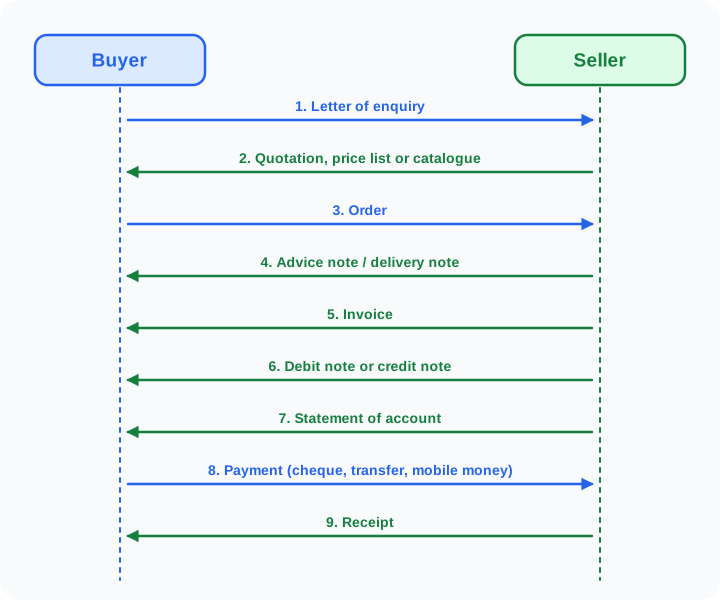
Figure 1. Documents in home trade, from enquiry to receipt. WASSCE Tutor diagram.
| Document | Sent by | Purpose |
|---|---|---|
| Letter of enquiry | Buyer | Asks about goods, prices, terms of sale and delivery |
| Quotation | Seller | Replies with prices, terms and delivery dates; may be accompanied by a price list or catalogue |
| Order | Buyer | A formal request to supply goods on the stated terms; creates a contract when accepted |
| Acknowledgement | Seller | Confirms the order has been received and accepted |
| Advice note | Seller | Tells the buyer the goods have been sent and how |
| Delivery note | Seller | Goes with the goods; the buyer signs to confirm receipt |
| Invoice | Seller | A bill showing goods supplied, quantities, prices, discounts and the total amount due |
| Debit note | Seller | Corrects an undercharge on an invoice: the buyer owes more |
| Credit note | Seller | Reduces the amount owed, for overcharges, returned or damaged goods; usually printed in red |
| Statement of account | Seller | A summary of all transactions in a period and the balance owed; a reminder to pay |
| Payment | Buyer | Cheque, bank transfer, mobile money or cash |
| Receipt | Seller | Proof that payment was received |
Pro forma invoice
A pro forma invoice is sent before goods are supplied, either to show what the invoice will look like, to ask for payment in advance, or to support an application for an import licence or foreign exchange. An ordinary invoice is sent after (or with) the goods and demands payment.
A credit note reduces what the buyer owes; a debit note increases it. Both are sent by the seller. Remember: the credit note "credits" (helps) the buyer.
Trade terms
| Term | Meaning |
|---|---|
| Trade discount | A reduction off the list price given to traders who buy for resale (often a percentage) |
| Cash discount | A reduction for paying promptly, within a stated period (for example "5% for payment within 14 days") |
| Quantity discount | A reduction for buying large quantities |
| CWO (cash with order) | Payment must accompany the order |
| COD (cash on delivery) | Payment is made when the goods are delivered |
| E&OE (errors and omissions excepted) | The seller may correct mistakes in the invoice later |
| Carriage paid | The seller pays the cost of transport |
| Carriage forward | The buyer pays the cost of transport |
| Ex-works (ex-factory, loco) | The price covers goods at the seller's premises; the buyer collects and pays transport |
| Franco (free delivered) | The price includes all costs to the buyer's premises |
| Net / Prompt | No discount; payment due immediately or within a short time |
| Month's credit | Payment is due within one month of the invoice |
Calculating discounts
Trade discount is deducted first, from the list (catalogue) price. Cash discount is then deducted from the amount after trade discount, if the buyer pays within the stated period.
An invoice. A retailer in Bo orders 40 cartons of soap at a list price of NLe 250 each. The wholesaler gives a 20% trade discount and a 5% cash discount for payment within 14 days.
- Gross value NLe 10,000
- Trade discount NLe 2,000
- Net invoice value NLe 8,000 (the amount on the invoice)
- Cash discount (if paid within 14 days) NLe 400
- Amount paid if paid promptly NLe 7,600
A credit note. Two of the 40 cartons arrive damaged and are returned. The credit note is for less 20% trade discount NLe 400. The retailer now owes NLe 7,600 (before any cash discount).
| Trade discount | Cash discount | |
|---|---|---|
| Given for | Buying for resale (being a trader), or buying in bulk | Paying promptly |
| Shown on | The invoice | The invoice terms; taken when paying |
| Purpose | Lets the retailer resell at the list price and make a profit | Encourages quick payment and improves the seller's cash flow |
Freetown wholesalers often quote retailers "net cash" for small orders, but give trade discounts and short credit to regular retailers who buy many cartons each week. Payments increasingly arrive by mobile money, and the wholesaler sends a receipt by SMS or WhatsApp.
Key points
- Order of documents: enquiry → quotation → order → advice/delivery note → invoice → debit/credit note → statement → payment → receipt.
- A pro forma invoice comes before supply; an invoice demands payment.
- Debit note increases, credit note decreases, the amount owed.
- Trade discount comes first (off list price); cash discount is for prompt payment.
WASSCE examination focus
WASSCE asks you to explain the purpose of named documents, to arrange them in order, to distinguish pairs (invoice and pro forma invoice; debit and credit note; trade and cash discount), to explain trade terms (CWO, COD, E&OE, carriage paid) and to calculate discounts on an invoice. Always take trade discount before cash discount.
Quick check
- What is the purpose of a statement of account?
- When is a credit note sent?
- Goods listed at NLe 6,000 carry a 15% trade discount. What is the invoice value?
- What does COD mean?
Answers: 1. To summarise the transactions of a period and show the balance the buyer owes, reminding them to pay. 2. When the buyer has been overcharged or has returned damaged or unwanted goods. 3. NLe 5,100. 4. Cash on delivery: payment is made when the goods are delivered.
Keep going with documents and terms in foreign trade
This is one of 2 lessons in Documents and Terms in Foreign Trade. Start free with the first lesson of every topic, then unlock them all, plus exam-style practice marked instantly and guided learning tools, from 25 NLe.
- Free account, no card needed
- Everything from 25 NLe
- No automatic renewal
More lessons in Documents and Terms in Foreign Trade
- Documents and terms in foreign trade🔒