WASSCE Commerce · Communication
Communication in business
By the WASSCE Tutor team
Updated 12 November 2026 · 7 min read · Prepared against the WASSCE syllabus.
A wholesaler's price change is useless if retailers never hear of it, and an order is worthless if the supplier misreads it. Communication is the passing of information, ideas and instructions between people. In commerce it removes the hindrance of knowledge (information): buyers and sellers must know about each other before they can trade.
Learning objectives
By the end of this lesson you should be able to:
- define communication and explain its importance in commerce
- describe the communication process
- classify the types and methods of communication
- compare oral, written, visual and electronic communication
- explain the barriers to effective communication and how to overcome them
Meaning and importance of communication
Communication is the transfer of messages (information, ideas, instructions or feelings) from a sender to a receiver through a channel, with the receiver understanding and responding.
Importance of communication in commerce:
- Links buyers and sellers: enquiries, quotations, orders and complaints.
- Speeds up business: decisions and transactions are made faster.
- Advertising depends on it to inform and persuade consumers.
- Coordinates work within a firm: instructions, reports and meetings.
- Market information: traders learn about prices, demand and competitors.
- Helps other aids to trade: banking, insurance and transport rely on messages.
- Makes foreign trade possible by linking traders across countries.
- Reduces costs of travel and wasted journeys.
- Good public relations with customers and the public.
The communication process
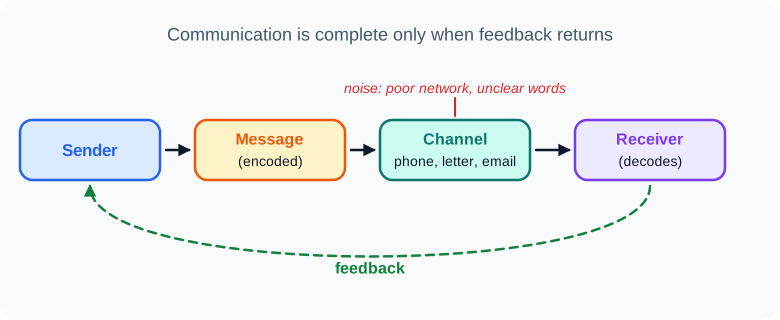
Figure 1. Communication is complete only when feedback returns to the sender. WASSCE Tutor diagram.
| Element | Meaning |
|---|---|
| Sender | The person or firm with the message |
| Encoding | Putting the idea into words, figures, pictures or signals |
| Message | The information itself |
| Channel (medium) | The means used: letter, telephone, email, meeting, poster |
| Receiver | The person who gets the message |
| Decoding | The receiver interpreting the message |
| Feedback | The receiver's response, showing whether the message was understood |
| Noise | Anything that distorts the message (poor network, jargon, distraction) |
Types of communication
By direction
- Internal: within a firm (manager to staff, between departments). It may be downward (instructions), upward (reports, suggestions) or horizontal (between people at the same level).
- External: between the firm and outsiders (customers, suppliers, banks, government).
By formality
- Formal: through official channels and records (letters, memos, minutes).
- Informal: casual conversation, "grapevine" information.
Methods of communication
| Method | Examples | Advantages | Disadvantages |
|---|---|---|---|
| Oral (verbal) | Face-to-face talk, telephone, meetings, interviews, radio | Quick; immediate feedback; personal; questions answered at once | No permanent record; can be forgotten or denied; may be misheard |
| Written | Letters, memos, reports, notices, minutes, circulars, invoices | Permanent record and evidence; can be checked and copied; detailed | Slower; costly in time; no instant feedback; can be misread |
| Visual | Charts, graphs, posters, signs, photographs, films | Attracts attention; easy to understand; crosses language barriers | Limited detail; may be misinterpreted |
| Electronic | Email, SMS, WhatsApp, video calls, websites, social media | Very fast; cheap; reaches many people; works over long distances; can keep records | Needs power, devices and network; risk of hacking, fraud and viruses |
A market trader in Freetown may phone a supplier in Kenema to check prices (oral), send the order on WhatsApp (electronic), receive a written invoice with the goods and pay by mobile money with an SMS receipt. One deal can use several methods, and the written and electronic ones leave a record.
Qualities of good communication
The message should be:
- clear: simple words
- correct: accurate facts and figures
- complete: all the necessary details
- concise: no unnecessary words
- courteous: polite
- timely: sent at the right time
- sent through the right channel
Barriers to effective communication
| Barrier | How it is overcome |
|---|---|
| Language differences and jargon | Use simple, common language; interpreters |
| Noise: poor network, distractions | Better equipment; quiet place; repeat important points |
| Poor listening or lack of attention | Active listening; ask for feedback |
| Wrong choice of channel | Choose the channel that suits the message and receiver |
| Distance and time differences | Telephone, email, video calls |
| Illiteracy | Oral and visual messages; local languages |
| Emotions and attitudes: anger, bias, fear | Calm, respectful tone |
| Too much information (overload) | Keep messages short and focused |
| Cultural differences | Respect for customs; local agents |
| Poor infrastructure: power cuts, weak networks | Backup power; several networks |
Communication is not complete when the message is sent. It is complete when the receiver understands it and gives feedback. Answers that leave out feedback lose marks.
Key points
- Communication removes the hindrance of knowledge; it links buyers and sellers.
- Process: sender → encoding → message → channel → receiver → decoding → feedback, with noise as interference.
- Methods: oral, written, visual and electronic; written methods give a record, oral gives quick feedback.
- Barriers: language, noise, poor listening, wrong channel, illiteracy, emotions, overload, poor infrastructure.
WASSCE examination focus
Expect to explain the importance of communication to commerce, to describe the communication process (sometimes with a diagram), to compare oral and written communication, and to state barriers to effective communication and how to overcome them. Draw the process with feedback when asked.
Quick check
- Which hindrance to trade does communication remove?
- What is feedback, and why is it important?
- Give one advantage and one disadvantage of written communication.
- Give three barriers to effective communication.
Answers: 1. The hindrance of knowledge (information). 2. The receiver's response to a message; it shows the sender whether the message was understood. 3. Advantage: a permanent record (or evidence, detail). Disadvantage: slow (or no instant feedback, can be misread). 4. Any three: language and jargon, noise, poor listening, wrong channel, distance, illiteracy, emotions, overload, cultural differences, poor infrastructure.
Keep going with communication
This is one of 2 lessons in Communication. Start free with the first lesson of every topic, then unlock them all, plus exam-style practice marked instantly and guided learning tools, from 25 NLe.
- Free account, no card needed
- Everything from 25 NLe
- No automatic renewal
More lessons in Communication
- Postal, telecommunication and digital services🔒