WASSCE Commerce · Banking
Banks and their services
By the WASSCE Tutor team
Updated 12 November 2026 · 10 min read · Prepared against the WASSCE syllabus.
A trader in Makeni who keeps the week's takings under the mattress risks theft and fire, earns nothing on the money and cannot easily pay a supplier in Freetown. A bank solves all three problems: it keeps money safe, pays interest and moves money where it is needed. Banks are the aid to trade that removes the hindrance of finance.
Learning objectives
By the end of this lesson you should be able to:
- define a bank and describe the banking system
- explain the functions of the central bank
- explain the services of commercial banks
- describe the types of bank account and how to open one
- distinguish a loan from an overdraft and calculate simple interest
- describe other financial institutions: community banks, microfinance and mobile money
The banking system
A bank is a financial institution that accepts deposits from the public, lends money and provides other financial services such as payments and safekeeping.
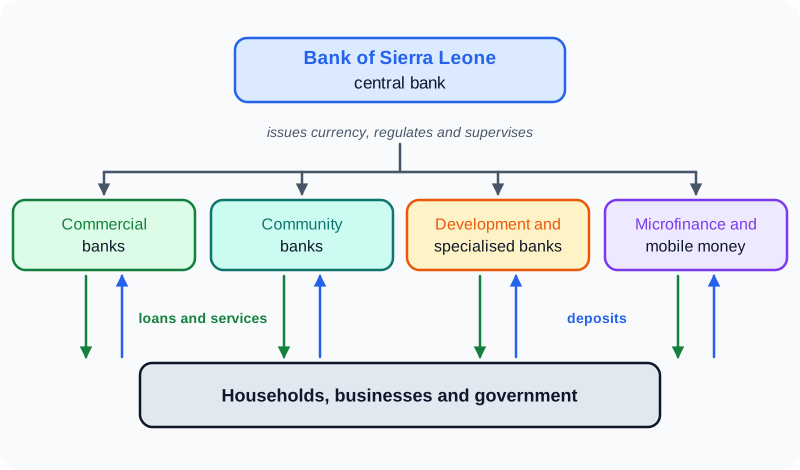
Figure 1. The banking system in Sierra Leone. WASSCE Tutor diagram.
| Type | Main role |
|---|---|
| Central bank | Controls the money and banking system (Bank of Sierra Leone) |
| Commercial banks | Take deposits and lend to the public and businesses |
| Development banks | Long-term loans for agriculture, industry and infrastructure |
| Merchant banks | Serve large firms: raising capital, accepting bills, advising on mergers |
| Mortgage banks | Long-term loans for buying or building houses |
| Community (rural) banks | Banking services in rural communities |
| Microfinance institutions | Small loans and savings for small traders and the poor, often in groups |
| Mobile money providers | Payments, transfers and savings by mobile phone |
The central bank
The Bank of Sierra Leone was set up in 1964, when it began to issue the leone.
Functions of the central bank:
- Issues currency: the sole issuer of notes and coins.
- Banker to the government: keeps government accounts, makes payments and lends to the government.
- Bankers' bank: commercial banks keep accounts with it, and it settles cheque clearing between them.
- Lender of last resort: lends to commercial banks in difficulty.
- Controls credit and money supply (monetary policy) through the policy interest rate, reserve requirements and open market operations (buying and selling government securities).
- Regulates and supervises banks and other financial institutions, including mobile money.
- Manages foreign reserves and the exchange rate.
- Manages the national debt and issues treasury bills.
- Advises the government on economic and financial matters.
Services of commercial banks
- Accepting deposits into current, savings and fixed deposit accounts.
- Lending: loans and overdrafts to customers and businesses.
- Means of payment: cheques, bank drafts, transfers, standing orders, cards and mobile banking.
- Safekeeping of valuables and documents in strongrooms and safe deposit boxes.
- Foreign exchange: buying and selling foreign currency; letters of credit for importers.
- Financial advice to customers on investment and business.
- Agency services: paying bills, buying shares, acting as executors and trustees.
- Discounting bills of exchange.
- Status enquiries: references on a customer's creditworthiness (with consent).
- Electronic banking: ATMs, POS terminals, internet and mobile banking, SMS alerts.
Examples of commercial banks in Sierra Leone include the Sierra Leone Commercial Bank, Rokel Commercial Bank, Ecobank, UBA and Union Trust Bank.
Types of bank account
| Current account | Savings account | Fixed (time) deposit account | |
|---|---|---|---|
| Purpose | Day-to-day business payments | Saving | Saving a sum for a fixed period |
| Cheque book | Yes | Usually no | No |
| Interest | Usually none | Paid | Highest rate |
| Withdrawals | Any time, by cheque, card or transfer | Any time, with limits | Only at the end of the period (or notice and penalty) |
| Overdraft | Allowed by arrangement | No | No |
| Charges | Bank charges (commission on turnover) | Few or none | None |
| Suits | Traders and businesses | Individuals and students | People with spare money to invest |
Opening a current account usually requires:
- a completed application form
- identification (national ID card, passport or voter card)
- passport photographs
- proof of address
- a reference or introducer acceptable to the bank
- a specimen signature
- an initial deposit
- for a company: its certificate of incorporation, memorandum and articles, and a board resolution
Loans and overdrafts
| Loan | Overdraft |
|---|---|
| A fixed sum given at once, credited to a loan account | Permission to withdraw more than is in the current account, up to a limit |
| Interest on the whole amount borrowed | Interest only on the amount actually overdrawn, day by day |
| Repaid in instalments over an agreed period (often long or medium term) | Short term; repayable on demand |
| Used for buying assets: machines, vehicles, buildings | Used for working capital and short-term needs |
| Usually needs collateral | May need collateral |
Loan or overdraft? A trader needs up to NLe 20,000 for 3 months to buy stock, but expects to use only NLe 8,000 on average.
- Loan of NLe 20,000 at 18% a year for 3 months:
- Overdraft limit NLe 20,000 at 24% a year, average NLe 8,000 used for 3 months:
The overdraft has the higher rate but costs less, because interest is charged only on what is used. For a large purchase that needs the whole sum at once, the loan would be cheaper.
Security (collateral) for loans:
- title deeds of land or a house
- share certificates
- life assurance policies
- warehouse warrants
- fixed deposits
- a guarantor
Other financial institutions
- Community banks bring savings and credit to rural towns. They are supported by Apex Bank, which also oversees financial services associations (FSAs).
- Microfinance institutions lend small sums, often to groups of market traders who guarantee each other.
- Mobile money (for example Orange Money and Afrimoney) lets people send, receive and save money by phone, pay bills and buy airtime. It is regulated by the Bank of Sierra Leone.
- Thrift and savings groups (osusu) let members contribute regularly and take the pot in turns.
Many Sierra Leonean traders belong to an osusu group: each member pays an agreed sum every week, and one member collects the whole amount in turn. It works like an interest-free savings and loan scheme based on trust. Banks and microfinance institutions now offer group loans built on the same idea.
The central bank does not do ordinary banking with the public. It does not open accounts for traders or lend to individuals. It is the bank of the government and of the banks.
Key points
- Banks accept deposits, lend and make payments; they remove the hindrance of finance.
- The central bank (Bank of Sierra Leone) issues currency, is banker to the government and the banks, is lender of last resort, controls credit and supervises banks.
- Current accounts suit business payments (cheques, overdrafts); savings and fixed deposit accounts earn interest.
- An overdraft charges interest only on the amount used; a loan charges interest on the whole sum.
WASSCE examination focus
WASSCE regularly asks for the functions of the central bank and the services of commercial banks, to distinguish current, savings and fixed deposit accounts, and to distinguish a loan from an overdraft. Simple interest calculations may appear. Do not mix up central and commercial bank functions.
Quick check
- Give three functions of the central bank.
- Which type of account gives the customer a cheque book?
- Find the simple interest on NLe 12,000 at 15% a year for 8 months.
- Give two differences between a loan and an overdraft.
Answers: 1. Any three: issues currency, banker to the government, bankers' bank, lender of last resort, controls credit, supervises banks, manages foreign reserves, manages national debt, advises government. 2. A current account. 3. NLe 1,200. 4. Any two: a loan is a fixed sum given at once, an overdraft is permission to overdraw up to a limit; loan interest is on the whole sum, overdraft interest only on the amount used; loans are repaid in instalments, overdrafts are repayable on demand; loans are often medium or long term, overdrafts short term.
Keep going with banking
This is one of 2 lessons in Banking. Start free with the first lesson of every topic, then unlock them all, plus exam-style practice marked instantly and guided learning tools, from 25 NLe.
- Free account, no card needed
- Everything from 25 NLe
- No automatic renewal
More lessons in Banking
- Cheques and other means of payment🔒